JavaScript creates a new object, links it to the function's prototype, binds this to that object, executes the function, and returns the object unless another object is explicitly returned.

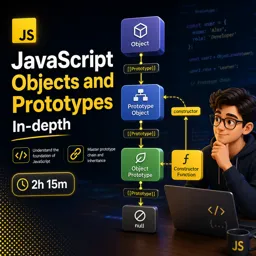
Duration of the online course: 2 hours and 15 minutes
New
Master JavaScript objects and prototypes with this free course—write cleaner OOP code, understand this/new, and boost your web dev skills fast.
Understanding objects and prototypes is one of the biggest turning points in becoming confident with JavaScript. Many bugs, performance issues, and confusing behaviors come from not knowing where properties and methods really live, how they are found, and what happens when functions are invoked in different ways. This course takes you beyond surface-level syntax so you can reason about code the same way the JavaScript engine does—an essential skill for modern web development.
You will build a solid foundation in object basics and object creation patterns, then connect that knowledge to constructors and what the language does behind the scenes when you use the new keyword. You will learn to spot the difference between calling a regular function and a constructor call, why that difference matters, and how execution context affects the value of this in real applications. By practicing with function invocation types and borrowing behavior with call, you will gain the practical ability to reuse functions across objects without rewriting or mutating original implementations.
As you move deeper, the course clarifies why defining methods inside constructors can be wasteful at scale and how prototypes solve that problem. You will understand what __proto__ points to, how prototype links are formed, and how property lookup travels up the prototype chain when a value is not found directly on an object. This knowledge helps you debug faster, design APIs more cleanly, and avoid common misconceptions around inheritance and shared behavior.
Finally, you will connect prototype concepts to JavaScript’s inheritance model, including how specialized objects can access methods from more general types without duplicating them. You will also build intuition for how common patterns relate back to the language’s core object function and the prototype object itself. By the end, you will be able to read and write object-oriented JavaScript with more clarity, choose the right construction approach for a situation, and confidently explain how prototypes power reusable behavior in everyday code.

Explore the best free online JavaScript courses with certificates and build in-demand web development skills at your own pace. Learn JavaScript fundamentals, DOM manipulation, ES6, APIs, frameworks, and more through beginner-friendly and advanced classes. Enroll today, earn a certificate, and strengthen your resume for developer career opportunities.

Explore free online Object Oriented Programming courses and build practical skills in classes, objects, inheritance, polymorphism, encapsulation, and popular OOP languages. Learn at your own pace with beginner-friendly lessons, hands-on projects, and expert guidance. Enroll today and earn a certificate to showcase your programming skills.

2 hours and 15 minutes of online video course

Digital certificate of course completion (Free)

Exercises to train your knowledge

100% free, from content to certificate
What happens when a JavaScript function is called with the new keyword?
JavaScript creates a new object, links it to the function's prototype, binds this to that object, executes the function, and returns the object unless another object is explicitly returned.
How does JavaScript look up a property through the prototype chain?
JavaScript checks the object first, then its prototype and each higher prototype until it finds the property or reaches null.
Why put shared methods on a constructor's prototype instead of inside the constructor?
Prototype methods are shared by all instances, avoiding creation of a duplicate function for every object.
Ready to get started?Download the app and get started today.
Install the app now
to access the course
Over 5,000 free courses
Programming, English, Digital Marketing and much more! Learn whatever you want, for free.

Study plan with AI
Our app's Artificial Intelligence can create a study schedule for the course you choose.

From zero to professional success
Improve your resume with our free Certificate and then use our Artificial Intelligence to find your dream job.
You can also use the QR Code or the links below.



Free CourseLaravel
5

(2)

4h04m

20 exercises
Free CourseProgressive Web Application PWA for Beginners
5
(5)
3h24m
15 exercises
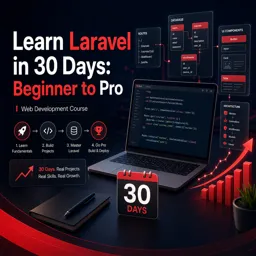
Free CourseLearn Laravel in 30 Days: Beginner to Pro
5
(1)
17h00m
30 exercises
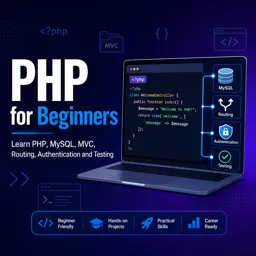
Free CoursePHP for Beginners: Learn PHP, MySQL, MVC, Routing, Authentication and Testing
5
(1)
10h45m
49 exercises
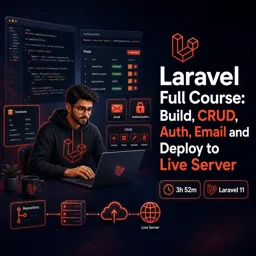
Free CourseLaravel Full Course: Build, CRUD, Auth, Email and Deploy to Live Server
5
(1)
3h52m
15 exercises
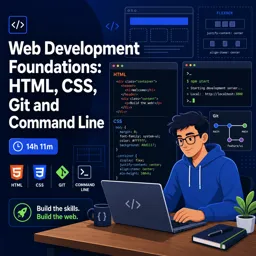
Free CourseWeb Development Foundations: HTML, CSS, Git and Command Line
5
(3)
14h11m
37 exercises
Free CourseCSS Complete Tutorial
5
(1)
8h30m
49 exercises
Free CoursePHP for Beginners: Learn PHP, MySQL and Login Systems
5
(3)
10h49m
29 exercises
Free CourseJavaScript for beginners
4.9
(27)
1h40m
2 exercises
Free CourseUmbraco CMS
4.9
(22)
6h21m
19 exercises
Carry knowledge in your pocket.
Download the Cursa app.
There are hundreds of free courses available, with a free certificate of completion that is saved in your mobile image gallery.
Download the app to access the Course Completion Certificate for Free.


+ 10 million
students

Free and Valid
Certificate

60 thousand free
exercises

4.8/5 rating in
app stores

Free courses in
video and ebooks