Install Node.js to run JavaScript outside the browser and Visual Studio Code to write and edit your files.

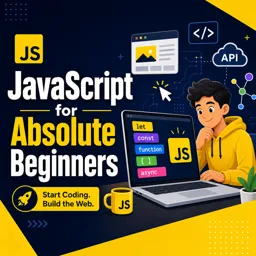
Duration of the online course: 10 hours and 50 minutes
New
Build real JavaScript skills fast with a free beginner course—set up tools, write your first code, master arrays, functions, and async patterns to create web apps.
Starting with JavaScript can feel overwhelming, especially when you are not sure what to install, what to type first, or how all the concepts connect. This free online course is built for absolute beginners who want a smooth path from zero experience to writing clear, working JavaScript that you can actually use in web development.
You will begin by setting up a modern environment with Node.js and a code editor, so you can run scripts locally, experiment safely, and see results immediately. From there, the course guides you through the fundamentals that shape everyday JavaScript: choosing the right kind of variable, making decisions with conditions, and repeating tasks with loops in a way that matches the data you are working with.
As you gain confidence, you will work with arrays and the core patterns that power most real projects. You will learn to transform and analyze data using modern methods, write reusable functions in multiple styles (including arrow functions), and understand how objects are created and structured. These skills help you move beyond isolated snippets and into writing code that is readable, flexible, and easier to maintain.
The course then bridges into the concepts that often confuse beginners the most: classes, inheritance, static members, and method overriding. You will understand how JavaScript models behavior and structure, and when these tools make sense in practical development.
A key focus is asynchronous JavaScript, where many learners get stuck. You will make sense of callbacks, avoid the pitfalls of callback hell, and learn how promises, chaining, and async/await work together to write cleaner, more reliable code. You will also practice common workflows like fetching data, improving debugging with richer console methods, and using modern syntax features such as destructuring and template literals.
Throughout the learning experience, quick exercises reinforce what you just learned so the knowledge sticks. By the end, you will be able to read JavaScript confidently, build stronger logic, and feel prepared to take on beginner web projects or continue toward more advanced front-end frameworks.
break statement inside each case?

10 hours and 50 minutes of online video course

Digital certificate of course completion (Free)

Exercises to train your knowledge

100% free, from content to certificate
What tools do I need to run JavaScript code locally?
Install Node.js to run JavaScript outside the browser and Visual Studio Code to write and edit your files.
What is the difference between var, let, and const in JavaScript?
var is function-scoped; let and const are block-scoped. Use const by default, let for reassignment, and avoid var in modern code.
What is the difference between Promise.all() and Promise.allSettled()?
Promise.all() rejects as soon as one promise fails, while Promise.allSettled() waits for every promise and reports each result.
Ready to get started?Download the app and get started today.
Install the app now
to access the course
Over 5,000 free courses
Programming, English, Digital Marketing and much more! Learn whatever you want, for free.

Study plan with AI
Our app's Artificial Intelligence can create a study schedule for the course you choose.

From zero to professional success
Improve your resume with our free Certificate and then use our Artificial Intelligence to find your dream job.
You can also use the QR Code or the links below.



Free CourseLaravel
5

(2)

4h04m

20 exercises
Free CourseProgressive Web Application PWA for Beginners
5
(5)
3h24m
15 exercises
Free CourseLearn Laravel in 30 Days: Beginner to Pro
5
(1)
17h00m
30 exercises
Free CoursePHP for Beginners: Learn PHP, MySQL, MVC, Routing, Authentication and Testing
5
(1)
10h45m
49 exercises
Free CourseLaravel Full Course: Build, CRUD, Auth, Email and Deploy to Live Server
5
(1)
3h52m
15 exercises
Free CourseWeb Development Foundations: HTML, CSS, Git and Command Line
5
(3)
14h11m
37 exercises
Free CourseCSS Complete Tutorial
5
(1)
8h30m
49 exercises
Free CoursePHP for Beginners: Learn PHP, MySQL and Login Systems
5
(3)
10h49m
29 exercises
Free CourseJavaScript for beginners
4.9
(27)
1h40m
2 exercises
Free CourseUmbraco CMS
4.9
(22)
6h21m
19 exercises
Carry knowledge in your pocket.
Download the Cursa app.
There are hundreds of free courses available, with a free certificate of completion that is saved in your mobile image gallery.
Download the app to access the Course Completion Certificate for Free.


+ 10 million
students

Free and Valid
Certificate

60 thousand free
exercises

4.8/5 rating in
app stores

Free courses in
video and ebooks