Go modules define a project’s dependencies and versions in go.mod, allowing projects to live outside GOPATH and build reproducibly.

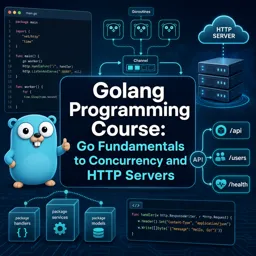
Duration of the online course: 20 hours and 36 minutes
New
Build real Go skills fast: learn modules, testing, concurrency and HTTP servers in a free online course—ideal for backend growth and a stronger portfolio.
Want to move beyond scripting and build fast, reliable backend systems? This free online course helps you get comfortable with Go from the ground up, guiding you from first syntax to the kind of practical patterns used in production services. You will learn how Go thinks about structure, clarity, and simplicity, so you can write code that is easy to read, maintain, and scale.
Early on, you will build confidence with Go fundamentals: lexical elements, primitives, variables, constants, and the difference between expressions and statements. From there, the focus shifts to the language traits that make Go stand out in professional development: idiomatic error handling, adding context to failures, and knowing when panic and recovery are appropriate. These skills translate directly into writing software that behaves predictably and is easier to debug under pressure.
As you progress, you will deepen your understanding of Go’s type system and the day-to-day tools you will use constantly, especially slices and maps. You will learn where common pitfalls happen, why certain slice behaviors surprise developers, and what to do when map usage meets concurrency. You will also explore structs, functions, and methods, including the impact of pointer versus value receivers on correctness and performance.
The course then connects fundamentals to robust design by introducing interfaces and showing how to use them in an idiomatic way. You will see how to design flexible APIs without creating unnecessary abstractions, reducing interface pollution while keeping code adaptable. Along the way, you will gain practical insight into memory allocations, alignment considerations, and how these details influence efficiency.
Quality and performance are central outcomes. You will practice writing tests with a clear understanding of helpful assertion styles, and you will learn how to benchmark correctly so performance improvements are measured rather than guessed. Modern Go development is also covered through modules and packaging, helping you work cleanly with dependencies and repeatable builds.
Finally, you will step into the features that power modern Go services: goroutines, channels, and essential packages like context and sync. You will understand how concurrency behaves, how unbuffered channels coordinate work, and how context supports cancellation, deadlines, and request-scoped values. To tie everything together, you will build toward HTTP servers and routing concepts, gaining the foundation you need to create responsive APIs and backend services. By the end, you will have a strong Go toolkit for real-world development, interviews, and professional growth.

20 hours and 36 minutes of online video course

Digital certificate of course completion (Free)

Exercises to train your knowledge

100% free, from content to certificate
How do Go modules improve dependency management compared with GOPATH?
Go modules define a project’s dependencies and versions in go.mod, allowing projects to live outside GOPATH and build reproducibly.
What happens when sending data on an unbuffered Go channel?
A send blocks until another goroutine is ready to receive, synchronizing the two goroutines.
How do you add context when wrapping an error in Go?
Use fmt.Errorf with the %w verb, for example: fmt.Errorf("load config: %w", err), so the original error remains discoverable.
Ready to get started?Download the app and get started today.
Install the app now
to access the course
Over 5,000 free courses
Programming, English, Digital Marketing and much more! Learn whatever you want, for free.

Study plan with AI
Our app's Artificial Intelligence can create a study schedule for the course you choose.

From zero to professional success
Improve your resume with our free Certificate and then use our Artificial Intelligence to find your dream job.
You can also use the QR Code or the links below.



Free CourseLearn Python
5

(3)

13h00m

17 exercises
Free CourseCreate Desktop App
5
(4)
5h33m
30 exercises
Free CourseRuby on Rails
5
(7)
9h39m
34 exercises
Free CourseJava Programming
5
(4)
9h15m
48 exercises
Free CoursePython Ultimate Course: Learn Python from Scratch
5
(1)
12h31m
42 exercises
Free CourseJava
4.8
(56)
22h17m
28 exercises
Free CourseC# Sharp for beginner
4.8
(37)
3h55m
15 exercises
Free CourseC++ as your first Programming Language
4.8
(108)
5h12m
23 exercises
Free CourseJava for beginners
4.8
(183)
26h50m
49 exercises
Free CourseComputer science and Java
4.8
(65)
9h15m
31 exercises
Carry knowledge in your pocket.
Download the Cursa app.
There are hundreds of free courses available, with a free certificate of completion that is saved in your mobile image gallery.
Download the app to access the Course Completion Certificate for Free.


+ 10 million
students

Free and Valid
Certificate

60 thousand free
exercises

4.8/5 rating in
app stores

Free courses in
video and ebooks