The course covers single-variable calculus, definite integrals, multivariable calculus, maxima and minima, multiple integrals, and ordinary differential equations.

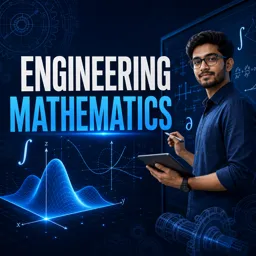
Duration of the online course: 25 hours and 19 minutes
1

(1)
Boost problem-solving for mechanical & industrial engineering with a free Engineering Mathematics course—calculus, integrals, ODEs, and exam-style practice.
Build the mathematical backbone used every day in mechanical and industrial engineering. This free online course strengthens the core ideas that sit behind modeling, analysis, optimization, and design, helping you move from memorizing formulas to understanding why methods work and when to apply them. You will develop confidence in setting up problems, choosing the right tools, and interpreting results the way engineers need to in real projects and competitive exams.
The learning experience blends clear explanations with focused, exam-style questions so you can practice turning concepts into solutions under constraints. Starting with single-variable calculus, you sharpen skills in limits, continuity, differentiation, and integration, then use those techniques to reason about critical points, approximations, and areas. As the course expands into multivariable calculus, you work with partial derivatives, Taylor ideas in more than one variable, and optimization, building the intuition needed for constrained and unconstrained minima and maxima in engineering contexts.
You will also learn to handle multiple integrals and geometric regions, a crucial step for applications like mass properties, distributions, and engineering geometry. The course then connects calculus to differential equations, guiding you through the language of order and degree, standard formations, and practical solving approaches used in physical system models. With linear methods, integrating factors, exact equations, and higher-order equations with constant coefficients, you gain a reliable workflow for solving and checking results rather than guessing the next step.
By the end, you will be better prepared to tackle GATE-style mathematics questions, collaborate more effectively with peers across engineering branches, and approach mechanics, manufacturing, and industrial problems with stronger analytical clarity. Whether you are revising fundamentals or building a disciplined practice routine, this course helps you develop skills that translate directly into academic performance and professional problem-solving.

25 hours and 19 minutes of online video course

Digital certificate of course completion (Free)

Exercises to train your knowledge

100% free, from content to certificate
What Engineering Mathematics topics are covered for GATE preparation?
The course covers single-variable calculus, definite integrals, multivariable calculus, maxima and minima, multiple integrals, and ordinary differential equations.
How do you find the nature of critical points for f(x) = x³ - 3x² + 4?
Set f′(x)=0 to find critical points, then use f″(x) to classify them: x=0 is a local maximum and x=2 is a local minimum.
What is the integrating factor for dy/dx + P(x)y = Q(x)?
The integrating factor is e^(∫P(x) dx). Multiplying by it converts the equation into an exact derivative.
Ready to get started?Download the app and get started today.
Install the app now
to access the course
Over 5,000 free courses
Programming, English, Digital Marketing and much more! Learn whatever you want, for free.

Study plan with AI
Our app's Artificial Intelligence can create a study schedule for the course you choose.

From zero to professional success
Improve your resume with our free Certificate and then use our Artificial Intelligence to find your dream job.
You can also use the QR Code or the links below.



Free CourseAerospace Engineering
5
(4)

17h32m

20 exercises
Free CourseFluid Mechanics
5
(3)
23h09m
16 exercises

Free CourseManagement - Business Analysis for Engineers
4.8
(84)
31h13m
29 exercises

Free CourseElectric Vehicles Fundamentals: EV Technology, Batteries, Motors, Charging and Economics
4.8

(4)
33h11m
39 exercises
Free CoursePrinciple of industrial engineering
4.8
(8)
32h27m
33 exercises

Free CourseMechanical - Metal Casting
4.7
(93)
30h34m
30 exercises
Free CourseDynamics course for Engineering
4.7
(3)
28h05m
30 exercises
Free CourseMechanical - Fluid Mechanics
4.6
(63)
41h57m
32 exercises
Free CourseEngineering Mechanics
4.6
(7)
40h32m
5 exercises

Free CourseRobotics and control
4.5
(4)
21h37m
31 exercises
Carry knowledge in your pocket.
Download the Cursa app.
There are hundreds of free courses available, with a free certificate of completion that is saved in your mobile image gallery.
Download the app to access the Course Completion Certificate for Free.


+ 10 million
students

Free and Valid
Certificate

60 thousand free
exercises

4.8/5 rating in
app stores

Free courses in
video and ebooks