Set the IDE to the C standard specified by the project and course style guide so compiler behavior, formatting, and language features remain consistent.

Duration of the online course: 4 hours and 32 minutes
New
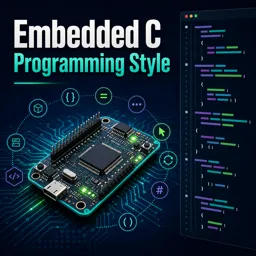
Write safer embedded C code with a free online course on clean style, naming, pointers, macros and switches—build reliability fast and earn a certificate.
Reliable embedded software is rarely about clever tricks; it is about making every line of C predictable, readable, and hard to misuse. This free online course helps you build that discipline through a practical programming style designed for embedded systems, where undefined behavior, hidden side effects, and unclear intent can become real failures in the field. You will learn how a consistent style reduces defects, improves reviews, and makes the compiler work with you instead of against you.
The course focuses on the everyday decisions that shape code quality: how to name variables so their scope and intent are obvious, how to structure constants, enums, and structs so the codebase remains coherent, and how to write conditions, switch statements, and loops in a way that avoids ambiguity. You will also develop a strong feel for const correctness and safe function interfaces, including how to express immutability for pointers and the data they reference. These habits make modules easier to integrate and safer to modify, especially when working close to hardware.
You will also learn how formatting and tooling support reliability. By configuring a C standard in your IDE and adopting a formatter configuration, your code becomes consistent across a team, reducing noise in code reviews and helping errors stand out. The course gives special attention to macros, including how to write function-like macros safely and how to apply X macros to generate enums and related items from a single source of truth, improving maintainability while lowering duplication.
As you progress, you will refine file organization, understand what should never live in a header, and learn safer approaches to copying and adapting existing code without spreading subtle bugs. Guidance on commenting and temporarily disabling code blocks helps you avoid preprocessor pitfalls while keeping intent clear. You will also see approaches for representing scaled numeric values with typedefs to make units and precision explicit, reducing errors in data handling typical of embedded applications.
Throughout the course, short checks and exercises reinforce the rules, and you will finish with a clear mental model for documenting style guidelines in a useful, repeatable manual format. If you want to write embedded C that is easier to test, easier to maintain, and less likely to surprise you at runtime, this course will help you adopt a professional style that scales from small drivers to full products.

Explore free online C and C++ courses designed for beginners and aspiring developers. Learn programming fundamentals, pointers, memory management, object-oriented programming, data structures, and more at your own pace. Build practical coding skills with expert-led lessons, and earn a certificate with every completed course.

Explore free online Programming Basics courses designed for beginners ready to learn coding. Build essential skills in programming concepts, logic, algorithms, variables, and problem-solving through flexible, self-paced lessons. Enroll at no cost, practice with beginner-friendly content, and earn a certificate to showcase your new programming skills.

4 hours and 32 minutes of online video course

Digital certificate of course completion (Free)

Exercises to train your knowledge

100% free, from content to certificate
What C language standard should an IDE use for reliable Embedded C coding style?
Set the IDE to the C standard specified by the project and course style guide so compiler behavior, formatting, and language features remain consistent.
How should function-like macros be written to safely handle expression arguments in C?
Fully parenthesize every macro parameter and the complete macro expression to prevent precedence and multiple-evaluation errors.
What should not be placed in an Embedded C header file?
Do not place variable or function definitions in headers; use declarations, type definitions, macros, and include guards instead.
Ready to get started?Download the app and get started today.
Install the app now
to access the course
Over 5,000 free courses
Programming, English, Digital Marketing and much more! Learn whatever you want, for free.

Study plan with AI
Our app's Artificial Intelligence can create a study schedule for the course you choose.

From zero to professional success
Improve your resume with our free Certificate and then use our Artificial Intelligence to find your dream job.
You can also use the QR Code or the links below.




Free CourseLearn Python
5

(3)

13h00m

17 exercises
Free CourseCreate Desktop App
5
(4)
5h33m
30 exercises

Free CourseRuby on Rails
5
(7)
9h39m
34 exercises
Free CourseJava Programming
5
(4)
9h15m
48 exercises
Free CoursePython Ultimate Course: Learn Python from Scratch
5
(1)
12h31m
42 exercises
Free CourseJava
4.8
(56)
22h17m
28 exercises
Free CourseC# Sharp for beginner
4.8
(37)
3h55m
15 exercises
Free CourseC++ as your first Programming Language
4.8
(108)
5h12m
23 exercises
Free CourseJava for beginners
4.8
(183)
26h50m
49 exercises
Free CourseComputer science and Java
4.8
(65)
9h15m
31 exercises
Carry knowledge in your pocket.
Download the Cursa app.
There are hundreds of free courses available, with a free certificate of completion that is saved in your mobile image gallery.
Download the app to access the Course Completion Certificate for Free.


+ 10 million
students

Free and Valid
Certificate

60 thousand free
exercises

4.8/5 rating in
app stores

Free courses in
video and ebooks