L2 regularization penalizes large weights, while dropout randomly disables units during training so the network relies less on any single feature or neuron.

Duration of the online course: 4 hours and 44 minutes
New
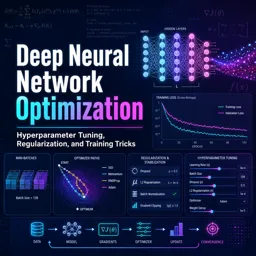
Build faster, more accurate models with this free deep learning course on tuning, regularization, and training tricks—learn to stabilize training and boost results.
Getting a deep neural network to train reliably is often harder than designing the architecture. Small choices like how you split data, set learning rates, initialize weights, or apply regularization can be the difference between a model that generalizes well and one that overfits or fails to converge. This free online course helps you develop the practical intuition and methods needed to optimize neural networks in real-world machine learning work.
You will learn how to diagnose training issues through the lens of bias and variance, and how to set up train, dev, and test sets so your evaluation truly matches your deployment goals. From there, the course builds the skills to reduce overfitting with techniques such as L2 regularization, dropout, and early stopping, while keeping model performance strong and training time reasonable. You will also explore why input normalization matters, and how thoughtful preprocessing can make optimization smoother and more predictable.
As networks get deeper, training instability can show up as vanishing or exploding gradients. The course explains how these problems arise and how to mitigate them using principled weight initialization strategies and gradient checking to verify correctness. You will then move into modern optimization approaches that make large-scale training practical, including mini-batch gradient descent, momentum, RMSProp, Adam, and learning rate decay, with an emphasis on understanding what each method is doing and when it is most useful.
Hyperparameter tuning is treated as a disciplined process rather than guesswork. You will practice choosing effective search strategies, sampling on appropriate scales, and making tradeoffs based on your project constraints. Finally, you will see how batch normalization and softmax-based classifiers fit into efficient training pipelines, and how frameworks like TensorFlow structure training loops in practice. By the end, you will be able to troubleshoot training behavior, select optimization and regularization techniques with confidence, and deliver models that learn faster and generalize better.

4 hours and 44 minutes of online video course

Digital certificate of course completion (Free)

Exercises to train your knowledge

100% free, from content to certificate
How do L2 regularization and dropout reduce overfitting in deep neural networks?
L2 regularization penalizes large weights, while dropout randomly disables units during training so the network relies less on any single feature or neuron.
Why is Adam often used to train deep neural networks?
Adam combines momentum with adaptive per-parameter learning rates, using moving averages of gradients and squared gradients for efficient, stable updates.
What is the difference between batch normalization during training and test time?
Training uses each mini-batch’s mean and variance; test time uses running estimates of those statistics because a mini-batch may not be available.
Ready to get started?Download the app and get started today.
Install the app now
to access the course
Over 5,000 free courses
Programming, English, Digital Marketing and much more! Learn whatever you want, for free.

Study plan with AI
Our app's Artificial Intelligence can create a study schedule for the course you choose.

From zero to professional success
Improve your resume with our free Certificate and then use our Artificial Intelligence to find your dream job.
You can also use the QR Code or the links below.



Free CourseDeep Learning With PyTorch
5

(6)

3h39m

19 exercises

Free CourseMachine Learning tutorial
5
(2)
10h20m
6 exercises

Free CourseGoogle Prompting Essentials
4.8

(4)
3h24m
10 exercises

Free CourseData Science
4.8
(4)
5h58m
38 exercises

Free CourseArtificial intelligence
4.7
(69)
12h40m
7 exercises
Free CourseFundamentals of Artificial Intelligence
4.6
(11)
25h26m
34 exercises

Free CourseGenerative AI
4.6
(5)
1h43m
11 exercises

Free CourseMachine Learning for complete beginners
4.6
(9)
1h09m
17 exercises

Free CourseGoogle AI Essentials
4.5
(17)
3h40m
13 exercises

Free CourseArtificial Intelligence Masterclass: Search, Logic, Machine Learning and Deep Learning
4.5
(8)
31h57m
57 exercises
Carry knowledge in your pocket.
Download the Cursa app.
There are hundreds of free courses available, with a free certificate of completion that is saved in your mobile image gallery.
Download the app to access the Course Completion Certificate for Free.


+ 10 million
students

Free and Valid
Certificate

60 thousand free
exercises

4.8/5 rating in
app stores

Free courses in
video and ebooks