MFCCs turn audio into time-frequency feature matrices that can be used as inputs to neural networks, CNNs, and LSTMs for genre prediction.

Duration of the online course: 9 hours and 9 minutes
New
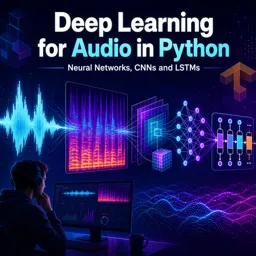
Build audio AI skills with this free deep learning course in Python: train CNNs and LSTMs for music genre classification and boost your ML career fast.
Turn raw sound into reliable predictions by learning how modern deep learning models understand audio. This course takes you from core ideas in AI and machine learning to hands-on deep learning workflows in Python, focusing on the patterns, representations, and model choices that matter when your data is music, speech, or any time-based signal. You will develop an intuition for what neural networks are really computing, why deep learning excels at automatically learning features, and how to think about model capacity, training behavior, and generalization when dealing with complex audio data.
You begin by building key building blocks from scratch: artificial neurons, vector and matrix operations, and the forward and backward passes that make multi-layer networks learn. By implementing backpropagation and gradient descent yourself, you will understand how errors flow through layers, how weights are updated, and why learning can stall or explode when design choices are poor. This foundation makes it much easier to use high-level tooling confidently instead of treating libraries like black boxes.
With the fundamentals in place, you transition to practical modeling with TensorFlow 2 and Keras, learning a clean end-to-end workflow for supervised learning. From there the course shifts into audio-specific deep learning: how to represent sound over time, why time-frequency analysis is essential, and how transforms such as the STFT and feature sets like MFCCs provide compact, learnable inputs for neural networks.
To ground everything in a real application, you work through a complete music genre classification pipeline. You learn how to prepare a dataset in a way that increases the number of training examples and captures time-local musical characteristics, then train models that map learned representations to multi-class outputs. Along the way, you develop the ability to spot and fix overfitting using training and validation behavior, and you gain an understanding of how regularization choices influence results.
Finally, you compare two powerhouse architectures for audio tasks: convolutional neural networks, which excel at learning local patterns in time-frequency maps, and recurrent networks with LSTMs, designed to model longer dependencies across sequences. By understanding how input shapes, data layout, and model assumptions change between CNNs and LSTMs, you will be able to select an approach that matches your problem and iterate with purpose. The result is a practical, job-relevant skill set for building audio AI systems in Python, backed by strong intuition about what your models are learning and why.

9 hours and 9 minutes of online video course

Digital certificate of course completion (Free)

Exercises to train your knowledge

100% free, from content to certificate
How are MFCCs used for music genre classification with deep learning in Python?
MFCCs turn audio into time-frequency feature matrices that can be used as inputs to neural networks, CNNs, and LSTMs for genre prediction.
Why use a CNN or LSTM for audio classification instead of a basic neural network?
CNNs learn local spectral patterns in audio features, while LSTMs model temporal dependencies across successive audio frames.
What is the advantage of STFT for deep learning audio preprocessing?
STFT shows how a signal’s frequency content changes over time, providing the time-frequency information needed for most audio models.
Ready to get started?Download the app and get started today.
Install the app now
to access the course
Over 5,000 free courses
Programming, English, Digital Marketing and much more! Learn whatever you want, for free.

Study plan with AI
Our app's Artificial Intelligence can create a study schedule for the course you choose.

From zero to professional success
Improve your resume with our free Certificate and then use our Artificial Intelligence to find your dream job.
You can also use the QR Code or the links below.



Free CourseDeep Learning With PyTorch
5

(6)

3h39m

19 exercises
Free CourseMachine Learning tutorial
5
(1)
10h20m
6 exercises

Free CourseGoogle Prompting Essentials
4.8

(4)
3h24m
10 exercises
Free CourseData Science
4.8
(4)
5h58m
38 exercises
Free CourseArtificial intelligence
4.7
(68)
12h40m
7 exercises
Free CourseFundamentals of Artificial Intelligence
4.6
(11)
25h26m
34 exercises
Free CourseGenerative AI
4.6
(5)
1h43m
11 exercises
Free CourseMachine Learning for complete beginners
4.6
(9)
1h09m
17 exercises
Free CourseGoogle AI Essentials
4.5
(17)
3h40m
13 exercises
Free CourseArtificial Intelligence Masterclass: Search, Logic, Machine Learning and Deep Learning
4.5
(8)
31h57m
57 exercises
Carry knowledge in your pocket.
Download the Cursa app.
There are hundreds of free courses available, with a free certificate of completion that is saved in your mobile image gallery.
Download the app to access the Course Completion Certificate for Free.


+ 10 million
students

Free and Valid
Certificate

60 thousand free
exercises

4.8/5 rating in
app stores

Free courses in
video and ebooks