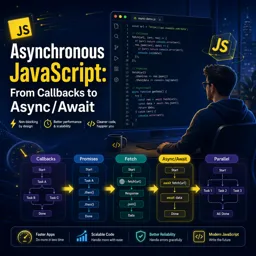
Callback hell is deeply nested callback code that is difficult to read and maintain. Promises allow sequential async work to be written as a flatter, chainable flow with .then() and .catch().

Duration of the online course: 2 hours and 5 minutes
New
Build faster, cleaner web apps by mastering async JavaScript. Learn callbacks, Promises and async/await in this free online course with practice.
Modern web development runs on asynchronous code: timers, events, file operations, and network requests all happen without blocking the page. If asynchronous JavaScript has ever felt confusing or unpredictable, this course helps you replace guesswork with a clear mental model. You will learn how async work is scheduled, how results flow through your code, and how to write logic that stays readable as complexity grows.
You will start with callbacks, building confidence with the fundamentals behind common patterns like setTimeout and setInterval. From there, you will apply callbacks in everyday situations, such as working with array methods to transform and filter data, and passing functions as parameters to keep code flexible. You will also see how callback-heavy code can become difficult to maintain, and why that happens, so you can recognize and avoid the traps that lead to tangled control flow.
Next, you will move into Promises, learning how they represent future results, what their lifecycle looks like, and how chaining creates reliable async pipelines. Instead of scattering logic across nested functions, you will practice structuring a sequence of dependent steps while keeping error handling consistent. Along the way, targeted questions reinforce key details, helping you spot the difference between a promise that is pending, one that is fulfilled, and one that is rejected, and what that means for your program.
Finally, you will bring everything together with async/await, writing asynchronous code that reads like synchronous code without losing the non-blocking benefits. You will learn standard error handling with try/catch, how to deal with dependent async steps, and how to speed up independent work by running Promises in parallel. Realistic examples like fetching data with the Fetch API show how these tools translate directly to day-to-day web development tasks.
By the end, you will be able to choose the right approach for the situation, debug asynchronous flows more confidently, and write clearer JavaScript for both browser and Node.js environments. Whether you are aiming to improve your front-end skills or build more dependable server-side scripts, this course gives you a practical path from callbacks to modern async patterns.

2 hours and 5 minutes of online video course

Digital certificate of course completion (Free)

Exercises to train your knowledge

100% free, from content to certificate
What is callback hell in JavaScript, and how can Promises help avoid it?
Callback hell is deeply nested callback code that is difficult to read and maintain. Promises allow sequential async work to be written as a flatter, chainable flow with .then() and .catch().
What is the difference between Promise.all() and Promise.race() in JavaScript?
Promise.all() waits for every supplied Promise to fulfill, rejecting if one fails. Promise.race() settles as soon as the first supplied Promise fulfills or rejects.
How do you handle errors with async/await in JavaScript?
Wrap awaited code in a try...catch block. The catch block receives errors from rejected Promises or exceptions thrown during the async operation.
Ready to get started?Download the app and get started today.
Install the app now
to access the course
Over 5,000 free courses
Programming, English, Digital Marketing and much more! Learn whatever you want, for free.

Study plan with AI
Our app's Artificial Intelligence can create a study schedule for the course you choose.

From zero to professional success
Improve your resume with our free Certificate and then use our Artificial Intelligence to find your dream job.
You can also use the QR Code or the links below.




Free CourseLaravel
5

(2)

4h04m

20 exercises
Free CourseProgressive Web Application PWA for Beginners
5
(5)
3h24m
15 exercises
Free CourseLearn Laravel in 30 Days: Beginner to Pro
5
(1)
17h00m
30 exercises
Free CoursePHP for Beginners: Learn PHP, MySQL, MVC, Routing, Authentication and Testing
5
(1)
10h45m
49 exercises
Free CourseLaravel Full Course: Build, CRUD, Auth, Email and Deploy to Live Server
5
(1)
3h52m
15 exercises
Free CourseWeb Development Foundations: HTML, CSS, Git and Command Line
5
(3)
14h11m
37 exercises
Free CourseCSS Complete Tutorial
5
(1)
8h30m
49 exercises
Free CoursePHP for Beginners: Learn PHP, MySQL and Login Systems
5
(3)
10h49m
29 exercises
Free CourseJavaScript for beginners
4.9
(27)
1h40m
2 exercises
Free CourseUmbraco CMS
4.9
(22)
6h21m
19 exercises
Carry knowledge in your pocket.
Download the Cursa app.
There are hundreds of free courses available, with a free certificate of completion that is saved in your mobile image gallery.
Download the app to access the Course Completion Certificate for Free.


+ 10 million
students

Free and Valid
Certificate

60 thousand free
exercises

4.8/5 rating in
app stores

Free courses in
video and ebooks