
Exercises
Test your understanding of continuity editing and its role in clear visual storytelling. This quiz covers essential techniques used to maintain spatial, temporal, and directional clarity from shot to shot. Explore the 180-degree rule, shot-reverse-shot patterns, match on action, eyeline matches, cutaways, the 30-degree rule, establishing shots, screen direction, jump cuts, cross-cutting, motivated cuts, ellipsis, insert shots, and master shots. Use your knowledge of camera placement, coverage, and editing choices to identify how filmmakers create smooth transitions, preserve audience orientation, and build coherent scenes.
Answer the questions below and check the explanation for each answer.
0/14 answered
Auto audio on: the next questions will be read aloud when you click Continue.

The 180-degree rule keeps cameras on one side of the action axis so characters retain consistent left-right positions. Crossing that axis can make their positions appear reversed.
Shot/reverse shot alternates between characters, usually preserving their eyelines and screen positions. It is a standard method for editing dialogue scenes clearly.
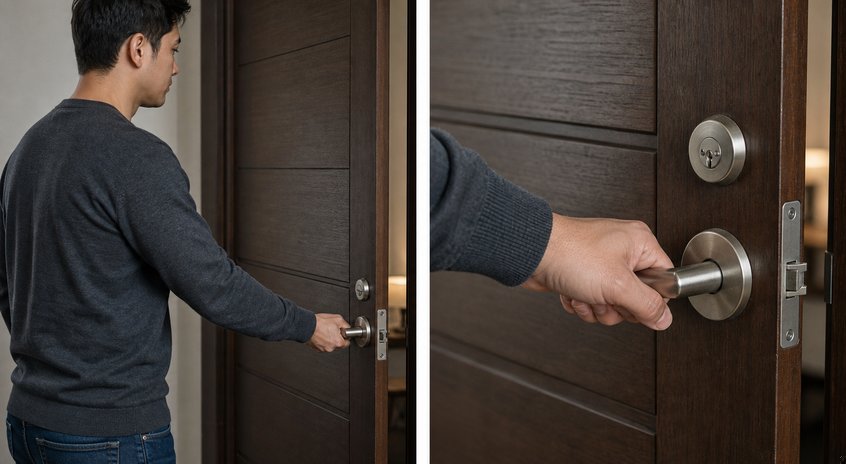
A match on action continues one movement across a cut. Matching the position and timing of the action helps viewers perceive a single uninterrupted event.
An eyeline match cuts from a character looking off-screen to the object they appear to be viewing. The object's placement should correspond to the direction of the gaze.
A relevant cutaway can cover the visible discontinuity while the edited dialogue continues. Useful examples include the listener, the setting, or an object being discussed.

The 30-degree rule recommends a meaningful change in camera angle between shots of the same subject. A smaller change can resemble an accidental jump cut.
An establishing shot gives viewers a broad view of the setting and often shows where characters or important objects are located before closer coverage begins.
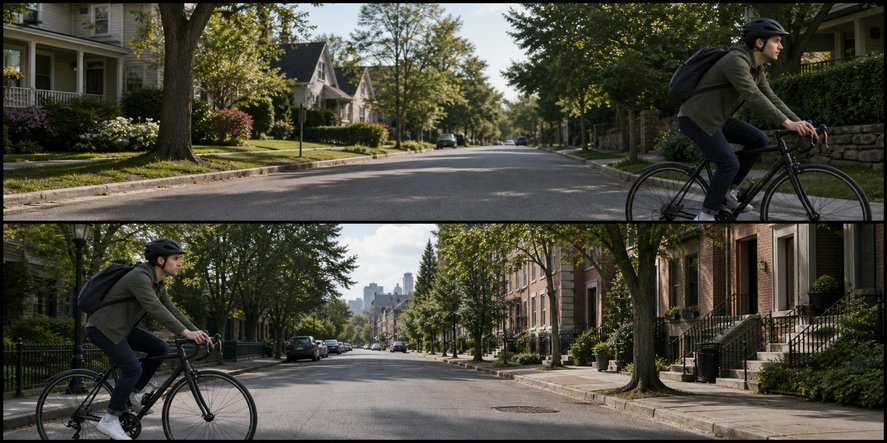
The cyclist continues moving from left to right across both shots, preserving screen direction. Reversing that direction without explanation could imply the cyclist turned around.
Removing time from a shot without changing the framing significantly makes the subject appear to jump abruptly. This is known as a jump cut.
Cross-cutting alternates between actions in different locations, often implying that they occur at the same time and may eventually intersect.
A motivated cut has a perceptible reason, such as revealing what a character sees, following movement, responding to sound, or presenting important story information.
A temporal ellipsis skips unnecessary periods while retaining enough information for viewers to understand the sequence and passage of time.

An insert shot presents a close view of an important detail, such as a hand operating an object. It can clarify an action and provide useful editing coverage.
A master shot records the broader scene, often from beginning to end. It supplies safety coverage and helps the editor maintain clear character positions and action continuity.
Free CourseAfter Effects
5

(2)

22h49m

30 exercises

Free CourseAdobe Express in video edition
5
(1)
25m
6 exercises

Free CourseAdobe After Effects
5
(1)
2h18m
17 exercises

Free CourseAdobe Premiere Pro crash course
5
(2)
1h58m
6 exercises

Free CourseLearn Adobe Premiere Pro from Start to Finish
5
(3)
2h26m
6 exercises

Free CourseFilmora Master Class Filmora Wondershare
5
(1)
1h52m
8 exercises
Free CourseCapCut Video Editing for YouTube: Beginner to Pro
4.9
(8)
4h24m
31 exercises
Free CourseAdobe After effects
4.8

(16)
15h13m
31 exercises
Thousands of online courses in video, ebooks and audiobooks.
To test your knowledge during online courses
Generated directly from your cell phone's photo gallery and sent to your email

Download our app via QR Code or the links below:.



Carry knowledge in your pocket.
Download the Cursa app.
There are hundreds of free courses available, with a free certificate of completion that is saved in your mobile image gallery.
Download the app to access the Course Completion Certificate for Free.


+ 10 million
students

Free and Valid
Certificate

60 thousand free
exercises

4.8/5 rating in
app stores

Free courses in
video and ebooks