
Exercises
Put your video editing color grading skills to the test. This quiz covers essential post-production concepts, including saturation, gamma, LUTs, white balance, color selection tools, and techniques for matching shots across scenes. Explore how professional editors shape mood, maintain visual continuity, correct color casts, and adjust specific hues without changing the entire image. You will also answer questions about industry-standard software known for advanced color grading capabilities. Whether you are a beginner learning color correction or an experienced creator refining your workflow, this quiz is a practical way to review the foundations of cinematic color grading.
Answer the questions below and check the explanation for each answer.
0/9 answered
Auto audio on: the next questions will be read aloud when you click Continue.
Color Correction is the term that refers to adjusting the intensity and balance of colors in an image to match the intended appearance or correct color inaccuracies.
The Color Key is a tool used in post-production software to select and adjust color ranges. It allows users to isolate specific colors in an image or video and make adjustments to them, often for effects such as chroma keying (green screen). The Color Wheel is used for grading and balance, while the Color Picker is for selecting colors from an image.
The term LUT stands for Look-Up Table. In color grading, a LUT is a mathematical formula used to map one set of colors to another, which helps achieve the desired look for film or video by adjusting color and brightness.
The 'Gamma' setting primarily affects the Midtones of an image. When adjusting gamma, you're essentially changing the luminance of the mid-range tones without significantly altering shadows or highlights. This allows for more subtle control over the overall contrast of the image.
Color grading is primarily used to enhance or alter the mood and atmosphere of the video, allowing editors to create a visual tone that supports the storytelling. This involves adjusting colors, contrast, and brightness to achieve a desired aesthetic.
A common method for creating visual continuity between shots in different scenes is Color Matching. This technique ensures that colors are consistent across shots, maintaining a cohesive look and feel throughout a film or video. As lighting and color conditions can vary during shooting, color matching is essential in post-production to achieve seamless transitions.
The HSL Qualifier is a color grading tool that allows you to isolate and modify specific colors in your video footage without impacting other colors. HSL stands for Hue, Saturation, and Luminance, and this tool provides fine control over these parameters for selected colors.
The process of adjusting the balance of an image to make the whites appear truly white is known as White Balancing. It ensures that colors in the image appear natural under different lighting conditions, compensating for any color cast.
DaVinci Resolve is renowned for its comprehensive and advanced color grading tools. It is widely used in the film and television industry specifically for its color correction and grading capabilities, making it the preferred choice for many professionals working with video editing and post-production.
Free CourseAfter Effects
5

(2)

22h49m

30 exercises
Free CourseAdobe Express in video edition
5
(1)
25m
6 exercises
Free CourseAdobe After Effects
5
(1)
2h18m
17 exercises
Free CourseAdobe Premiere Pro crash course
5
(2)
1h58m
6 exercises

Free CourseLearn Adobe Premiere Pro from Start to Finish
5
(3)
2h26m
6 exercises

Free CourseFilmora Master Class Filmora Wondershare
5
(1)
1h52m
8 exercises
Free CourseCapCut Video Editing for YouTube: Beginner to Pro
4.9
(8)
4h24m
31 exercises
Free CourseAdobe After effects
4.8

(16)
15h13m
31 exercises
Thousands of online courses in video, ebooks and audiobooks.
To test your knowledge during online courses
Generated directly from your cell phone's photo gallery and sent to your email

Download our app via QR Code or the links below:.


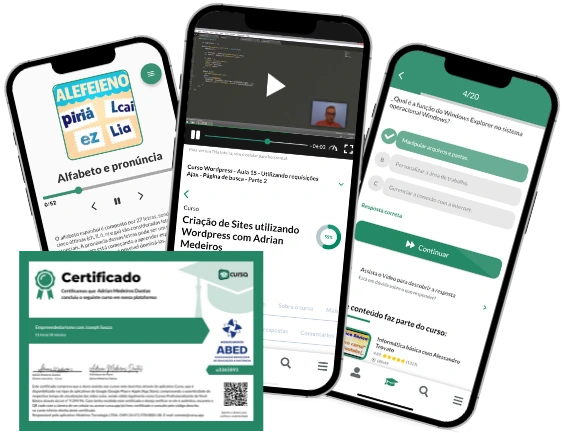
Carry knowledge in your pocket.
Download the Cursa app.
There are hundreds of free courses available, with a free certificate of completion that is saved in your mobile image gallery.
Download the app to access the Course Completion Certificate for Free.


+ 10 million
students

Free and Valid
Certificate

60 thousand free
exercises

4.8/5 rating in
app stores

Free courses in
video and ebooks