
Exercises
This quiz examines how governments assess proposed and existing regulations. It covers baselines, counterfactuals, cost-benefit and cost-effectiveness analysis, discounting, distributional effects, uncertainty, stakeholder consultation, causal evaluation methods, and post-implementation review. Questions combine foundational concepts with practical interpretation of timelines, decision trees, comparison tables, and evaluation graphs.
Answer the questions below and check the explanation for each answer.
0/18 answered
Auto audio on: the next questions will be read aloud when you click Continue.
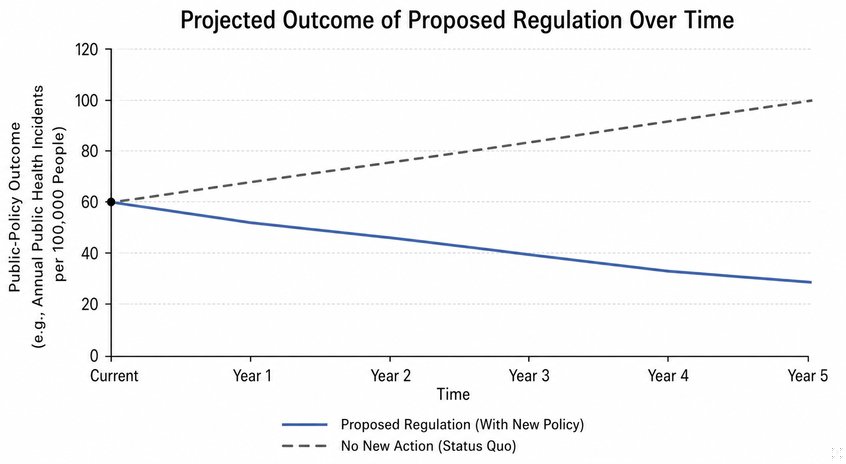
The baseline is the projected path without the proposed intervention. Comparing regulatory options with this path reveals their incremental costs and benefits.
A counterfactual provides the comparison needed for causal attribution. Without it, observed changes could be mistakenly credited to the regulation rather than other events or trends.
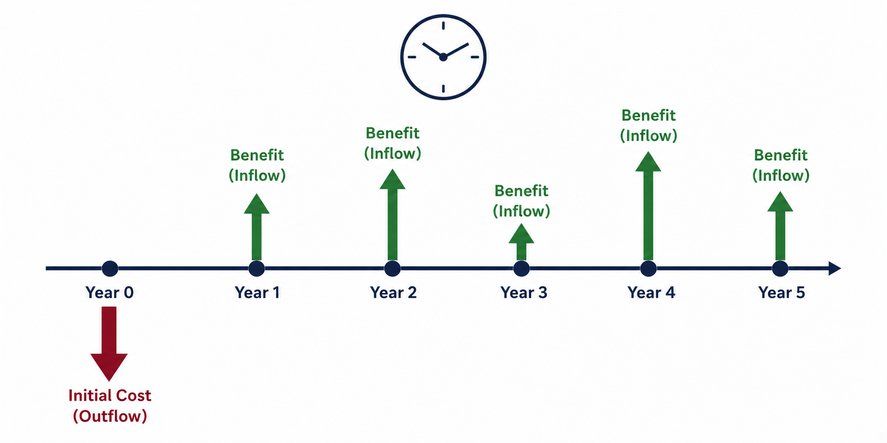
Net present value discounts future benefits and costs to a common date and subtracts total present-value costs from total present-value benefits.
A higher discount rate reduces the present value of future amounts more sharply. It can therefore make regulations with immediate costs and distant benefits appear less favorable.
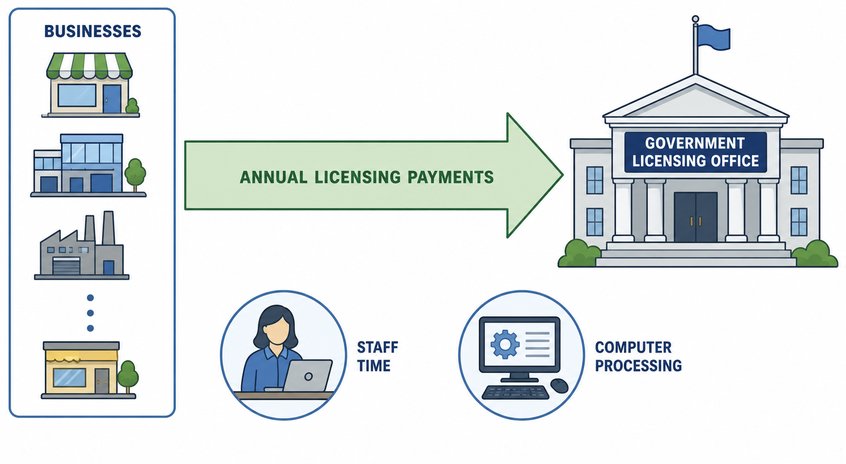
The fee moves money from firms to government and is generally a transfer from society's perspective. Administrative effort, payment processing, and behavioral distortions may still create real social costs.
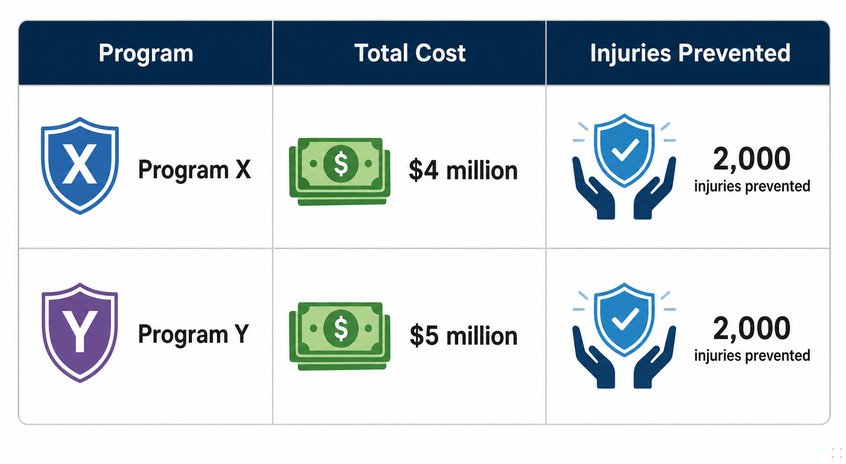
Both programs produce the same measured outcome, but Program X does so at a lower cost. Its cost is $2,000 per injury prevented, compared with $2,500 for Program Y.
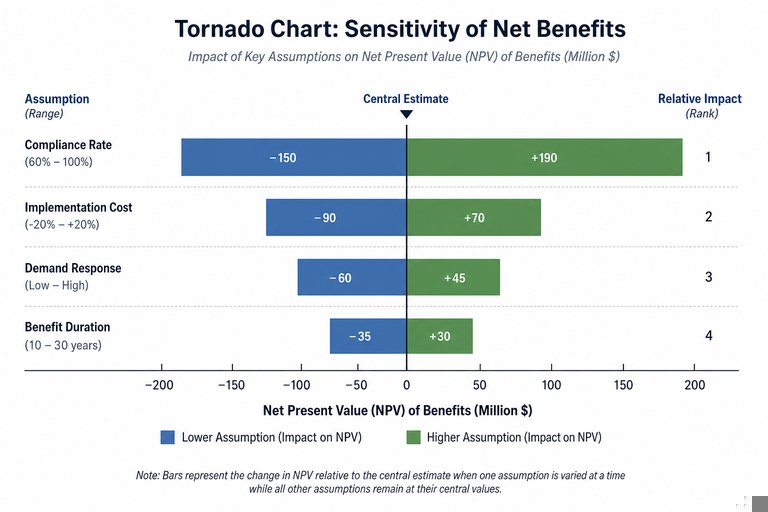
Sensitivity analysis tests how results change when uncertain assumptions vary. A tornado chart highlights which assumptions have the greatest influence on the result.
Distributional analysis identifies who bears costs and who receives benefits. A regulation can produce positive total net benefits while placing disproportionate burdens on a particular group.
Consultation can improve the evidence base by uncovering implementation barriers, overlooked costs, affected groups, and workable alternatives. Claims should still be tested critically.
Compliance costs are resources regulated entities use to satisfy requirements. Required equipment, training, recordkeeping, and staff time are common examples.
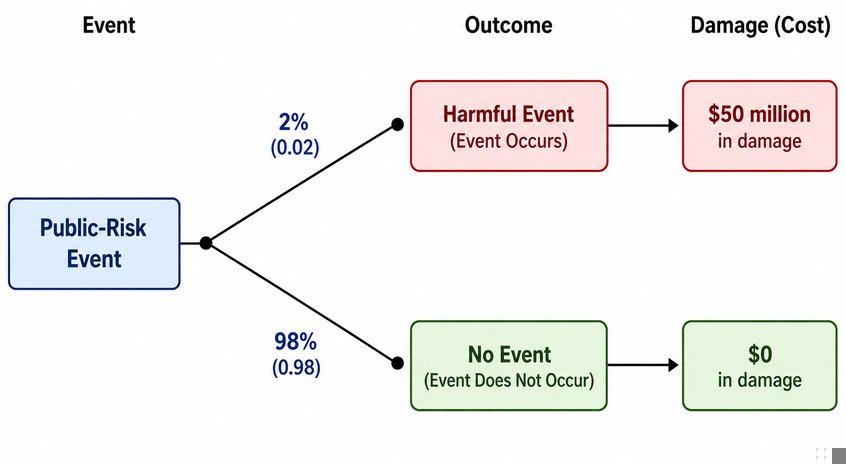
Expected loss equals probability multiplied by consequence: 0.02 × $50 million = $1 million. This is an expected-value calculation, not a prediction of annual damage.
Proportionality directs more rigorous analysis toward proposals with major impacts, uncertainty, or risk. Minor proposals may justify a simpler assessment.
Ex post evaluation occurs after implementation and compares actual effects with objectives, forecasts, and an appropriate counterfactual.
A sunset clause sets an expiration point. It can prompt policymakers to review whether the regulation remains necessary, effective, and proportionate before renewing it.
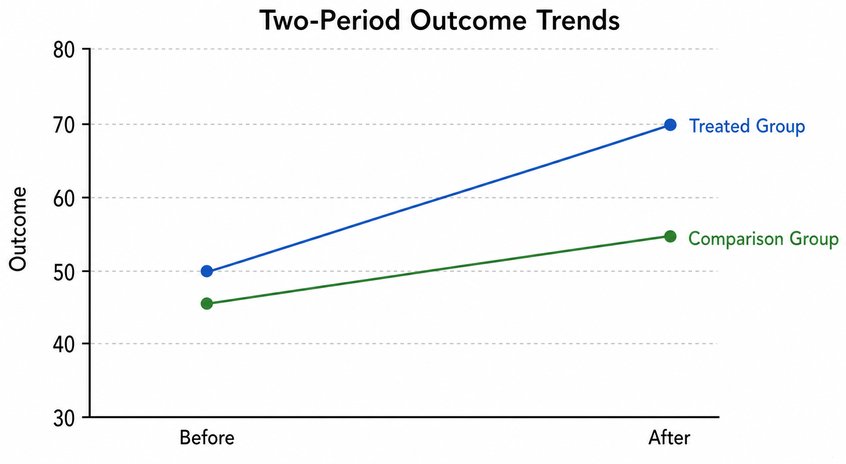
The treated group changes by 20 units, while the comparison group changes by 10. Difference-in-differences subtracts these changes: 20 − 10 = 10 units.
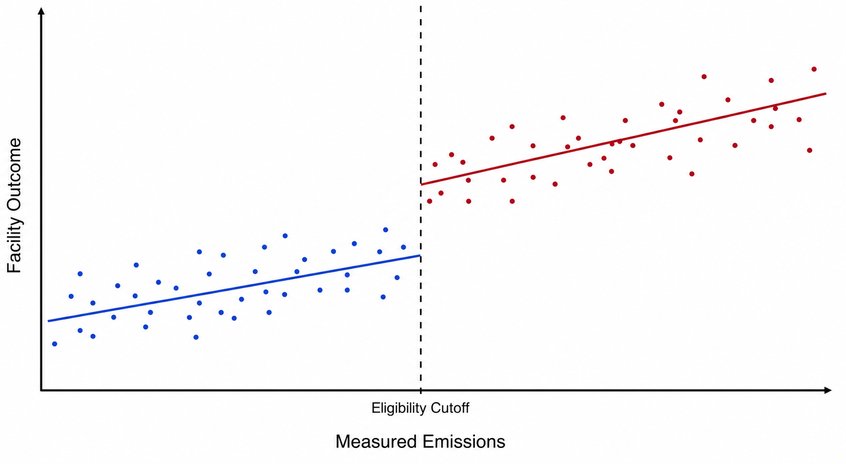
Regression discontinuity relies on units just above and below the cutoff being comparable except for treatment. Smooth potential outcomes and limited manipulation support this interpretation.
A rebound effect occurs when improved efficiency lowers the effective cost of using a product, encouraging additional use that offsets some of the expected resource savings.
Break-even analysis identifies how large an uncertain or non-monetized benefit must be to equal or exceed net costs. Decision-makers can then judge whether that threshold is plausible.

Free CourseEssentials of Global Health
5

(3)

11h16m

27 exercises

Free CourseIntroduction to Public Relations
5
(8)
7h51m
11 exercises
Free CourseIntroduction to Political Philosophy
5
(1)
17h35m
24 exercises
Free CoursePolitical Complexity
5
(52)
6h54m
19 exercises

Free CourseIntroduction to Enviromental Policy and Planning
4.7

(3)
1h52m
17 exercises

Free CourseInternational Relations
4.4
(9)
12h00m
54 exercises
Free CoursePower and politics
4.4
(20)
31h33m
22 exercises

Free CourseIntro to Political Science
4
(4)
1h51m
11 exercises
Thousands of online courses in video, ebooks and audiobooks.
To test your knowledge during online courses
Generated directly from your cell phone's photo gallery and sent to your email

Download our app via QR Code or the links below:.



Carry knowledge in your pocket.
Download the Cursa app.
There are hundreds of free courses available, with a free certificate of completion that is saved in your mobile image gallery.
Download the app to access the Course Completion Certificate for Free.


+ 10 million
students

Free and Valid
Certificate

60 thousand free
exercises

4.8/5 rating in
app stores

Free courses in
video and ebooks