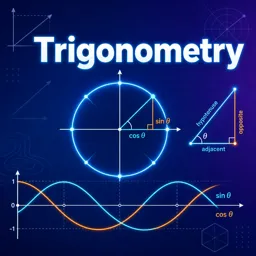
Trigonometry has a reputation for being intimidating, yet its starting point is surprisingly friendly. If you can recognize a right triangle and remember a short nonsense word, you already have the key to solving a huge range of problems, from finding the height of a tree to working out the slope of a roof. That word is SOH-CAH-TOA. In this article you will learn what it means, how to use it, and how to avoid the mistakes that trip up most beginners.
What is a right triangle, and why does it matter?
A right triangle is a triangle with one angle of exactly 90 degrees. The longest side, which sits opposite the right angle, is called the hypotenuse. The other two sides are called legs. Because the angles of any triangle add up to 180 degrees, the two remaining angles in a right triangle must add up to 90 degrees. This fixed relationship is what makes trigonometry possible: the ratios between the sides depend only on the size of the other angles, not on how big the triangle is.
Labeling the sides correctly
Before using any formula, you must choose a reference angle. Call it θ (theta). Then label the sides relative to that angle:
- Hypotenuse: always the side opposite the 90-degree angle, no matter which angle you choose.
- Opposite: the side directly across from θ.
- Adjacent: the side next to θ that is not the hypotenuse.
If you switch to the other acute angle, the opposite and adjacent sides swap roles. This is the most common source of confusion, so always start by marking your reference angle.
What SOH-CAH-TOA means
The three trigonometric ratios are sine, cosine and tangent. The mnemonic SOH-CAH-TOA packs all three definitions into one phrase:
| Mnemonic | Meaning | Formula |
|---|---|---|
| SOH | Sine = Opposite / Hypotenuse | sin θ = opposite ÷ hypotenuse |
| CAH | Cosine = Adjacent / Hypotenuse | cos θ = adjacent ÷ hypotenuse |
| TOA | Tangent = Opposite / Adjacent | tan θ = opposite ÷ adjacent |
Each ratio compares two sides of the triangle. Which one to use depends on what you know and what you want to find. If the problem mentions the opposite side and the hypotenuse, reach for sine. If it involves the adjacent side and the hypotenuse, use cosine. If it involves the two legs, use tangent.
Example 1: finding a missing side
Imagine a ladder leaning against a wall. The ladder is 5 metres long and makes a 60-degree angle with the ground. How high up the wall does it reach?
- Draw the triangle: the ladder is the hypotenuse (5 m), the wall is the side opposite the 60-degree angle, and the ground is the adjacent side.
- Choose the ratio: you know the hypotenuse and want the opposite side, so use sine.
- Write the equation: sin 60° = height ÷ 5.
- Solve: height = 5 × sin 60°. With sin 60° ≈ 0.866, the height is about 4.33 metres.
Example 2: finding a missing angle
Now suppose a ramp rises 1 metre over a horizontal distance of 4 metres. What angle does it make with the ground? Here you know the opposite side (1 m) and the adjacent side (4 m), so tangent is the right tool: tan θ = 1 ÷ 4 = 0.25. To get the angle itself, use the inverse tangent function on your calculator, written as tan⁻¹ or arctan. The result is roughly 14 degrees.
Whenever you need an angle instead of a side, you use the inverse function: sin⁻¹, cos⁻¹ or tan⁻¹. This is the step students most often forget.
A simple method for any problem
- Sketch the triangle and mark the right angle.
- Mark the reference angle θ you are working with.
- Label the sides as opposite, adjacent and hypotenuse relative to θ.
- Decide which two sides are involved (one known, one unknown, or two known).
- Pick sine, cosine or tangent using SOH-CAH-TOA.
- Write the equation, solve it, and check that the answer makes sense.
Common mistakes to avoid
- Calculator in the wrong mode: make sure it is set to degrees if the angle is given in degrees, or radians if the problem uses radians.
- Mislabeling sides: opposite and adjacent depend on the chosen angle, so relabel whenever you change it.
- Using the ratios on non-right triangles: SOH-CAH-TOA only applies to right triangles; other triangles need the law of sines or the law of cosines.
- Forgetting the hypotenuse is longest: if your answer for a leg is longer than the hypotenuse, something went wrong.
- Rounding too early: keep extra decimals during the calculation and round only at the end.
Where you will actually use it
These ratios are everywhere. Builders use them to cut rafters and check stairs. Surveyors use them to measure distances that cannot be reached directly. Pilots and navigators use them to compute headings. Game developers rely on trigonometry to move characters and cameras, and physics students use it to split a force into horizontal and vertical components. Learning the basics now opens the door to all of these fields.
Practice ideas
Try measuring something real. Stand some distance from a tall object, estimate the angle from your eye to its top using a protractor and a straw, and compute its height with tangent, remembering to add the height of your eyes. Then compare with a known measurement. Hands-on practice makes the abstract ratios feel concrete and helps the mnemonic stick.
Conclusion
SOH-CAH-TOA turns trigonometry from a list of abstract definitions into a practical toolkit. Label the triangle, choose the ratio, solve, and check. With a bit of practice, you will find that right-triangle problems become routine. If you would like structured guidance, explore the math and trigonometry courses available on Cursa, where you can build confidence step by step and move on to more advanced topics.