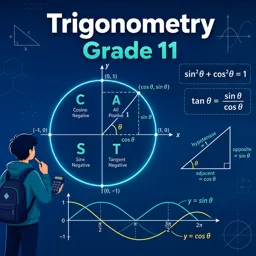
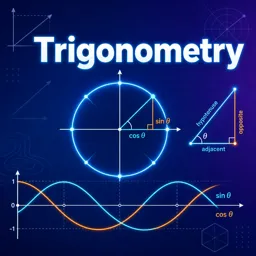
Every student learns that a full circle has 360 degrees. Then, somewhere around trigonometry or early calculus, the textbook quietly switches to writing angles as fractions of π, and the reason is rarely explained. It looks like an arbitrary change of habit. It isn’t. Radians exist because degrees make certain formulas needlessly complicated, and radians make them clean. This article explains what a radian is, how to move between the two units, and where the difference genuinely matters.
Where 360 degrees came from
Degrees are a historical convention. The division of the circle into 360 parts traces back to ancient Babylonian mathematics, which used a base-60 number system. The number 360 is extraordinarily convenient for hand calculation: it divides evenly by 2, 3, 4, 5, 6, 8, 9, 10, 12, 15, 18, 20, 24, 30, 36, 40, 45, 60, 72, 90, 120 and 180.
That convenience is real, and it’s why degrees survive in navigation, surveying, construction and everyday conversation. But notice what it is not: it isn’t derived from any property of a circle. Nothing about a circle points to the number 360. It’s a choice that worked well and stuck.
What a radian actually measures
A radian is defined by the circle itself. Take a circle and measure out along its circumference an arc whose length equals the radius. The angle that arc subtends at the centre is one radian.
That definition has an immediate consequence. The circumference of a circle is 2πr, so an arc of length r fits around the circle exactly 2π times. A full turn is therefore 2π radians, a half turn is π radians, and a quarter turn is π/2 radians.
Because a radian is a ratio of two lengths — arc length divided by radius — it has no units. This is the key idea. A radian is a pure number, which is why it can appear inside algebraic expressions without dragging a conversion factor along with it.
Converting between the two
Everything follows from a single equality: a half turn is both 180 degrees and π radians. So:
- Degrees to radians: multiply by π/180.
- Radians to degrees: multiply by 180/π.
The values worth memorising are the ones that keep reappearing:
| Degrees | Radians | Approximate decimal |
|---|---|---|
| 0° | 0 | 0 |
| 30° | π/6 | 0.524 |
| 45° | π/4 | 0.785 |
| 60° | π/3 | 1.047 |
| 90° | π/2 | 1.571 |
| 180° | π | 3.142 |
| 270° | 3π/2 | 4.712 |
| 360° | 2π | 6.283 |
One radian is roughly 57.3 degrees. That number is worth knowing, because it gives you a physical sense of the unit: a radian is a fairly large angle, a bit less than a sixth of a full turn.
The formulas that only work in radians
Here is where the switch pays off. Several important formulas are simple in radians and cluttered in degrees.
Arc length
The length of an arc is simply s = rθ, where θ is the central angle in radians. Radius times angle. Nothing else. In degrees you would need s = 2πr × (θ/360), which carries a conversion factor you must remember and can misplace.
Area of a sector
The area of a circular sector is A = ½r²θ in radians. Again, no constants smuggled in from outside.
Derivatives of trigonometric functions
In calculus, the derivative of sin x is cos x, and the derivative of cos x is −sin x. These beautifully simple results are true only when x is measured in radians. If you insist on degrees, the derivative of sin x becomes (π/180)·cos x, and that factor then propagates through every subsequent calculation. This single fact is the strongest reason radians became the standard in advanced mathematics.
Small-angle approximation
For small angles in radians, sin θ ≈ θ and tan θ ≈ θ. Physics and engineering lean on this constantly — pendulum motion, optics, structural deflection. The approximation is meaningless in degrees, because sin(1°) is about 0.0175, not 1.
Angular velocity
Rotational motion is described in radians per second, which lets you write v = ωr for the linear speed at radius r. Mixing in degrees would require a conversion factor in every step.
A practical warning: check your calculator
The single most common source of wrong trigonometric answers has nothing to do with understanding. It’s a calculator left in the wrong mode. Most scientific calculators display DEG, RAD or GRAD somewhere on the screen, and most programming languages — Python, JavaScript, C and others — expect radians in their trigonometric functions, with no warning if you feed them degrees.
A fast sanity check: sin(30) should give 0.5 in degree mode. If it returns roughly −0.988, you are in radian mode. Build the habit of running that check before any calculation you care about.
When to use which
| Use degrees for | Use radians for |
|---|---|
| Navigation, bearings and compass headings | Calculus and analysis |
| Surveying, construction and drafting | Arc length and sector area |
| Geometry problems at school level | Physics of rotation and oscillation |
| Everyday communication of angles | Programming and numerical computation |
Neither unit is more correct. They answer the question “how much turn?” with different rulers. Degrees are convenient for humans dividing circles by hand; radians are convenient for mathematics that relates angles to lengths and rates of change.
Conclusion
Radians are not a more difficult way of saying the same thing. They are a measurement built out of the circle’s own geometry, which is exactly why the formulas that connect angle to length, area and rate of change come out clean. Once you see that s = rθ and that the derivative of sin x is cos x both depend on this choice, the π everywhere stops looking like decoration and starts looking like the point.
If you want to build real fluency here, the free trigonometry and calculus courses on Cursa move step by step from the unit circle through angle measurement to derivatives — a natural path for turning these conversions into something you no longer have to think about.