
Free ebook for learning to read piano music, from staff notes and rhythm to treble, bass, and simple songs.
Free ebook content
-

Music Reading for Piano: How the Staff Maps to the Keyboard
+ Exercise: When a melody moves up on the staff by a skip (jumping over one line/space), how should your hand move on the keyboard during early white-key reading?
-
Treble Clef Note Reading for Piano: Lines, Spaces, and Landmarks
+ Exercise: When reading treble clef notes, what is the recommended method for quickly identifying an unfamiliar note without counting from the bottom every time?
-
Bass Clef Note Reading for Piano: Left-Hand Notes and Anchors
+ Exercise: When reading bass clef notes, what approach best helps you find and play notes quickly on the keyboard?
-
Grand Staff Reading for Piano: Coordinating Treble and Bass Clef
+ Exercise: When reading piano music on the grand staff, what does it mean if a note in the treble staff lines up vertically with a note in the bass staff?


-
Rhythm Basics for Piano Reading: Beat, Pulse, and Note Values
+ Exercise: While practicing a rhythm pattern, you realize your timing drifts and you lose the beat. What is the recommended way to fix it?
-
Measures and Bar Lines: Reading Music in Manageable Chunks
+ Exercise: Why is it helpful to think of each measure as a “chunk” when reading piano music?
-
Simple Time Signatures for Piano: 4/4, 3/4, and 2/4 Reading
+ Exercise: If you play four quarter notes with identical timing, what changes when the music is written as two measures of 2/4 instead of one measure of 4/4?
-
Reading Steps, Skips, and Repeats: Interval-Based Piano Decoding
+ Exercise: While sight-reading with interval-based thinking, what is the recommended order of actions to avoid naming every note first?
-
Finger Numbers and 5-Finger Positions: Connecting Reading to Comfortable Hands
+ Exercise: In a right-hand 5-finger C-position, what is the main benefit for reading and playing when you keep the hand still and let each finger stay with its assigned key?
-
Accidentals for Beginners: Sharps, Flats, Naturals on the Piano
+ Exercise: Which statement correctly describes how a natural sign (♮) works within a measure?
-
Putting It Together: Reading and Playing Simple Songs on Piano
+ Exercise: While using the 3-pass method to learn a simple beginner piece, what should you do first to keep rhythm and pitch from overwhelming you?
About the free ebook
Reading Music for Piano: From Zero to Simple Songs
This free ebook gives aspiring pianists a practical path to reading standard notation and turning it into confident playing. It connects what you see on the page with where your fingers go on the keyboard, so music reading becomes a repeatable skill rather than a guessing game.
Build a clear map from notation to keys
Learn how the piano staff represents pitch, how treble and bass clefs relate to the right and left hands, and how the grand staff brings both hands together. Landmark notes and keyboard reference points help you identify notes without relying on memorization alone.
Read rhythm with a steady pulse
Discover how note values, beats, measures, bar lines, and common time signatures work together. The lessons focus on counting clearly and recognizing small musical units, making it easier to keep moving while you play.
Decode patterns instead of reading one note at a time
Music often moves in steps, skips, and repeated notes. By recognizing these interval patterns, you can read more smoothly and react faster. You will also explore finger numbers, comfortable five-finger positions, and beginner-friendly accidentals such as sharps, flats, and naturals.
Move from symbols to simple piano pieces
The ebook brings pitch, rhythm, hand coordination, and basic technique into one approachable process for reading simple songs. Practice each idea slowly, keep a regular pulse, and use the keyboard as your visual guide. With consistent repetition, the staff becomes easier to understand and familiar melodies become possible to play.
What you will gain
- A reliable way to locate written notes on the piano
- Tools for counting common beginner rhythms
- Strategies for coordinating treble and bass clef
- A pattern-based approach to reading simple music
How do treble and bass clef notes correspond to piano keys?
Treble clef generally guides right-hand notes and bass clef left-hand notes; each staff position represents a specific key.
What are steps and skips in beginner piano sheet music?
A step moves to the next line or space, while a skip moves over one line or space, helping you recognize note patterns quickly.
How do I count 4/4 and 3/4 time when playing piano?
Count four steady beats per measure in 4/4 and three steady beats per measure in 3/4, using note values to fill each measure.
This ebook includes:

11 content chapters

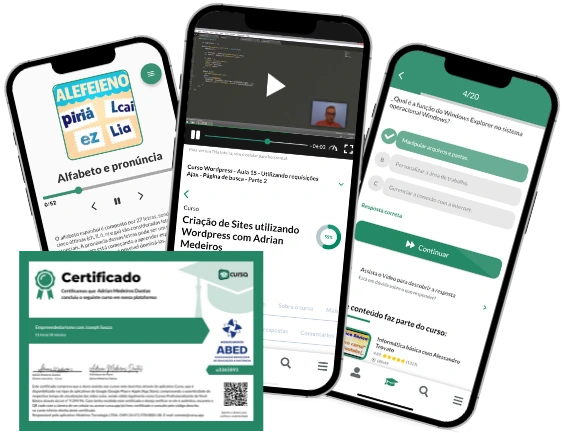
Digital certificate of course completion (Free)

Exercises to train your knowledge

100% free, from content to certificate
Ready to get started?

 recommended
In the app you will also find...

Over 5,000 free courses
Programming, English, Digital Marketing and much more! Learn whatever you want, for free.

Study plan with AI
Our app's Artificial Intelligence can create a study schedule for the course you choose.

From zero to professional success
Improve your resume with our free Certificate and then use our Artificial Intelligence to find your dream job.
You can also use the QR Code or the links below.