Middle C is the fourth C from the left on a standard 88-key piano, located near the center of the keyboard.

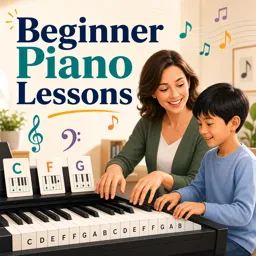
Duration of the online course: 2 hours and 38 minutes
New
Start playing piano with confidence—learn notes, chords, rhythm, and reading music in a free online course with practical drills and optional certificate.
Learning piano can feel overwhelming at first: so many keys, symbols, and techniques, all at once. This beginner-friendly course is designed to remove that confusion and replace it with clear, step-by-step progress. You will build a strong foundation from the very beginning, so your hands, eyes, and ears start working together naturally—whether you are playing on an acoustic piano or a keyboard at home.
You will start with the essentials of healthy technique, including how to sit correctly and position your hands for control and comfort. From there, you will learn the finger numbers that pianists use to move efficiently across the keys, helping you play more accurately and with better dynamics. You will also become confident finding Middle C and understanding the musical alphabet, so the keyboard stops looking like a mystery and begins to feel predictable and organized.
As you continue, you will learn how to name both white and black keys and understand why a black key can be called a sharp or a flat depending on context. You will make sense of half steps and whole steps, which unlock how melodies and chords are built. With that understanding, chords become less like memorized shapes and more like a system you can recognize and use—major and minor chords included—so you can accompany songs and begin creating a real musical sound quickly.
The course then connects these skills to practical playing by showing you different ways to use chords, including block and broken styles, and how to follow chord charts. You will also explore common chord progressions used in popular music, helping you move from isolated practice to music that feels familiar and motivating. Along the way, you will build rhythmic confidence by learning note values and timing concepts, giving your playing steadiness and flow instead of guesswork.
Finally, you will develop the ability to read music with less stress by understanding the staff, measures, time signatures, treble and bass clefs, ledger lines, and helpful memory tricks for locating any note. By the end, you will be equipped to put both hands together with greater coordination, turning fundamentals into real piano-playing skills you can keep growing. If you are looking for a free online piano course that builds your technique, theory, and reading in a practical way, this is a reliable starting point.

2 hours and 38 minutes of online video course

Digital certificate of course completion (Free)

Exercises to train your knowledge

100% free, from content to certificate
How do I find middle C on an 88-key piano?
Middle C is the fourth C from the left on a standard 88-key piano, located near the center of the keyboard.
What notes are in the C, F, and G major chords on piano?
C major is C–E–G, F major is F–A–C, and G major is G–B–D.
What is the difference between a sharp and a flat on piano?
A sharp raises a note by one half step, while a flat lowers a note by one half step.
Ready to get started?Download the app and get started today.
Install the app now
to access the course
Over 5,000 free courses
Programming, English, Digital Marketing and much more! Learn whatever you want, for free.

Study plan with AI
Our app's Artificial Intelligence can create a study schedule for the course you choose.

From zero to professional success
Improve your resume with our free Certificate and then use our Artificial Intelligence to find your dream job.
You can also use the QR Code or the links below.



Free CoursePiano theory course
5

(4)

2h58m

29 exercises
Free CourseHow to play Piano for beginners
5
(1)
7h13m
27 exercises
Free CoursePiano Level 1
5
(1)
11h24m
31 exercises
Free CourseIntermediate Piano
5
(1)
2h15m
6 exercises
Free CourseLearn Piano for Beginners to Advanced
5
(1)
15h43m
37 exercises

Free CoursePiano
4.9
(73)
10h44m
51 exercises
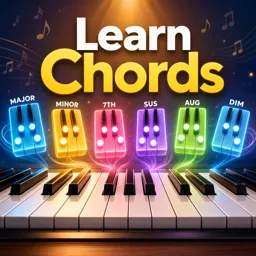
Free CourseLearn Chords
4.5

(37)
45m
12 exercises

Free CoursePiano lessons
New
17h21m
40 exercises
Free CoursePiano for complete beginners
New
2h53m
10 exercises
Free CourseBeginner Piano lessons
New
8h10m
32 exercises
Carry knowledge in your pocket.
Download the Cursa app.
There are hundreds of free courses available, with a free certificate of completion that is saved in your mobile image gallery.
Download the app to access the Course Completion Certificate for Free.


+ 10 million
students

Free and Valid
Certificate

60 thousand free
exercises

4.8/5 rating in
app stores

Free courses in
video and ebooks