
A half tone is the distance to the nearest key; a whole tone equals two half tones.

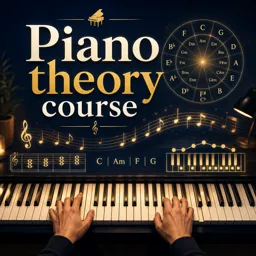
Duration of the online course: 2 hours and 58 minutes
5

(4)
Play with confidence: master piano theory in a free online course and build scales, chords, and progressions fast—ideal for beginners seeking a certificate.
Understanding why music works is the difference between simply copying songs and truly being able to play them. This free online piano theory course helps you build that understanding step by step, turning the keyboard into a map you can navigate with confidence. You will connect names of notes to real positions on the piano, recognize patterns quickly, and develop the kind of musical awareness that makes learning new pieces feel easier and more logical.
You will start by getting comfortable with the layout of the instrument, including how white and black keys are organized and how to find notes reliably across the keyboard. From there, the course builds the foundation of pitch distance, using half tones and whole tones to explain how scales are constructed. Once those building blocks are clear, key signatures become less like memorization and more like a simple system you can apply whenever you sit down to play.
As you progress, you will learn how major and minor scales relate, how to identify and measure intervals, and why octaves matter when shaping melodies and arranging parts. A major highlight is learning to use the Circle of Fifths as a practical tool, helping you work out sharps and flats, match related keys, and understand how harmony is organized across common musical situations.
The course then guides you into chords and chord progressions so you can move from single notes to full, rich harmony. You will gain the ability to build major and minor chords, seventh chords, and other common chord types, then apply them to the kind of patterns used in countless songs. You will also explore chord inversions and simple setups that make transitions smoother, strengthen your hand coordination, and help your playing sound more polished.
By the end, you will be better equipped to decipher chord symbols, learn songs faster, and remember music in a smarter way by thinking in shapes and harmonies instead of isolated notes. Whether your goal is to accompany singers, play pop progressions, understand classical pieces more deeply, or improve your improvisation, this course gives you a solid theory framework you can use immediately at the piano.

2 hours and 58 minutes of online video course

Digital certificate of course completion (Free)

Exercises to train your knowledge

100% free, from content to certificate
What is the difference between a half tone and a whole tone on the piano?
A half tone is the distance to the nearest key; a whole tone equals two half tones.
What notes are in the F major and G major scales?
F major is F–G–A–B♭–C–D–E; G major is G–A–B–C–D–E–F♯.
How do you form a minor chord on piano?
Play the root, a minor third, and a perfect fifth; equivalently, lower the third of a major chord by one half tone.
Ready to get started?Download the app and get started today.
Install the app now
to access the course
Over 5,000 free courses
Programming, English, Digital Marketing and much more! Learn whatever you want, for free.

Study plan with AI
Our app's Artificial Intelligence can create a study schedule for the course you choose.

From zero to professional success
Improve your resume with our free Certificate and then use our Artificial Intelligence to find your dream job.
You can also use the QR Code or the links below.



Free CourseHow to play Piano for beginners
5
(1)

7h13m

27 exercises
Free CoursePiano Level 1
5
(1)
11h24m
31 exercises
Free CourseBeginner Piano Lessons
5
(1)
2h38m
20 exercises
Free CourseIntermediate Piano
5
(1)
2h15m
6 exercises
Free CourseLearn Piano for Beginners to Advanced
5
(1)
15h43m
37 exercises

Free CoursePiano
4.9
(73)
10h44m
51 exercises
Free CourseLearn Chords
4.5

(37)
45m
12 exercises

Free CoursePiano lessons
New
17h21m
40 exercises
Free CoursePiano for complete beginners
New
2h53m
10 exercises
Free CourseBeginner Piano lessons
New
8h10m
32 exercises
Carry knowledge in your pocket.
Download the Cursa app.
There are hundreds of free courses available, with a free certificate of completion that is saved in your mobile image gallery.
Download the app to access the Course Completion Certificate for Free.


+ 10 million
students

Free and Valid
Certificate

60 thousand free
exercises

4.8/5 rating in
app stores

Free courses in
video and ebooks
Course comments: Piano theory course
M “N8TUR DAGR8” V
very very helpful he breaks it down in simple form this is a wonderful way of learning to play! 5 stars
Roshni Ghosh
Loved this! Very helpful ❤️