

Free ebook on Mandarin pronunciation: master Pinyin initials and finals, four tones, tone sandhi, rhythm, and clear speech habits.
Free ebook content
-

Mandarin Pronunciation Foundations: Pinyin, Tones, and Clear Speech Goals
+ Exercise: When using the Hear–Identify–Repeat–Record–Compare routine, what is the recommended way to compare your recording to the model without getting overwhelmed?
-
Pinyin Initials: Consonant Sounds You Must Separate Clearly
+ Exercise: When practicing the Mandarin initial pair b vs p, what is the quickest way to check which one is aspirated?
-
Pinyin Finals: Vowels, Diphthongs, and Nasal Endings Without English Drift
+ Exercise: When practicing nasal finals, what does pinching your nose at the end help you check?


-
Tone Production: Four Tones, Neutral Tone, and Stable Pitch Targets
+ Exercise: When practicing Mandarin tones, what is the key principle for making a tone sound “strong” and clear?
-
Tone Pairs and Tone Sandhi: Producing Natural Tone Changes
+ Exercise: In normal speech, how should you pronounce two third tones back-to-back (3+3) to sound natural?
-
Syllable Timing and Connected Speech: Clear Rhythm Without Extra Vowels
+ Exercise: When practicing the two-tap drill for a two-syllable phrase like "wǒ jiào", what is the best way to link the syllables in connected speech?
-
Common Pronunciation Pitfalls: Targeted Fixes for Beginner Errors
+ Exercise: When practicing the contrast between j/q/x and zh/ch/sh, which mouth-shape checkpoint best helps you avoid mispronouncing j/q/x as retroflex sounds?
-
Listening-and-Speaking Drills: Minimal-Pair Style Practice in Real Phrases
+ Exercise: In the drill framework, what should you do immediately after making an error during controlled repetition?
-
Pronunciation Habits From Day One: Self-Monitoring for Lasting Accuracy
+ Exercise: When you notice your tones are drifting, what is the recommended order for the tone self-check?
About the free ebook
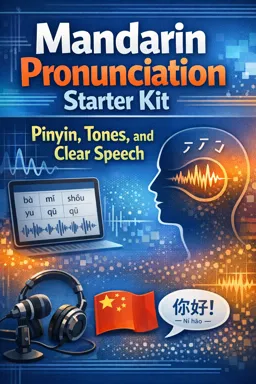
Mandarin Pronunciation Starter Kit: Pinyin, Tones, and Clear Speech
Build a reliable foundation for speaking Mandarin with clearer sounds, steadier tones, and more natural rhythm. This free ebook explains how Pinyin represents Mandarin pronunciation and helps you turn spelling into accurate speech rather than English-style approximations.
Speak each syllable with confidence
Learn to distinguish Pinyin initials, shape finals accurately, and handle vowels, diphthongs, and nasal endings without adding extra sounds. Practical guidance highlights contrasts that can be difficult for English speakers, including sounds that may appear similar in writing but require different tongue, lip, or airflow positions.
Make tones audible and consistent
Mandarin tones carry meaning, so pitch movement matters as much as consonants and vowels. Practice the four tones, neutral tone, common tone pairs, and tone sandhi patterns with stable pitch targets. You will also explore syllable timing and connected speech to sound clear without stretching words or inserting unnecessary vowels.
Correct errors through focused practice
Use listening-and-speaking drills, minimal-pair-style contrasts, and short real-phrase practice to notice what you hear and improve what you say. The ebook also offers self-monitoring habits that support lasting accuracy from your first Mandarin conversations.
What you will strengthen
- Pinyin sound recognition and production
- Clear initials, finals, and nasal endings
- Four-tone control, neutral tone, and tone changes
- Natural syllable rhythm and connected speech
- Error correction through targeted listening and repetition
Use this starter kit as a practical reference while studying Mandarin vocabulary, practicing with audio, or preparing to speak short everyday phrases.
How do Mandarin tones change the meaning of a syllable?
The same Pinyin syllable can represent different words when spoken with different tones, so accurate pitch movement is essential.
What is tone sandhi in Mandarin Chinese?
Tone sandhi is a predictable tone change in connected speech, such as a third tone changing before another third tone.
Why do Mandarin learners add extra vowel sounds?
English speech habits can cause learners to release consonants or separate syllables too much, adding sounds not present in Mandarin.
This ebook includes:

9 content chapters

Digital certificate of course completion (Free)

Exercises to train your knowledge

100% free, from content to certificate
Ready to get started?

 recommended
In the app you will also find...

Over 5,000 free courses
Programming, English, Digital Marketing and much more! Learn whatever you want, for free.

Study plan with AI
Our app's Artificial Intelligence can create a study schedule for the course you choose.

From zero to professional success
Improve your resume with our free Certificate and then use our Artificial Intelligence to find your dream job.
You can also use the QR Code or the links below.