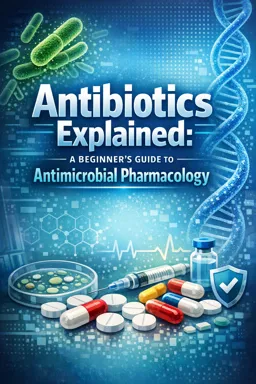

Free ebook explaining antibiotic mechanisms, major drug classes, bacterial resistance, safety, and antimicrobial stewardship.
Free ebook content
-

How Antibiotics Work: Core Concepts in Antimicrobial Pharmacology
+ Exercise: Which statement best explains why antibiotics can harm bacteria more than human cells?
-
Bacterial Targets and Spectrum: Cell Wall, Ribosomes, and Beyond
+ Exercise: Two antibiotics inhibit the same cell-wall enzyme, but only one reliably covers many Gram-negative bacteria. Which factor best explains this difference in spectrum?


-
Beta-Lactam Antibiotics Explained: Penicillins, Cephalosporins, Carbapenems, and Monobactams
+ Exercise: Which statement best reflects the practical implication of time-dependent killing for many beta-lactam antibiotics?
-
Glycopeptides and Other Cell-Wall Active Options: Vancomycin and Alternatives
+ Exercise: Which statement best explains why vancomycin can be useful when some gram-positive bacteria are resistant to many beta-lactam antibiotics?
-
Protein Synthesis Inhibitors I: Macrolides, Tetracyclines, and Clindamycin
+ Exercise: A patient has a suspected anaerobic infection where an oral antibiotic is desired. Which option best matches a drug choice that targets the 50S subunit by blocking peptide chain elongation and has a notable C. difficile risk?
-
Protein Synthesis Inhibitors II: Aminoglycosides, Oxazolidinones, and Other Key Agents
+ Exercise: Which approach best reflects safe, practical use of aminoglycosides in clinical care?
-
DNA and RNA Targeting Antibiotics: Fluoroquinolones, Rifamycins, and Metronidazole
+ Exercise: Which pairing correctly matches each antibiotic class with its primary mechanism described here?
-
Folate Pathway Inhibitors and Urinary Antibiotics: Trimethoprim-Sulfamethoxazole and Nitrofurantoin
+ Exercise: Why is nitrofurantoin generally avoided for suspected pyelonephritis (kidney infection) despite being effective for uncomplicated cystitis?
-
Resistance Mechanisms Made Simple: How Bacteria Outsmart Antibiotics
+ Exercise: A Gram-negative isolate shows reduced susceptibility across several beta-lactams, and the report suggests possible porin changes. Which interpretation best matches this resistance mechanism?
-
Choosing an Antibiotic Safely: Indications, De-escalation, and Stewardship Principles
+ Exercise: Which action best reflects antibiotic de-escalation after starting empiric therapy?
-
Adverse Effects and Interactions Across Antibiotic Classes: What to Watch For
+ Exercise: A patient taking doxycycline also uses a daily multivitamin with iron and magnesium. What is the most appropriate counseling point to reduce the risk of antibiotic treatment failure?
About the free ebook
Antibiotics Explained: A Beginner’s Guide to Antimicrobial Pharmacology
This free ebook introduces the principles behind antibiotic therapy, helping readers understand how antimicrobial medicines act on bacteria, why drug choice matters, and how resistance develops. It translates core pharmacology into clear, practical language without replacing clinical advice.
Understand antibiotic actions and bacterial targets
Learn how antibiotics interrupt essential bacterial processes, including cell-wall construction, protein production, nucleic-acid function, and folate metabolism. The ebook explains why different drug classes have different spectra, routes of use, and clinical roles.
Connect major antibiotic classes to safe use
Explore the foundational characteristics of commonly used antibacterial agents, from beta-lactams and glycopeptides to macrolides, tetracyclines, aminoglycosides, fluoroquinolones, and urinary antibiotics. Emphasis is placed on mechanisms, key differences, and important safety considerations.
Make sense of resistance and stewardship
Antibiotic resistance can arise when bacteria alter drug targets, destroy medicines, reduce drug entry, or pump drugs out of the cell. This ebook explains these concepts and shows why culture-guided therapy, de-escalation, and avoiding unnecessary antibiotics are central to antimicrobial stewardship.
A practical pharmacology foundation
- Clarify bactericidal and bacteriostatic activity.
- Recognize factors that influence antibiotic selection.
- Review notable adverse effects and drug interactions.
- Understand why antibiotics do not treat viral infections.
Important: This educational ebook is not a substitute for diagnosis, prescribing guidance, or advice from a qualified healthcare professional. Antibiotics should be used only as directed by an appropriate clinician.
What is the difference between bactericidal and bacteriostatic antibiotics?
Bactericidal antibiotics kill bacteria, while bacteriostatic antibiotics mainly slow bacterial growth so the immune system can clear infection.
Why are antibiotics ineffective against colds and flu?
Colds and influenza are caused by viruses, and antibiotics target bacterial structures or processes rather than viruses.
What does antibiotic de-escalation mean?
De-escalation means narrowing or adjusting treatment after test results identify the likely bacteria and its antibiotic susceptibility.
This ebook includes:

11 content chapters

Digital certificate of course completion (Free)

Exercises to train your knowledge

100% free, from content to certificate
Ready to get started?

 recommended
In the app you will also find...

Over 5,000 free courses
Programming, English, Digital Marketing and much more! Learn whatever you want, for free.

Study plan with AI
Our app's Artificial Intelligence can create a study schedule for the course you choose.

From zero to professional success
Improve your resume with our free Certificate and then use our Artificial Intelligence to find your dream job.
You can also use the QR Code or the links below.