The course covers local anesthetics, pharmacokinetics, pharmacodynamics, antibiotics, analgesics, autonomic nervous system drugs, cardiovascular pharmacology, CNS medications, and practice questions.

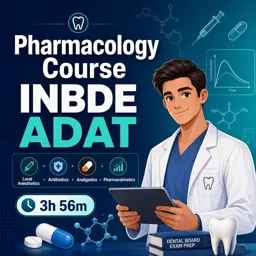
Duration of the online course: 3 hours and 56 minutes
5

(1)
Boost your pharmacology confidence with a free online course built for INBDE/ADAT—master anesthetics, antibiotics, CNS drugs, and key practice questions.
Strengthen your pharmacology foundation with a focused, exam-oriented learning experience designed to help you think like a clinician and perform like a test taker. This free online course supports students preparing for the INBDE and ADAT by turning high-yield pharmacology into clear, usable knowledge you can apply to real dental and healthcare scenarios. Instead of memorizing endless facts, you will build a structured understanding of how drugs work, how the body handles them, and how to connect mechanisms to outcomes and side effects.
The course begins with local anesthetics, helping you confidently handle common calculations and decision points tied to safe dosing. You will also refine your understanding of injection techniques and needle gauge choices, translating technical details into practical reasoning you can use in clinics and exams. From there, you will solidify the core principles of pharmacokinetics and pharmacodynamics, including absorption and drug-response relationships, so that unfamiliar questions become manageable by logic rather than guesswork.
As you progress, the course expands into major drug categories that frequently appear in board-style questions. You will sharpen your ability to distinguish antibiotic classes by their mechanisms, connect analgesics to expected effects and adverse reactions, and recognize how autonomic and cardiovascular pharmacology influence blood flow and blood pressure. You will also review central nervous system medications, including how commonly tested antidepressants work, with an emphasis on typical wording and traps seen in multiple-choice formats.
Throughout the course, integrated questions reinforce each concept and help you practice reading prompts carefully, isolating key clinical clues, and selecting the best answer under time pressure. By the end, you will be better prepared to interpret pharmacology scenarios, predict drug interactions and toxicities, and approach INBDE/ADAT practice questions with clarity and confidence.

3 hours and 56 minutes of online video course

Digital certificate of course completion (Free)

Exercises to train your knowledge

100% free, from content to certificate
What pharmacology topics are covered for the INBDE and ADAT in this course?
The course covers local anesthetics, pharmacokinetics, pharmacodynamics, antibiotics, analgesics, autonomic nervous system drugs, cardiovascular pharmacology, CNS medications, and practice questions.
How do local anesthetics work in dental procedures?
Local anesthetics block voltage-gated sodium channels, preventing nerve impulse conduction and temporarily stopping pain sensation.
Which antibiotic class inhibits the 50S ribosomal subunit?
Macrolides, such as erythromycin and azithromycin, inhibit bacterial protein synthesis by binding to the 50S ribosomal subunit.
Ready to get started?Download the app and get started today.
Install the app now
to access the course
Over 5,000 free courses
Programming, English, Digital Marketing and much more! Learn whatever you want, for free.

Study plan with AI
Our app's Artificial Intelligence can create a study schedule for the course you choose.

From zero to professional success
Improve your resume with our free Certificate and then use our Artificial Intelligence to find your dream job.
You can also use the QR Code or the links below.



Free CourseIntroduction to Clinical Pharmacology and Therapeutics
4.9
(19)

1h22m

8 exercises
Free CoursePharmacology complete
4.9
(15)
42h15m
39 exercises
Free CoursePharmacology
4.8
(5)
5h57m
17 exercises
Free CourseIntroduction to Pharmacology
4.8

(8)
8h21m
26 exercises
Free CourseIntroduction to Pharmacology
4.5
(4)
38m
5 exercises
Free CourseIntroduction to Pharmacology for fundamentals
4
(2)
1h42m
10 exercises
Free CourseIntroduction to Pharmacology
3.7
(3)
1h05m
6 exercises
Carry knowledge in your pocket.
Download the Cursa app.
There are hundreds of free courses available, with a free certificate of completion that is saved in your mobile image gallery.
Download the app to access the Course Completion Certificate for Free.


+ 10 million
students

Free and Valid
Certificate

60 thousand free
exercises

4.8/5 rating in
app stores

Free courses in
video and ebooks