
Free ebook on pharmacology foundations: drug targets, dose-response, potency, efficacy, safety, side effects, and tolerance.
Free ebook content
-

Pharmacology Foundations: What It Means for a Drug to Work
+ Exercise: A person takes cetirizine for seasonal allergies and their sneezing and itchy eyes improve. Which option best describes the drug’s target and intended effect?
-
Drug Targets and Receptors: Binding, Activation, and Blocking
+ Exercise: A patient uses albuterol (a full β2 agonist) for wheezing but recently started propranolol (a nonselective β blocker). What is the most likely effect on bronchodilation at the same albuterol dose?
-
Dose–Response Relationships: From Dose to Effect
+ Exercise: Two drugs produce the same maximum (plateau) effect on a graded dose–response curve, but Drug B’s curve is shifted left compared with Drug A. What is the best interpretation?
-
Potency vs Efficacy: Interpreting Why Two Drugs Feel Different
+ Exercise: Two drugs are compared on dose–response curves. Drug A’s curve is shifted left of Drug B’s, but both curves plateau at the same maximum height. What is the best interpretation?


-
Therapeutic Window and Therapeutic Index: Balancing Benefit and Harm
+ Exercise: A medication has a narrow therapeutic index. What does this most strongly imply for dosing and monitoring?
-
Selectivity and Side Effects: Why Drugs Affect More Than One Thing
+ Exercise: A patient takes an antihistamine for allergies and becomes drowsy. Which explanation best fits this side effect?
-
Tolerance, Desensitization, and Dependence: When the Response Changes Over Time
+ Exercise: A patient says they feel unwell after missing a dose, and the symptoms improve quickly after taking the medication again. Which interpretation best fits this pattern?
-
Putting It Together: Clinical-Style Reasoning with Core Pharmacology Concepts
+ Exercise: A student has daytime allergy symptoms during exam week. Drug C provides stronger symptom relief but often causes drowsiness; Drug D provides slightly less relief with minimal drowsiness. Which choice best matches the clinical-style reasoning workflow for this patient?
About the free ebook
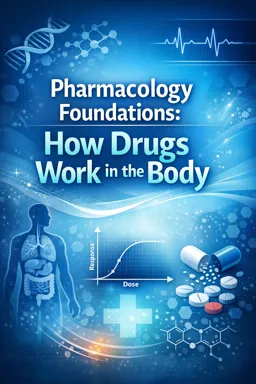
Pharmacology Foundations: How Drugs Work in the Body
This free ebook introduces the core principles used to explain how medicines produce intended effects, unwanted effects, and changing responses over time. It builds a practical framework for understanding drug action without treating the material as personal medical advice.
Understand the relationship between a drug and its target
Learn how drugs interact with receptors and other biological targets. The ebook explains binding, activation, and blocking, showing why an agonist can trigger a response while an antagonist can reduce or prevent one.
Connect dose with clinical effect
Explore dose–response relationships and the distinction between potency and efficacy. These concepts help explain why a lower dose of one medicine may be effective, while another drug may have a greater possible maximum effect.
Evaluate benefits, risks, and changing responses
The ebook examines therapeutic windows, therapeutic index, selectivity, side effects, tolerance, desensitization, and dependence. These ideas clarify why medication decisions require attention to both benefit and harm.
Apply core pharmacology concepts
- Recognize major types of drug–receptor interactions.
- Interpret basic dose–response patterns.
- Compare potency, efficacy, and safety margins.
- Reason through simplified clinical-style medication scenarios.
Important note
This educational resource supports foundational learning in pharmacology. Medication selection, dosing, stopping treatment, and safety decisions should be made with a qualified healthcare professional.
What is the difference between drug potency and efficacy?
Potency is the dose needed to produce an effect; efficacy is the greatest effect a drug can produce.
What does a therapeutic window mean in pharmacology?
It is the dose or concentration range where a drug is likely to provide benefit with acceptable toxicity.
Why can a drug cause side effects if it is selective?
Selectivity is rarely absolute; a drug may affect other targets or the same target in different tissues.
This ebook includes:

8 content chapters

Digital certificate of course completion (Free)

Exercises to train your knowledge

100% free, from content to certificate
Ready to get started?

 recommended
In the app you will also find...

Over 5,000 free courses
Programming, English, Digital Marketing and much more! Learn whatever you want, for free.

Study plan with AI
Our app's Artificial Intelligence can create a study schedule for the course you choose.

From zero to professional success
Improve your resume with our free Certificate and then use our Artificial Intelligence to find your dream job.
You can also use the QR Code or the links below.