It dissipates the voltage difference as heat. At 1 A, dropping 12 V to 5 V wastes about 7 W, so a switching converter is often more efficient.

Duration of the online course: 23 hours and 19 minutes
New
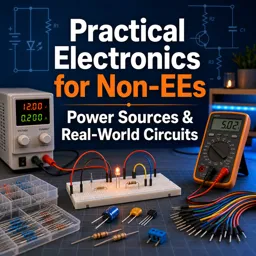
Build real-world electronics skills fast in this free online course—power supplies, regulators, PWM motor control, sensors, and RF basics, with practical exercises.
Working with electronics in the field often means making good decisions without a full electrical engineering background. This course is designed for technicians, makers, electricians, and anyone who needs practical intuition about power sources and real-world circuits. You will learn how voltage and current behave in everyday situations, how to interpret common labels and measurements, and how to avoid the most frequent wiring and power mistakes that cause overheating, noise, or unreliable operation.
A major focus is power: batteries, series vs parallel connections, DC-to-DC converters, and why linear regulators can waste significant energy when stepping down voltage at higher currents. You will also connect the dots between bench supplies, constant-current behavior, and what it means when the supply refuses to hold the voltage you set. These topics are approached from a practical perspective so you can choose and troubleshoot power solutions with confidence rather than guesswork.
You will then move into switching and control in a way that maps directly onto real projects: using MOSFETs to drive motors and loads, understanding what truly sets motor current, and why PWM is usually the efficient choice compared with analog control. Protective components such as flyback diodes are explained in terms of what inductive loads do in the real world and how that can damage switching devices if not handled properly.
Measurement and signal handling are treated as everyday skills, not abstract theory. You will practice reading digital waveforms, setting up a function generator for logic-level signals, and understanding how frequency and duty cycle can be measured even with limited instruments. From there, you will see how signal conditioning makes sensors usable, including common approaches used for thermocouples, photodiodes, strain gauges in Wheatstone bridges, and current measurement with shunt resistors.
To round out a modern practical toolkit, the course connects electronics fundamentals to embedded and connected systems: why microcontrollers are commonly used, why hexadecimal is the natural language of registers, and safe ways to interface different logic voltages. You will also gain a clearer picture of how data and energy move in communication systems, from MQTT publish/subscribe roles to the basics of RF transmitters, simple link budgets in dB, and why low-noise amplifiers sit close to antennas. By the end, you should be able to reason about power, measurement, control, and interfacing in a grounded, job-relevant way that transfers directly to the circuits you encounter.

23 hours and 19 minutes of online video course

Digital certificate of course completion (Free)

Exercises to train your knowledge

100% free, from content to certificate
Why does a 12 V to 5 V linear regulator get hot at higher currents?
It dissipates the voltage difference as heat. At 1 A, dropping 12 V to 5 V wastes about 7 W, so a switching converter is often more efficient.
How do series and parallel battery connections affect voltage and capacity?
Series wiring adds battery voltages while capacity in Ah stays the same. Parallel wiring keeps the voltage the same while increasing available capacity and current capability.
Why is a flyback diode needed when switching a DC motor with a MOSFET?
A motor is inductive and produces a high voltage spike when switched off. The diode provides a safe path for current, protecting the MOSFET and surrounding circuit.
Ready to get started?Download the app and get started today.
Install the app now
to access the course
Over 5,000 free courses
Programming, English, Digital Marketing and much more! Learn whatever you want, for free.

Study plan with AI
Our app's Artificial Intelligence can create a study schedule for the course you choose.

From zero to professional success
Improve your resume with our free Certificate and then use our Artificial Intelligence to find your dream job.
You can also use the QR Code or the links below.



Free CourseInstall Your Own Solar Power System
5

(2)

59m

6 exercises
Free CourseElectronic Circuits Course
5
(7)
43h25m
49 exercises

Free CourseWind Turbines
5
(4)
3h49m
19 exercises
Free CourseEngineering Circuits Analysis
5
(6)
3h11m
20 exercises
Free CourseElectronics - Nanoelectronics: Devices and Materials
4.8
(44)
40h15m
31 exercises
Free CourseBasic electronics
4.8
(23)
6h04m
30 exercises
Free CourseElectrical engineering
4.8
(27)
11h53m
20 exercises
Free CourseElectrical - Fabrication of Silicon
4.8
(26)
35h10m
28 exercises
Free CourseBeginner Electronics
4.8
(85)
5h27m
24 exercises
Free CourseElectricity course
4.8
(58)
31h41m
6 exercises
Carry knowledge in your pocket.
Download the Cursa app.
There are hundreds of free courses available, with a free certificate of completion that is saved in your mobile image gallery.
Download the app to access the Course Completion Certificate for Free.


+ 10 million
students

Free and Valid
Certificate

60 thousand free
exercises

4.8/5 rating in
app stores

Free courses in
video and ebooks