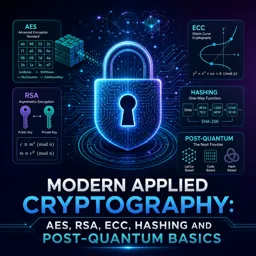
Free Course Image Modern Applied Cryptography: AES, RSA, ECC, Hashing and Post-Quantum Basics

Free online courseModern Applied Cryptography: AES, RSA, ECC, Hashing and Post-Quantum Basics

Duration of the online course: 37 hours and 34 minutes

New

Learn modern cryptography skills in this free online course: AES, RSA, ECC, hashing, PKI and post‑quantum basics, with practice questions and a certificate option.

In this free course, learn about

  • Core crypto goals and terminology: confidentiality, integrity, authenticity, non-repudiation, threat models
  • Modular arithmetic basics: inverses exist iff gcd(a,m)=1; foundations for many crypto algorithms
  • Stream ciphers & OTP: XOR encryption/decryption symmetry; randomness requirements; LFSR concepts
  • Attacking LFSR stream ciphers: recover taps via solving linear equations / Berlekamp–Massey
  • DES internals: Feistel rounds, key schedule; decryption uses same structure with reversed subkeys
  • Finite fields for AES: exist for p^n elements; GF(2^8) arithmetic for AES operations
  • AES structure: SubBytes/ShiftRows/MixColumns/AddRoundKey; last round omits MixColumns
  • Block cipher modes: ECB leaks patterns; CBC/CTR basics and why modes matter for multi-block data
  • Brute force & meet-in-the-middle: double encryption security drops to ~2^57 work and ~2^56 memory
  • Number theory for PKC: Euclid algorithm, Euler phi; RSA needs gcd(e,phi(n))=1 for d to exist
  • Diffie–Hellman & discrete log: MITM on unauthenticated DH; ECC uses smaller keys for same security
  • ElGamal encryption/signatures: fresh random k each message; ECDH shared secret from commutativity
  • Hash functions & signatures: prehash for efficiency/format; SHA-1/SHA-3; collision/preimage notions
  • Post-quantum basics: Grover impacts AES modestly vs Shor breaks RSA/ECC; Merkle auth paths & HMAC

Course Description

Build practical, up-to-date cryptography intuition by learning how modern security systems protect data in apps, networks, and cloud services. This free online course connects the math you need with the real mechanisms used in production: symmetric encryption for fast bulk protection, public-key cryptography for key exchange and authentication, and hashing for integrity and secure signatures.

You will start with core concepts that explain what cryptography can and cannot guarantee, then develop the foundations that make today’s algorithms work, such as modular arithmetic, number theory, and efficient exponentiation. From there, you will progress through classic and modern constructions, gaining a clear understanding of why certain designs are considered secure, how attacks influence parameter choices, and how implementation details can affect outcomes.

The course explains how stream ciphers generate keystream, what can go wrong when randomness is weak, and why reusing secrets can break confidentiality. You will also see how block ciphers evolved from DES to AES, and how modes of operation change security in real deployments, including why some modes leak patterns and why others require careful handling of nonces or IVs.

On the public-key side, you will learn the logic behind RSA and Diffie–Hellman, then move to elliptic-curve cryptography to understand why it delivers strong security with much smaller key sizes. You will also connect encryption and key exchange to digital signatures, clarifying the difference between authenticity, integrity, and non-repudiation, and why MACs and signatures serve different security goals.

Hash functions and modern standards such as SHA-1 and SHA-3 are covered with a focus on practical use: pre-hashing long messages before signing, preventing forgery, and reasoning about collision resistance. Finally, you will get a grounded introduction to post-quantum basics, learning how large-scale quantum computers change the threat model for RSA and ECC compared to symmetric cryptography, and how hash-based signatures like Merkle schemes fit into a future-ready security toolbox.

Throughout, short questions help you test understanding of the key ideas and typical pitfalls, making the course a strong fit for developers, security learners, and anyone preparing for work involving encryption, secure protocols, certificates, or PKI. By the end, you will be able to read and discuss cryptographic designs with confidence, choose safer options in common scenarios, and better understand why modern systems are built the way they are.

Course content

  • Video class: Lecture 1: Introduction to Cryptography by Christof Paar 1h17m
  • Exercise: What is the first topic in the program described?
  • Video class: Lecture 2: Modular Arithmetic and Historical Ciphers by Christof Paar 1h31m
  • Exercise: In modular arithmetic, when does a multiplicative inverse of an element a modulo m exist?
  • Video class: Lecture 3: Stream Ciphers, Random Numbers and the One Time Pad by Christof Paar 1h29m
  • Exercise: In a stream cipher, why can encryption and decryption use the same operation when working modulo 2?
  • Video class: Lecture 4: Stream Ciphers and Linear Feedback Shift Registers by Christof Paar 1h29m
  • Exercise: In an attack against a single LFSR-based stream cipher, what method can be used to recover the unknown feedback taps (the P-values) once enough keystream bits are known?
  • Video class: Lecture 5: Data Encryption Standard (DES): Encryption by Christof Paar 1h33m
  • Exercise: In one DES Feistel round, which half of the 64-bit state is actually encrypted (modified) by the XOR with the round function output?
  • Video class: Lecture 6: Data Encryption Standard (DES): Key Schedule and Decryption by Christof Paar 1h07m
  • Exercise: In DES decryption, what change allows the same round structure to be used as in encryption?
  • Video class: Lecture 7: Introduction to Galois Fields for the AES by Christof Paar 1h30m
  • Exercise: Which condition must be true for a finite field to exist with a given number of elements?
  • Video class: Lecture 8: Advanced Encryption Standard (AES) by Christof Paar 1h33m
  • Exercise: In AES, which transformation is omitted in the last encryption round compared to the first rounds?
  • Video class: Lecture 9: Modes of Operation for Block Ciphers by Christof Paar 1h25m
  • Exercise: Why is ECB mode considered insecure for encrypting multi-block messages in practice?
  • Video class: Lecture 10: Multiple Encryption and Brute-Force Attacks by Christof Paar 1h27m
  • Exercise: What is the main consequence of a meet-in-the-middle attack on double encryption with two 56-bit keys (e.g., DES)?
  • Video class: Lecture 11: Number Theory for PKC: Euclidean Algorithm, Euler's Phi Function 1h31m
  • Video class: Lecture 12: The RSA Cryptosystem and Efficient Exponentiation by Christof Paar 1h28m
  • Exercise: In RSA key generation, which condition must the public exponent e satisfy to ensure the private exponent d exists?
  • Video class: Lecture 13: Diffie-Hellman Key Exchange and the Discrete Log Problem by Christof Paar 1h20m
  • Video class: Lecture 14: The Generalized Discrete Log Problem and the Security of Diffie-Hellman by Christof Paar 1h28m
  • Exercise: Why do elliptic-curve discrete-log systems typically use much smaller key sizes (e.g., ~160–256 bits) than classic Diffie–Hellman over Zp* (e.g., ~1024–2048 bits)?
  • Video class: Lecture 15: Elgamal Encryption Scheme by Christof Paar 1h17m
  • Exercise: In ElGamal encryption, what must change for each new plaintext to ensure probabilistic encryption?
  • Video class: Lecture 16: Introduction to Elliptic Curves by Christof Paar 1h20m
  • Exercise: Which algorithm is a symmetric-key block cipher commonly used for fast bulk data encryption?
  • Video class: Lecture 17: Elliptic Curve Cryptography (ECC) by Christof Paar 1h26m
  • Exercise: In elliptic-curve Diffie–Hellman (ECDH), why do Alice and Bob end up with the same shared secret?
  • Video class: Lecture 18: Digital Signatures and Security Services by Christof Paar 1h17m
  • Exercise: Which security service cannot be achieved with symmetric-key signing (MACs) because both parties share the same key?
  • Video class: Lecture 19: Elgamal Digital Signature by Christof Paar 1h22m
  • Exercise: In the existential forgery attack on plain RSA signatures, how can an attacker create a pair (X, S) that verifies under the public key (n, e)?
  • Video class: Lecture 20: Hash Functions by Christof Paar 1h05m
  • Exercise: Why are hash functions used before signing long messages with RSA in practice?
  • Video class: Lecture 21: SHA-1 Hash Function by Christof Paar 1h18m
  • Video class: Lecture 22: SHA-3 Hash Function by Christof Paar 1h38m
  • Exercise: Which description best matches a cryptographic hash function?
  • Video class: Lecture 23: Introduction to Hash-based Post-quantum Cryptography (PQC) by Christof Paar 1h40m
  • Exercise: What is the key difference in how large-scale quantum computers affect AES versus RSA/ECC?
  • Video class: Lecture 24: PQC Signatures with the Merkle Signature Scheme (MSS) by Christof Paar 1h32m
  • Exercise: In a Merkle Signature Scheme (MSS), what is the purpose of the authentication path sent with a signature?
  • Video class: Lecture 25: MAC (Message Authentication Codes) and HMAC by Christof Paar 1h15m
  • Exercise: Which security service is NOT provided by message authentication codes (MACs) due to their symmetric-key nature?
  • Video class: Lecture 26: Symmetric Key Establishment and Kerberos by Christof Paar 54m
  • Video class: Lecture 27: Man-in-the-middle Attack, Certificates and PKI by Christof Paar 1h10m
  • Exercise: Why does a man-in-the-middle (MITM) attack succeed against basic Diffie–Hellman key exchange on an unsecured channel?

This free course includes:

37 hours and 34 minutes of online video course

Digital certificate of course completion (Free)

Exercises to train your knowledge

100% free, from content to certificate

Ready to get started?Download the app and get started today.

Install the app now

to access the course
Icon representing technology and business courses

Over 5,000 free courses

Programming, English, Digital Marketing and much more! Learn whatever you want, for free.

Calendar icon with target representing study planning

Study plan with AI

Our app's Artificial Intelligence can create a study schedule for the course you choose.

Professional icon representing career and business

From zero to professional success

Improve your resume with our free Certificate and then use our Artificial Intelligence to find your dream job.

You can also use the QR Code or the links below.

QR Code - Download Cursa - Online Courses

More free courses at Cyber Security

Free Ebook + Audiobooks! Learn by listening or reading!

Download the App now to have access to + 5000 free courses, exercises, certificates and lots of content without paying anything!

  • 100% free online courses from start to finish

    Thousands of online courses in video, ebooks and audiobooks.

  • More than 60 thousand free exercises

    To test your knowledge during online courses

  • Valid free Digital Certificate with QR Code

    Generated directly from your cell phone's photo gallery and sent to your email

Cursa app on the ebook screen, the video course screen and the course exercises screen, plus the course completion certificate