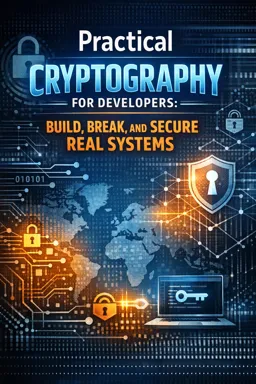
CBC with a fresh random IV hides repeated plaintext patterns, while ECB encrypts identical blocks identically and can reveal image structure.

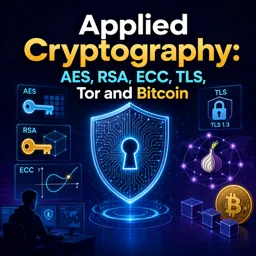
Duration of the online course: 13 hours and 20 minutes
New
Build practical crypto skills in this free online course: master AES, RSA, ECC, TLS, Tor and Bitcoin basics, with exercises and a shareable certificate.
Modern security depends on cryptography that works reliably in real systems, not just on paper. This course helps you build applied, hands-on intuition for the algorithms and protocols that protect data every day, from messaging apps and web browsers to smart cards and cryptocurrencies. You will learn how real implementations make design trade-offs, where common failures come from, and how to reason about security properties in ways that map directly to engineering decisions.
Starting from randomness and the role of PRNGs, you will see why key reuse can instantly undermine otherwise strong schemes and how stream encryption goes wrong in practice. You will also gain the ability to recognize the importance of data encoding in security, understanding how standards such as ASN.1 and DER influence interoperability and prevent ambiguous interpretations that attackers can exploit. As you work through hashes and message authentication, you will develop a clear mental model of integrity, authenticity, and the guarantees that HMAC provides in real-world settings.
The course then connects theory to widely deployed primitives. You will strengthen your grasp of symmetric encryption with AES and learn why modes of operation matter, especially when encrypting larger or structured data. On the public-key side, you will understand how RSA and elliptic-curve cryptography enable secure key exchange and digital signatures, and why details like nonce generation in ECDSA can be the difference between strong security and catastrophic private-key leakage. You will also learn how trust is managed at scale through X.509 certificates and PKI, and how revocation mechanisms such as CRLs and OCSP fit into the lifecycle of real certificates.
Because applied cryptography lives inside systems, you will explore how signatures are packaged and time-proven in practice, as well as how smart cards protect private keys while still facing risks when endpoints are compromised. You will then dive into TLS, moving from the basic handshake to the changes that enable Perfect Forward Secrecy, gaining clarity on what the browser-server dance is actually achieving. Finally, you will see how Tor’s onion routing design limits what any single relay can learn, and how Bitcoin combines cryptographic primitives and proof-of-work to maintain a decentralized ledger. Throughout, short exercises reinforce your understanding and help you learn to spot insecure assumptions before they ship.

13 hours and 20 minutes of online video course

Digital certificate of course completion (Free)

Exercises to train your knowledge

100% free, from content to certificate
Why is AES-CBC with a random IV safer than ECB mode for encrypting images?
CBC with a fresh random IV hides repeated plaintext patterns, while ECB encrypts identical blocks identically and can reveal image structure.
How does ephemeral Diffie-Hellman in TLS provide Perfect Forward Secrecy?
It creates temporary session keys for each connection, so stealing the server’s long-term private key later does not decrypt previously recorded sessions.
Why does Tor use multiple relays for onion routing?
Each relay knows only its adjacent hop: the entry relay sees the client IP, while the exit relay sees the destination, but no single relay sees both.
Ready to get started?Download the app and get started today.
Install the app now
to access the course
Over 5,000 free courses
Programming, English, Digital Marketing and much more! Learn whatever you want, for free.

Study plan with AI
Our app's Artificial Intelligence can create a study schedule for the course you choose.

From zero to professional success
Improve your resume with our free Certificate and then use our Artificial Intelligence to find your dream job.
You can also use the QR Code or the links below.



Free CourseFoundations of Cryptography: Symmetric, Public-Key, Hashing and Signatures
5

(1)

32h51m

57 exercises
Free CourseInformation Security Management Fundamentals
5
(8)
2h55m
15 exercises
Free CourseAdvanced Topics in Cryptography
5
(2)
22h34m
9 exercises
Free CourseComputer systems security
4.8
(151)
29h44m
20 exercises
Free CourseIT Security
4.8
(19)
15h04m
18 exercises
Free CourseInformation security lessons
4.8
(49)
7h15m
11 exercises
Free CourseCyber security
4.8
(376)
2h07m
24 exercises
Free CourseCyber Security Masterclass
4.6

(22)
1h36m
6 exercises
Free CourseIntroduction to Cybersecurity
4.6
(18)
7h43m
6 exercises
Free CourseCompTIA Security course
4.4
(5)
26h11m
41 exercises
Carry knowledge in your pocket.
Download the Cursa app.
There are hundreds of free courses available, with a free certificate of completion that is saved in your mobile image gallery.
Download the app to access the Course Completion Certificate for Free.


+ 10 million
students

Free and Valid
Certificate

60 thousand free
exercises

4.8/5 rating in
app stores

Free courses in
video and ebooks