
Exercises
Explore the fundamentals of robot kinematics with this quiz on how robotic arms move, position, and orient themselves in space. Test your understanding of degrees of freedom, common manipulator joint types, homogeneous transformation matrices, the Denavit-Hartenberg convention, and end effectors. You will also review the distinction between forward and inverse kinematics and how inverse kinematics helps determine the joint values needed to place a robot’s tool at a desired location and orientation. Ideal for robotics students, engineers, and anyone building a foundation in robot manipulation.
Answer the questions below and check the explanation for each answer.
0/7 answered
Auto audio on: the next questions will be read aloud when you click Continue.
The primary focus of robot kinematics is the study of robot motion without regard to the forces that cause it. It examines how the positions, velocities, and accelerations of the parts of a robot relate to one another and to the overall motion of the robot, dealing purely with the geometry of motion.
In the context of robot arms, degrees of freedom refer to the number of independent parameters that define the robot's configuration. This term describes how many independent movements or motions a robot arm can execute, such as rotations and translations. Each joint or axis of rotation adds a degree of freedom, allowing the arm to access different positions and orientations in its working space.
A homogeneous transformation matrix is utilized in robot kinematics to transform coordinates from one frame of reference to another. It combines rotation and translation in a single matrix, allowing for transformations between different coordinate systems, which is essential for controlling and simulating the movements of robots.
Prismatic joints and Rotary joints are common types of joints found in robot manipulators. A prismatic joint allows linear motion, whereas a rotary joint allows rotational motion. Gyroscope joints are not typically used as a type of joint in robot manipulators; gyroscopes are used to measure or maintain orientation, not as joints.
The Denavit-Hartenberg convention is used for systematically describing the joint kinematics of robotic manipulators. It provides a standardized way to assign reference frames to the links of a robot arm and defines the position and orientation of these frames using four parameters, making it easier to derive the transformation matrices that describe the robot's motion.
An end effector is a device or tool that is connected to the end of a robotic arm, designed to interact with the environment. It can be a gripper, welding torch, or any other tool, depending on the task the robot is programmed to perform.
Inverse kinematics in robotics refers to calculating the necessary joint angles for a desired position of the robot's end effector. It is the process of determining how a robot must move its joints to place the end effector at a desired location and orientation in space, ensuring precise movements and task execution.

Free CourseArduino tutorial for beginners
5

(2)

12h28m

24 exercises

Free CourseArduino Masterclass in 90 mins
5
(3)
1h25m
6 exercises

Free CourseAutonomous Drone Systems, Swarm Intelligence and Control Engineering
5
(1)
27h57m
49 exercises
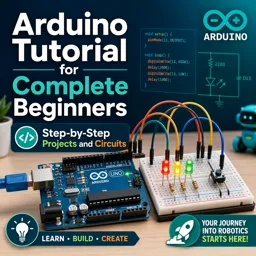
Free CourseArduino Tutorial for Complete Beginners: Step-by-Step Projects and Circuits
5
(1)
2h11m
15 exercises

Free CourseArduino for beginners
4.8

(8)
4h04m
9 exercises
Free CourseArduino complete tutorials
3.9
(9)
32h21m
35 exercises
Free CourseAdvanced Arduino Programming
1
(1)
5h41m
36 exercises
Free CourseArduino for Beginners
New
9h53m
39 exercises
Thousands of online courses in video, ebooks and audiobooks.
To test your knowledge during online courses
Generated directly from your cell phone's photo gallery and sent to your email

Download our app via QR Code or the links below:.



Carry knowledge in your pocket.
Download the Cursa app.
There are hundreds of free courses available, with a free certificate of completion that is saved in your mobile image gallery.
Download the app to access the Course Completion Certificate for Free.


+ 10 million
students

Free and Valid
Certificate

60 thousand free
exercises

4.8/5 rating in
app stores

Free courses in
video and ebooks