
Exercises
Explore the principles used to design, evaluate, and interpret psychological tests. This quiz covers standardized administration, reliability, validity, norm-referenced scores, measurement error, screening accuracy, item analysis, factor loadings, and measurement invariance. Questions range from foundational definitions to practical interpretation of distributions, scatterplots, diagnostic tables, and assessment data.
Answer the questions below and check the explanation for each answer.
0/18 answered
Auto audio on: the next questions will be read aloud when you click Continue.
Standardization reduces irrelevant variation by keeping instructions, timing, materials, and scoring procedures consistent. This makes score comparisons more meaningful.
Reliability concerns the consistency or precision of measurement. A reliable test minimizes random measurement error, although it is not necessarily valid.
Content validity concerns whether test items adequately represent the full domain the assessment is intended to measure.
Test-retest reliability evaluates score stability across two administrations. It is most appropriate when the measured trait is expected to remain relatively stable.
Cronbach's alpha estimates how consistently a group of items measures a common construct. Cohen's kappa is instead commonly used for agreement between categorical ratings.
The strong association with a related measure supports convergent validity. The weak association with an unrelated characteristic supports discriminant validity.
Norm-referenced interpretation compares an individual's performance with a relevant reference group. Criterion-referenced interpretation compares performance with a defined standard.
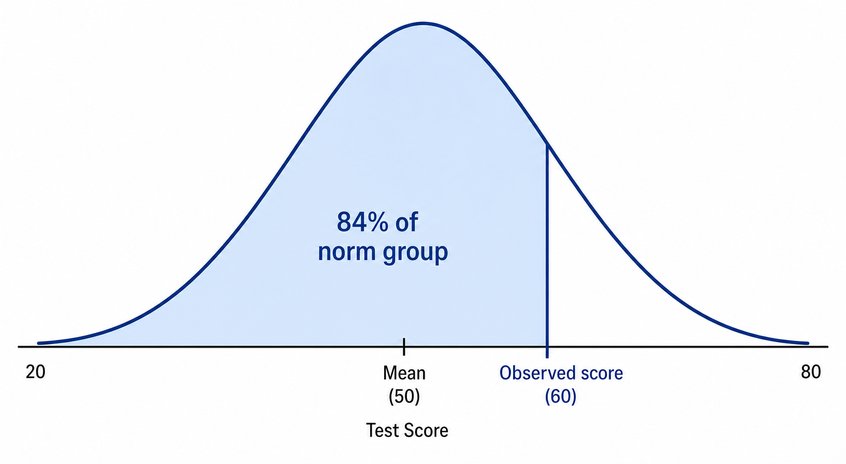
A percentile rank indicates relative standing in a norm group. The 84th percentile means approximately 84% of that group obtained scores at or below the examinee's score.
SEM = 15 × √(1 − 0.64) = 15 × √0.36 = 15 × 0.60 = 9.0. The SEM estimates the typical effect of measurement error on an observed score.
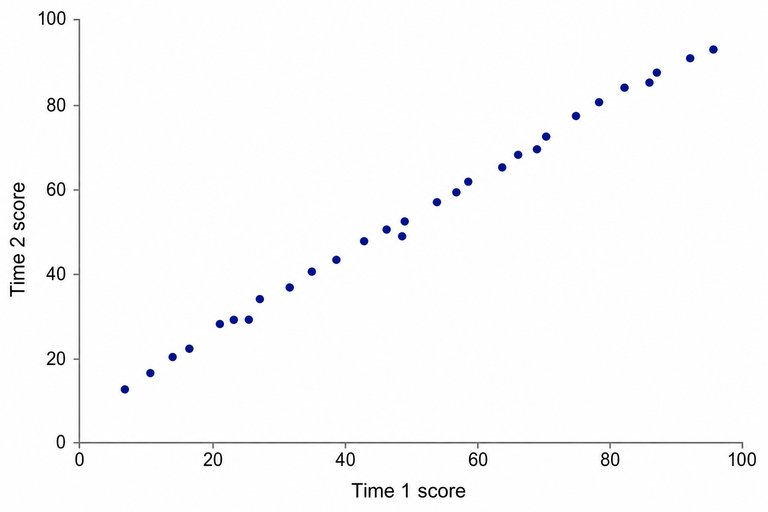
A tight positive relationship between Time 1 and Time 2 scores indicates that participants maintain a similar relative standing, supporting high test-retest reliability.
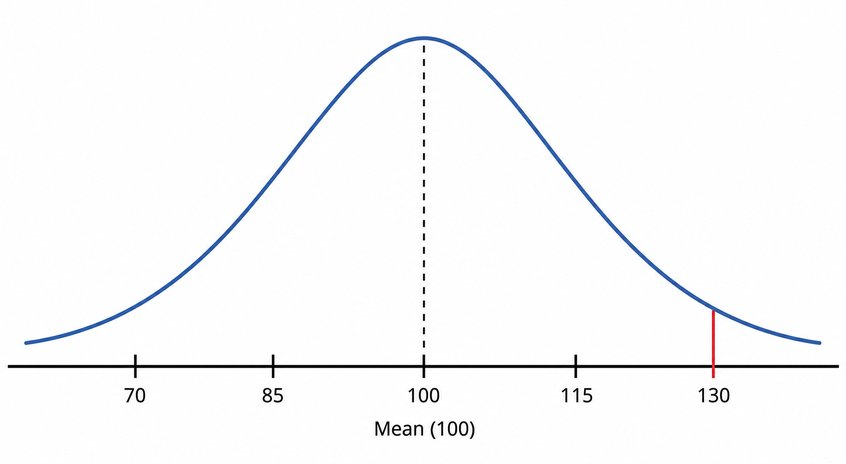
The difference is 130 − 100 = 30 points. Because 30 ÷ 15 = 2, the score is two standard deviations above the mean.
Predictive validity examines whether test scores forecast a criterion measured in the future. Concurrent validity uses a criterion measured at approximately the same time.
Sensitivity is the true-positive rate: the proportion of people who have the condition and are correctly identified by the screening test.
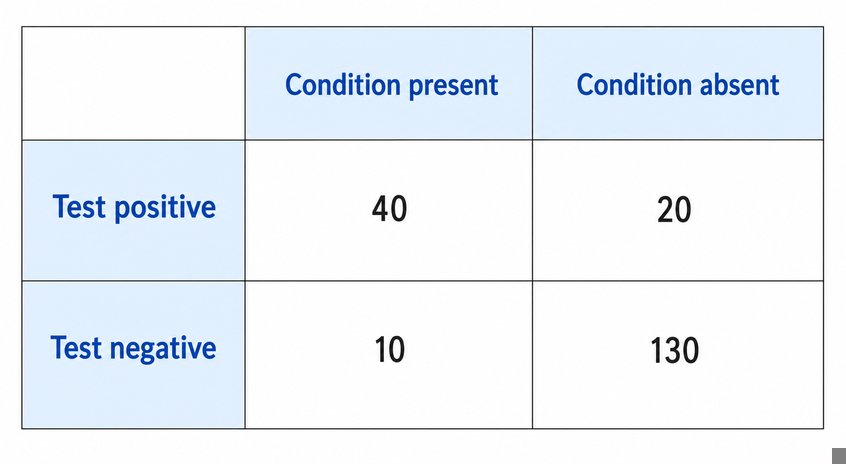
Positive predictive value is TP ÷ (TP + FP). From the table, this is 40 ÷ (40 + 20) = 40 ÷ 60, or approximately 66.7%.
The classical item difficulty index is the proportion answering correctly. A higher p value therefore indicates an easier item, despite the term difficulty.
The item has positive discrimination because high-scoring examinees answer it correctly much more often than low-scoring examinees. It therefore helps distinguish stronger from weaker performers.
Item B has the smallest factor loading, 0.18. A lower absolute loading indicates a weaker relationship between the observed item and the latent factor.
Measurement invariance provides evidence that a scale represents the same construct in comparable ways across groups. Without it, apparent group differences may reflect measurement artifacts.

Free CourseIntro to Psychology
5

(7)

3h28m

18 exercises

Free CourseIntroduction to Psychology Lecture Videos
5
(2)
16h21m
34 exercises

Free CourseThe Future of Neuromarketing
5
(1)
1h01m
6 exercises

Free CourseIntroduction to Psychology
4.9
(101)
18h43m
30 exercises

Free CourseIntroduction to Psychology
4.9
(7)
18h43m
20 exercises

Free CourseChild and Adolescent Mental Health
4.8
(26)
46m
21 exercises
Free CourseCognitive Psychology
4.8
(5)
21h18m
38 exercises

Free CoursePsychology Class
4.8
(126)
12h34m
22 exercises
Thousands of online courses in video, ebooks and audiobooks.
To test your knowledge during online courses
Generated directly from your cell phone's photo gallery and sent to your email

Download our app via QR Code or the links below:.



Carry knowledge in your pocket.
Download the Cursa app.
There are hundreds of free courses available, with a free certificate of completion that is saved in your mobile image gallery.
Download the app to access the Course Completion Certificate for Free.


+ 10 million
students

Free and Valid
Certificate

60 thousand free
exercises

4.8/5 rating in
app stores

Free courses in
video and ebooks