
Exercises
Assess your practical knowledge of relational database work in Microsoft Access. This quiz covers primary and foreign keys, table relationships, referential integrity, normalization, joins, criteria, parameter queries, totals, calculated fields, indexing, and cascade options. Questions range from foundational concepts to realistic design and troubleshooting scenarios.
Answer the questions below and check the explanation for each answer.
0/14 answered
Auto audio on: the next questions will be read aloud when you click Continue.
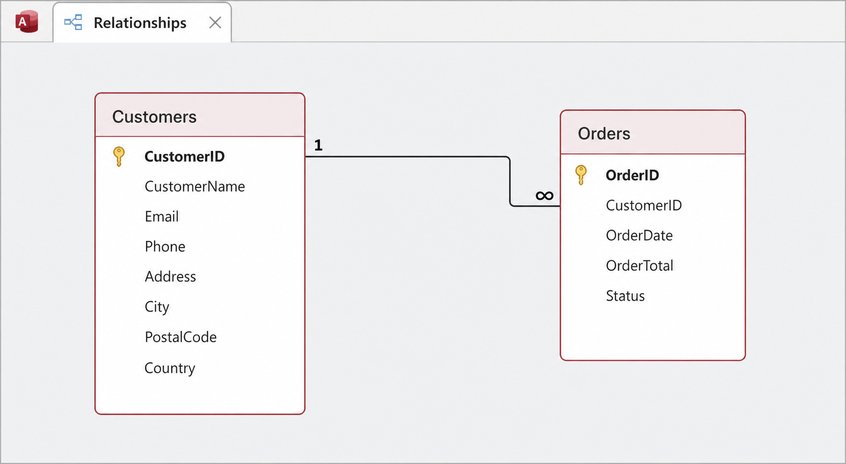
The 1 and infinity symbols indicate a one-to-many relationship. A customer may have multiple orders, while each order refers to one customer.
A primary key must uniquely and reliably identify each record. An AutoNumber CustomerID supplies a distinct value even when customers share names or locations.
A foreign key stores a value that refers to a primary key in another table, connecting each order to its customer.
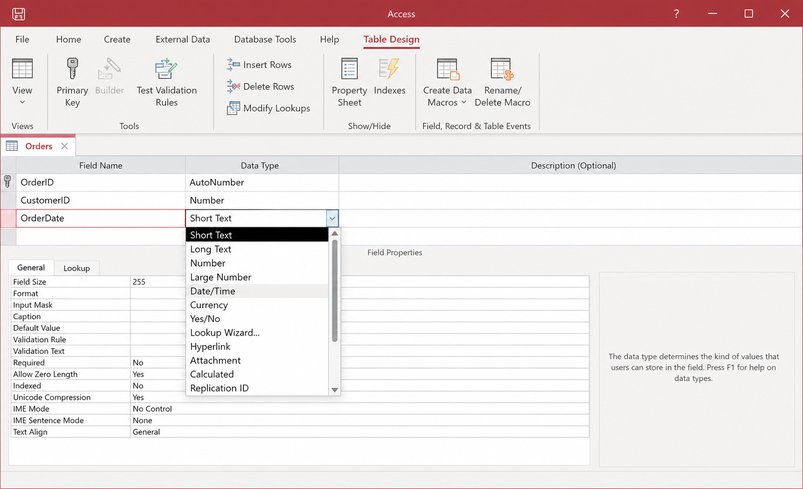
The Date/Time type stores valid temporal values and supports date arithmetic, sorting, validation, and criteria such as date ranges.
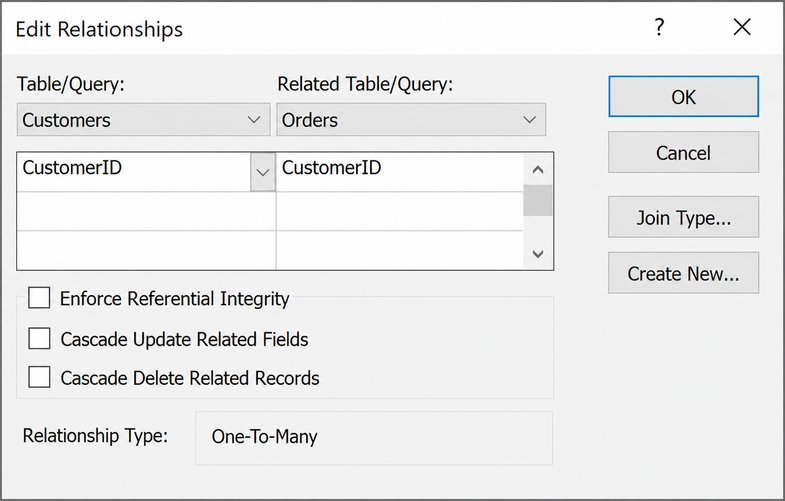
Enforce Referential Integrity prevents invalid foreign-key values and helps ensure that every related order refers to an existing customer.
An AutoNumber primary key normally corresponds to a Number foreign key whose Field Size is Long Integer. The foreign key must permit repeated customer IDs across orders.
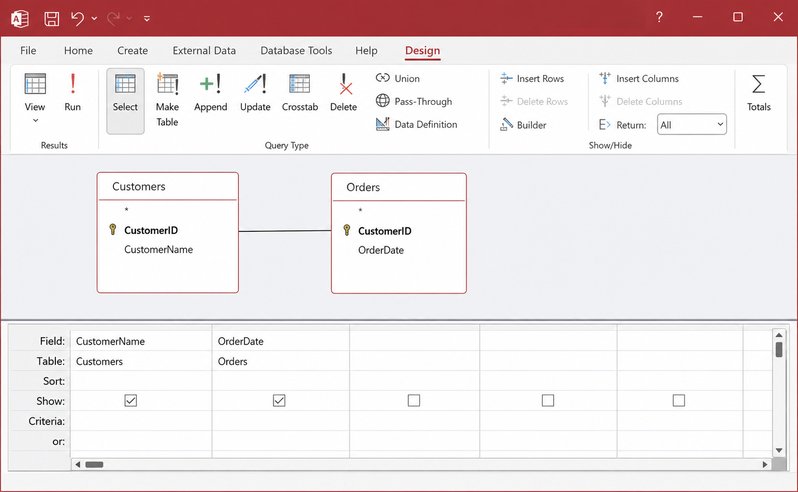
An inner join returns rows only when the joined fields contain matching values in both tables.
In standard Access wildcard syntax, the asterisk represents any sequence of characters. Therefore, Like "A*" matches values that start with A.
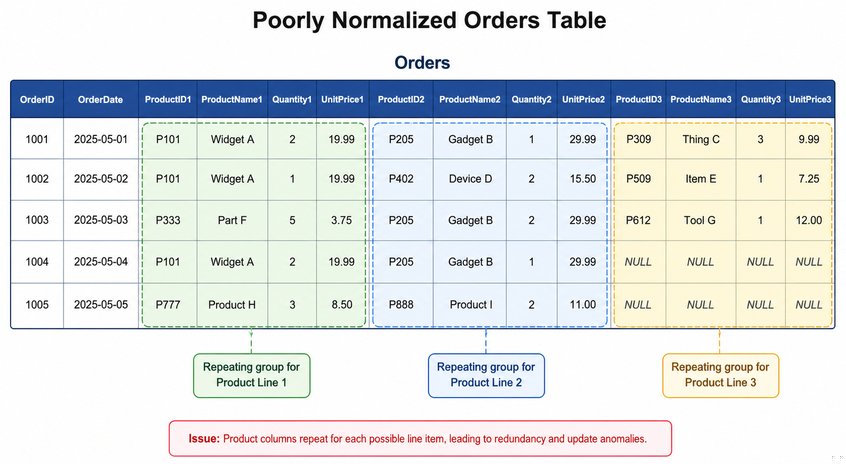
An OrderDetails table removes repeating product groups. Each row can store one OrderID, one ProductID, quantity, and applicable price, producing a scalable normalized design.
Text inside square brackets that does not match a field name is treated as a parameter prompt. The comparison operator restricts results to dates on or after the entered value.
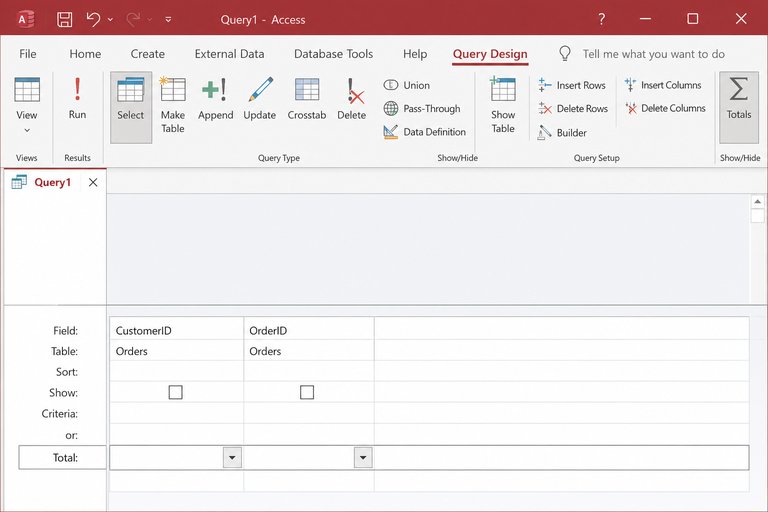
CustomerID must use Group By to create one group per customer. Applying Count to OrderID then counts the orders in each group.
Access calculated fields use the format Alias: Expression. Multiplication uses an asterisk, so the expression calculates quantity times unit price.
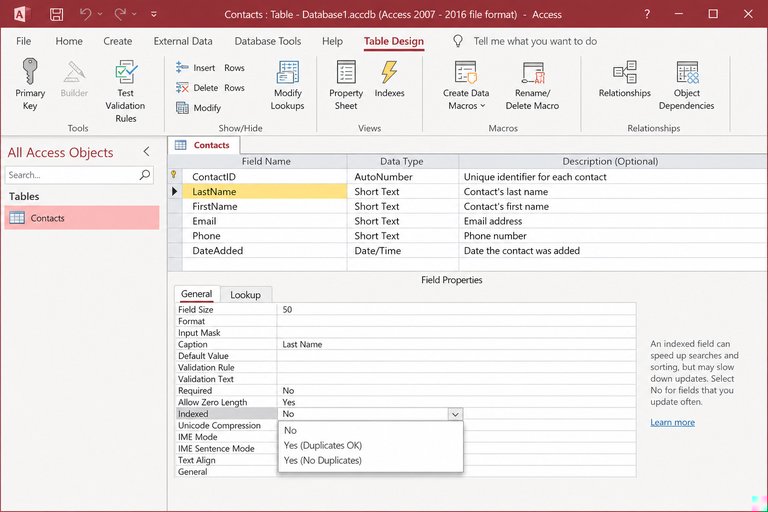
A non-unique index can improve searches and sorting while still allowing multiple customers to share the same last name.
Deleting the customer would leave related orders without a valid parent record. Referential integrity blocks that deletion unless the related records are handled or cascade deletion is enabled.

Free CourseExcel for Beginners: 2-Hour Crash Course in Formulas, Charts and Pivot Tables
5

(10)

2h09m

30 exercises

Free CourseExcel Intermediate to Advanced: Formulas, PivotTables, Power Query, Dashboards and VBA
5
(4)
18h53m
28 exercises

Free CourseMS Excel Beginner to Advanced: Formulas, Charts, Pivot Tables and Shortcuts
5
(4)
10h08m
26 exercises

Free CourseMicrosoft 365 Fundamentals MS-900 Certification Prep Course
5
(3)
3h16m
14 exercises

Free CourseGoogle data studio
5
(1)
3h42m
11 exercises

Free CourseMS Word Complete Course: Basics to Advanced Features
5
(1)
2h47m
20 exercises

Free CourseExcel Basics: Formulas, Functions, PivotTables and Power Query for Work
5
(3)
12h14m
22 exercises

Free CourseBusiness Applications in Microsoft Excel
5
(1)
46m
7 exercises
Thousands of online courses in video, ebooks and audiobooks.
To test your knowledge during online courses
Generated directly from your cell phone's photo gallery and sent to your email

Download our app via QR Code or the links below:.



Carry knowledge in your pocket.
Download the Cursa app.
There are hundreds of free courses available, with a free certificate of completion that is saved in your mobile image gallery.
Download the app to access the Course Completion Certificate for Free.


+ 10 million
students

Free and Valid
Certificate

60 thousand free
exercises

4.8/5 rating in
app stores

Free courses in
video and ebooks