
Exercises
Develop your ability to construct convincing three-dimensional space through linear perspective. This quiz covers one-point, two-point, and three-point perspective, along with horizon lines, orthogonals, picture planes, station points, perspective grids, measuring points, foreshortening, circles, inclined lines, and common construction errors. The questions combine essential principles with practical visual analysis useful for drawing interiors, objects, streets, and architecture.
Answer the questions below and check the explanation for each answer.
0/20 answered
Auto audio on: the next questions will be read aloud when you click Continue.
The horizon line represents the viewer's eye level. It can exist even when no natural horizon is visible, such as inside a room.
Orthogonals are projected lines that represent parallel edges receding in depth. In a one-point construction, they converge at the main vanishing point.
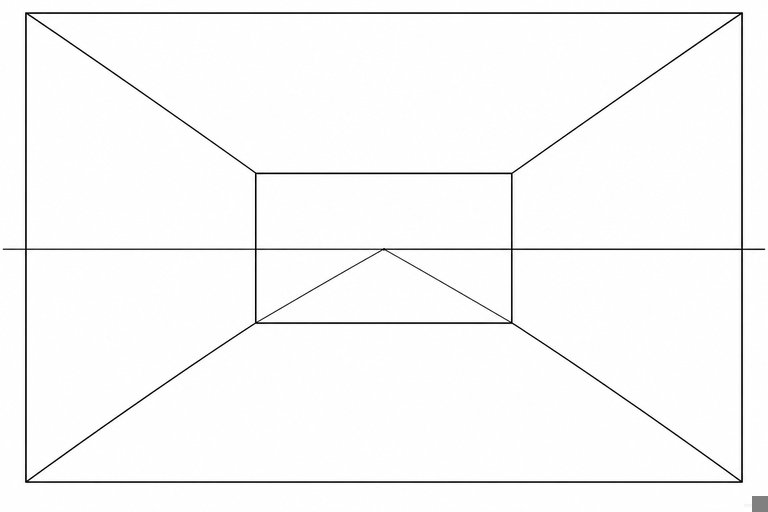
The room uses one-point perspective: its frontal surfaces face the viewer while the depth edges converge toward one central vanishing point.
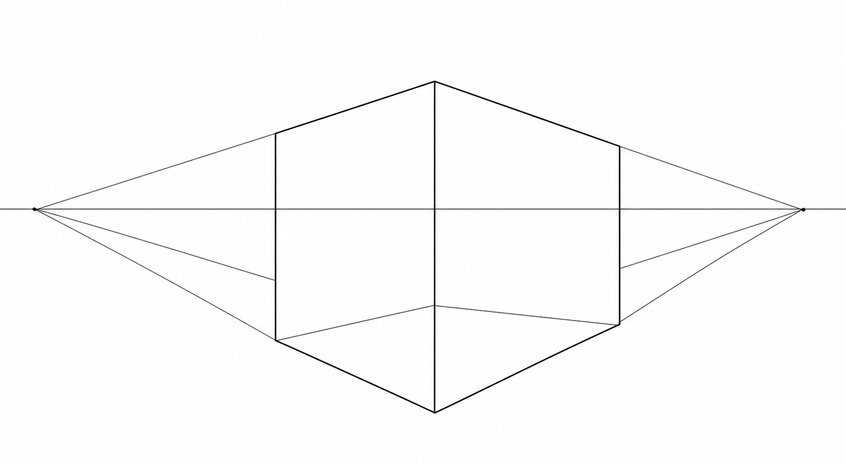
Standard two-point perspective uses two vanishing points for horizontal edge directions. Vertical edges remain parallel; their convergence is introduced only in three-point perspective.
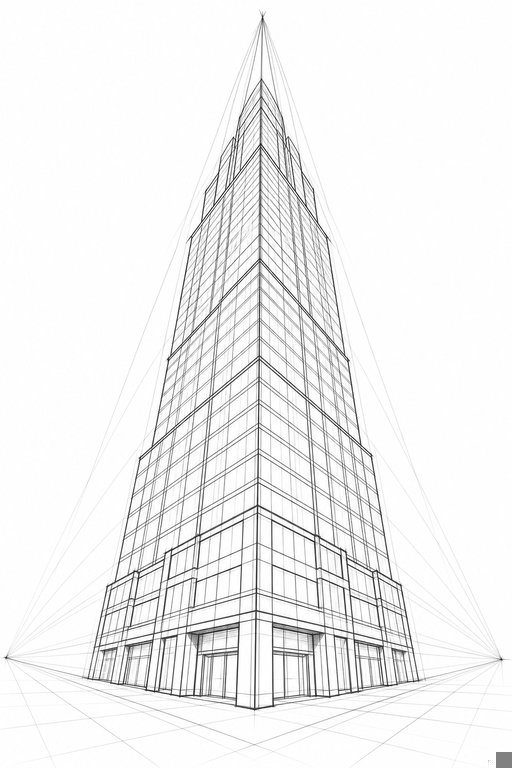
Three-point perspective adds a third vanishing point for vertical edges. This creates the strong upward or downward convergence often seen in views of tall buildings.
The picture plane is an imaginary flat surface between the viewer and the scene. The perspective image is formed where sight lines intersect this plane.
The station point records the viewer's position relative to the picture plane. Changing it alters the viewing angle and the apparent perspective of the scene.
A plane parallel to the picture plane appears without convergence within that plane. Its proportions are preserved, although its overall projected size depends on its depth.

Parallel lines sharing the same spatial direction project toward a common vanishing point. Extending visible receding edges is a practical way to locate it.
Because the horizon represents eye level, raising the viewpoint raises the horizon in the framed image. More of the upper surfaces of objects below the viewer may then become visible.
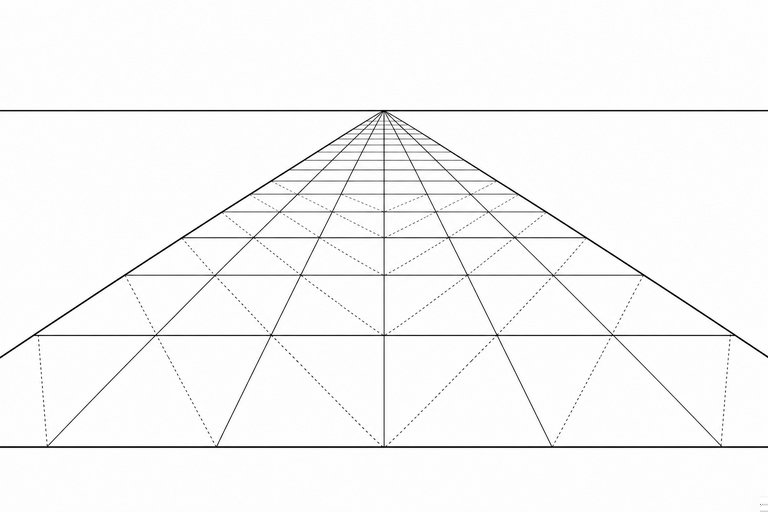
A perspective grid combines orthogonals with diagonal construction to project equal real-world intervals. The visible intervals become progressively smaller with distance.
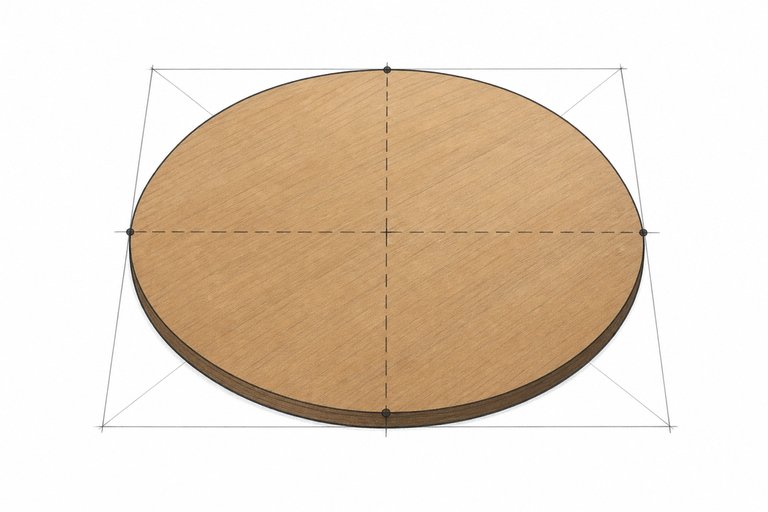
A circle viewed at an oblique angle generally projects as an ellipse. Constructing it inside a perspective square helps control its placement and curvature.
Vanishing points are determined by spatial direction, not by the paper's boundaries. In two-point views, one or both points commonly fall far beyond the drawing.
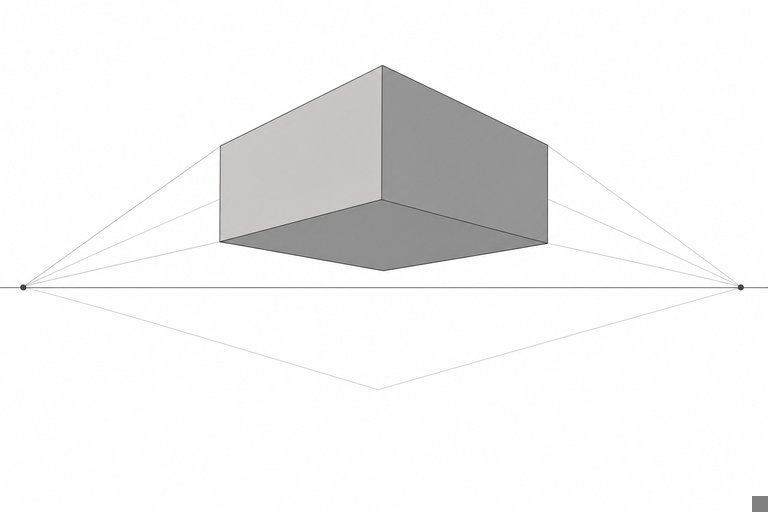
An object above eye level can reveal its underside, while its top is hidden. Objects below the horizon generally reveal their upper surfaces instead.
Foreshortening occurs when a length aligned partly with the viewing direction appears compressed. Correct foreshortening makes forms project convincingly through depth.
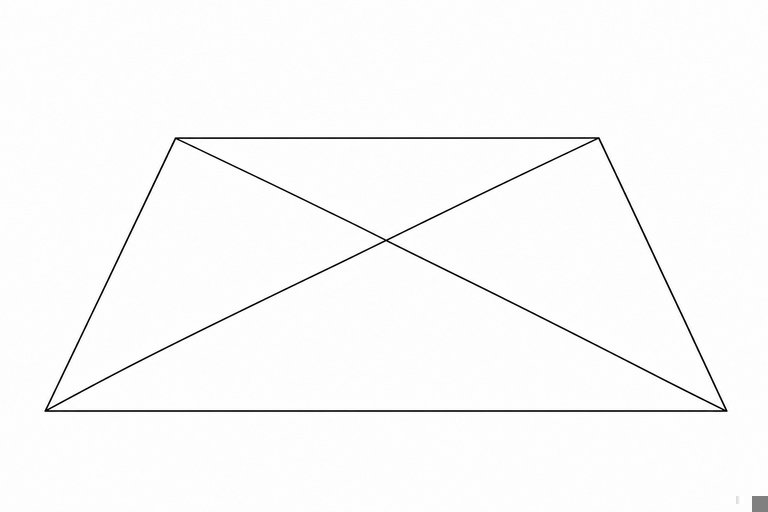
The diagonals of a rectangle cross at its center, and their projected versions retain that intersection relationship. This works even when the plane is strongly foreshortened.
A measuring point allows known or equal dimensions to be projected accurately along receding directions. It is especially useful in architectural and geometric constructions.
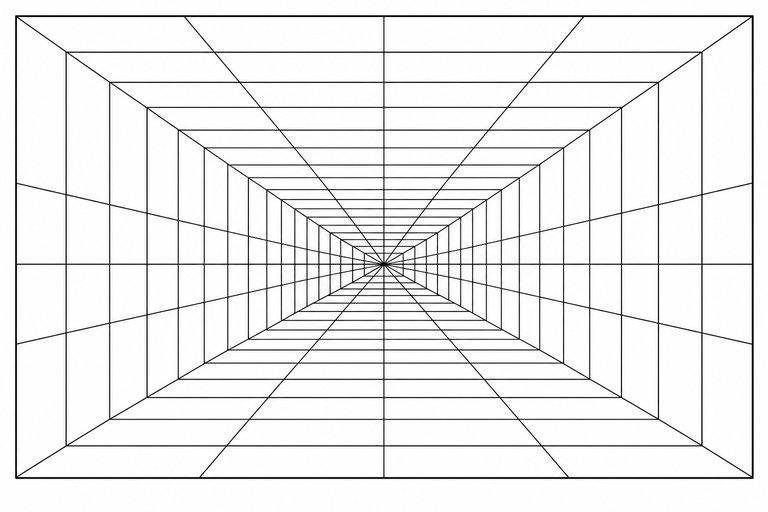
An excessively wide field of view can strongly stretch forms near the image edges. A controlled cone of vision produces a perspective closer to ordinary visual experience.
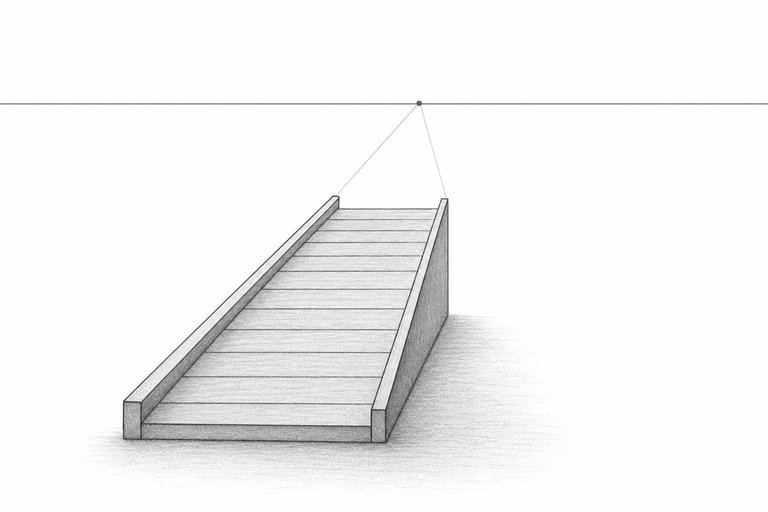
Horizontal directions vanish on the horizon, but ascending parallel lines vanish above it. Descending lines would generally vanish below the horizon.
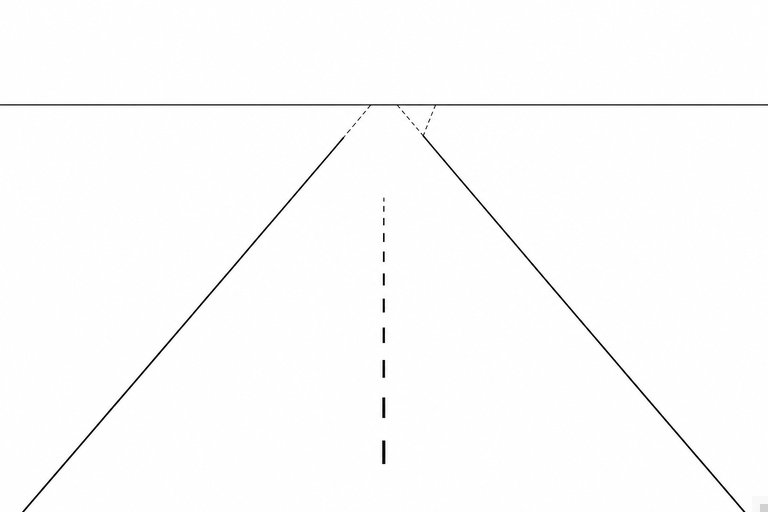
Physically parallel lines with the same direction must share a vanishing point in linear perspective. Different endpoints create an unintended bend or change of direction.

Free CourseHow to Draw on iPad
5

(3)

35m

6 exercises

Free CourseOil Painting techniques
5
(1)
23m
4 exercises
Free CoursePerspective Drawing Fundamentals: One, Two and Three-Point Perspective
5
(2)
2h57m
22 exercises
Free CourseArt Fundamentals
5
(3)
13h16m
29 exercises

Free CourseAcrylic Painting Course
5
(5)
135h55m
51 exercises
Free CoursePainting tutorials and lessons
4.9
(47)
5h26m
19 exercises
Free CourseContemporary Art Trends
4.9
(11)
24h51m
18 exercises
Free CourseBeginners Drawing course
4.9
(7)
72h50m
24 exercises
Thousands of online courses in video, ebooks and audiobooks.
To test your knowledge during online courses
Generated directly from your cell phone's photo gallery and sent to your email

Download our app via QR Code or the links below:.



Carry knowledge in your pocket.
Download the Cursa app.
There are hundreds of free courses available, with a free certificate of completion that is saved in your mobile image gallery.
Download the app to access the Course Completion Certificate for Free.


+ 10 million
students

Free and Valid
Certificate

60 thousand free
exercises

4.8/5 rating in
app stores

Free courses in
video and ebooks