
Exercises
Assess your understanding of essential genetics concepts in this knowledge evaluation quiz. Explore how DNA stores genetic information, how mRNA and tRNA support protein synthesis, and which enzymes enable DNA replication. Test your knowledge of chromatin, alleles, genomes, phenotypes, genetic recombination, and Mendel’s Law of Segregation. Ideal for students and anyone seeking to review the foundations of heredity, molecular biology, and genetic variation.
Answer the questions below and check the explanation for each answer.
0/10 answered
Auto audio on: the next questions will be read aloud when you click Continue.
mRNA, or messenger RNA, serves as the template for protein synthesis by carrying the genetic information copied from DNA in the form of a series of codons to the ribosome.
tRNA, or transfer RNA, is responsible for bringing the appropriate amino acids in sequence to the ribosome during protein synthesis.
DNA polymerase is the enzyme critical for DNA replication, ensuring the formation of a complementary strand by adding nucleotides to the growing DNA chain.
Chromatin is a complex of DNA and protein that helps package the DNA into a compact, dense shape, facilitating the control of DNA replication and gene expression.
Alleles are variations of a gene that arise by mutation and are found at specific locations, or loci, on a chromosome.
Mendel's Law of Segregation posits that during the formation of gametes, the two alleles responsible for a trait separate from each other, ensuring offspring inherit one allele from each parent.
Genetic recombination is the process where genetic material is swapped between homologous chromosomes during meiosis, promoting genetic diversity in offspring.
A phenotype is the set of observable properties or characteristics of an organism, which are the result of interactions between its genotype and the environment.
DNA (deoxyribonucleic acid) is the molecule that carries the genetic instructions used in the growth, development, functioning, and reproduction of all known organisms and many viruses.
The genome of an organism is the complete set of DNA, including all the genes, which contains all the information necessary to build and maintain the organism.
Free CourseBiology Learning
5

(3)

12h23m

43 exercises
Free CourseGenetics Basics
5
(1)
3h26m
21 exercises
Free CourseCell Biology
4.8
(5)
13h41m
18 exercises
Free CourseBiology
4.7

(27)
27h28m
36 exercises
Free CourseIntroduction to Biology
4.7
(63)
1h41m
16 exercises
Free CourseIntroductory Biology
4.7
(6)
27h52m
20 exercises
Free CourseBiology course
4.7
(3)
7h09m
28 exercises
Free CourseBiology foundations
4.5
(6)
1h33m
12 exercises
Thousands of online courses in video, ebooks and audiobooks.
To test your knowledge during online courses
Generated directly from your cell phone's photo gallery and sent to your email

Download our app via QR Code or the links below:.


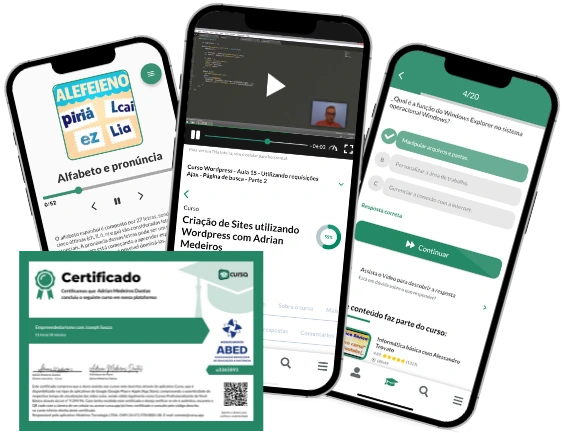
Carry knowledge in your pocket.
Download the Cursa app.
There are hundreds of free courses available, with a free certificate of completion that is saved in your mobile image gallery.
Download the app to access the Course Completion Certificate for Free.


+ 10 million
students

Free and Valid
Certificate

60 thousand free
exercises

4.8/5 rating in
app stores

Free courses in
video and ebooks