
Exercises
Put your React Native Navigation skills to the test. This quiz covers essential React Navigation concepts, including popular navigation libraries, StackNavigator behavior, tab and drawer navigation, screen configuration, header titles, route parameters, and the useNavigation hook. Explore how to move between screens, pass data, reset navigation stacks, control gestures, and understand common iOS transition behavior. Whether you are learning mobile app development or reviewing for a React Native project, these questions help assess your understanding of building clear, user-friendly navigation flows.
Answer the questions below and check the explanation for each answer.
0/10 answered
Auto audio on: the next questions will be read aloud when you click Continue.
React Navigation is a widely used navigation library in React Native applications, offering an easy way to implement navigation and handling of gesture-based actions. It is tailored specifically for React Native, making it suitable for mobile application development.
In React Navigation, the navigate.reset() method is used to reset and replace the current navigation stack. Using this method, you can specify the new state that should be applied to the navigation stack, effectively replacing it with a new set of screens.
In React Navigation, components like StackNavigator and DrawerNavigator are used to define how screens are organized and transitioned between one another. However, Screen is actually used to define an individual screen within those navigators. Therefore, Screen is the component that is used to define a screen, making it the correct answer as the option that does not answer the question.
Option 2 is correct. In many frameworks that handle navigation, such as React Navigation in React Native, data can be passed from one screen to another via the 'params' argument in the navigation.navigate() function. This allows the receiving screen to access the data through the route's parameters.
In React Navigation, navigation.setOptions() can be used to customize or set options, including the header title, for the current screen. Thus, navigation.setOptions({ headerTitle: 'New Title' }) is the valid method to configure the header title.
In React Native, the TabNavigator is typically used to create a tab-based navigation interface. It allows users to switch between different screens or components, each associated with a different tab. While the StackNavigator focuses on stack-based navigation and SwitchNavigator is used for switching based navigation, TabNavigator is specifically designed for tabbed interfaces, making it the right choice in this scenario.
The useNavigation hook's primary use case is to get the navigation prop inside any component. It allows components that are not screen components to access navigation functionalities in a React Navigation setup.
In React Navigation, the navigate prop is used to navigate to a new screen. It allows you to easily transition from one screen to another by specifying the name of the route you want to go to. The route is an object that provides the data for the current screen, while push is a method that adds a new screen to the stack but is not provided as a prop.
In a StackNavigator, the default transition effect when opening a new screen on iOS is Slide from the right. This animation is meant to mimic the native iOS behavior for transitions and provides a smooth user experience consistent with other iOS applications.
To disable the swipe gesture on a DrawerNavigator for a particular screen, you should use the swipeEnabled property. This property allows you to control whether the swipe gesture is enabled or not, providing control over the interaction with the drawer.

Free CourseDart and Flutter Developer course
5

(3)

20h47m

6 exercises

Free CourseFlutter for complete beginners
5
(2)
1h45m
6 exercises

Free CourseLearn Flutter and Dart to create apps
5
(1)
2h48m
25 exercises
Free CourseBuild Your First Universal React Native App
5
(1)
1h23m
9 exercises
Free CourseAndroid for beginners
4.9
(361)
10h47m
52 exercises

Free CourseIonic for Beginners
4.8
(17)
5h04m
22 exercises
Free CourseFlutter tutorial for beginners
4.8
(5)
4h23m
8 exercises

Free CourseMobile App Development
4.7

(7)
21h40m
14 exercises
Thousands of online courses in video, ebooks and audiobooks.
To test your knowledge during online courses
Generated directly from your cell phone's photo gallery and sent to your email

Download our app via QR Code or the links below:.


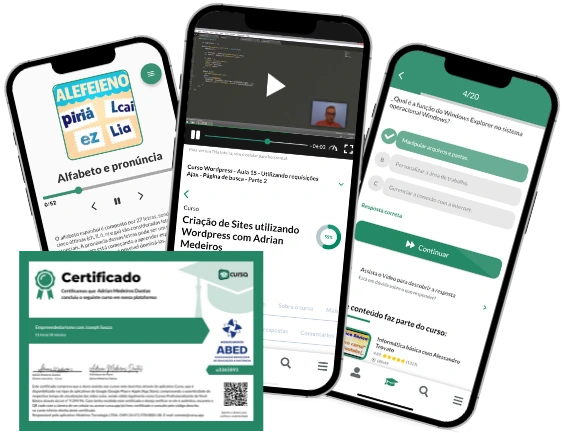
Carry knowledge in your pocket.
Download the Cursa app.
There are hundreds of free courses available, with a free certificate of completion that is saved in your mobile image gallery.
Download the app to access the Course Completion Certificate for Free.


+ 10 million
students

Free and Valid
Certificate

60 thousand free
exercises

4.8/5 rating in
app stores

Free courses in
video and ebooks