
Exercises
Challenge your understanding of Flutter state management with this quiz covering essential concepts and popular approaches. Explore the role of StatefulWidget and setState, Flutter’s default state handling, and the benefits of the Provider package. Test your knowledge of BLoC architecture, Streams, Redux immutability, widget rebuilding, BuildContext usage in Provider.of, and the principle of lifting state up. Ideal for Flutter developers and learners who want to strengthen their skills in building responsive, maintainable mobile apps.
Answer the questions below and check the explanation for each answer.
0/10 answered
Auto audio on: the next questions will be read aloud when you click Continue.
The purpose of a StatefulWidget in Flutter is to create interactive components capable of changing state over time. Unlike a StatelessWidget, which is immutable, a StatefulWidget can rebuild its interface in response to changes in its internal state.
In Flutter, the setState() method is the default way to manage state. It is used within StatefulWidgets to tell Flutter to redraw the widget tree with updated information when the application's state changes.
The Provider package in Flutter is primarily used for state management. Its main advantage is that it simplifies communication between widgets and sharing of data. It allows you to easily propagate state changes and keep your application's UI in sync with its data model, all while minimizing boilerplate code.
The BLoC pattern in Flutter stands for Business Logic Component. This is a design pattern used to help separate business logic from the user interface in Flutter applications, making the code more modular, testable, and maintainable.
In Flutter, state management involves managing the state of widgets in an application. Common state management approaches include MobX and Riverpod. However, RecycleBin is not a recognized state management approach in Flutter; it is not related to managing app data.
In Flutter, the setState() method is typically used to rebuild a widget in response to a state change. This method notifies the framework that the internal state of an object has changed in a way that might impact the user interface, prompting a rebuild of the widget to reflect the updated state.
The context parameter in Provider.of<T>(context) is crucial because it is used to locate the nearest Provider<T> above the current widget in the widget tree. This allows for dependency injection and state management by retrieving the nearest provider that matches the specified type. It does not identify the type of provider or provide theming configurations.
The BLoC (Business Logic Component) pattern is a popular state management approach in Flutter applications that utilizes Streams to manage state. It separates business logic from the UI layer by using Streams to communicate between the two, providing a reactive programming model.
Immutability in the Redux pattern is important because it allows for performance optimizations. By keeping state immutable, Redux can easily determine if changes have occurred by using shallow comparisons, which helps prevent unnecessary re-renders. This makes applications more efficient, especially when using selector functions that rely on reference identity to check for changes.
The correct answer is option 2. Lifting state up in Flutter involves moving the state to a common ancestor of widgets that require access to that state. This ensures consistent and efficient state management across multiple widgets by sharing the state at a higher position in the widget tree.
Free CourseDart and Flutter Developer course
5

(3)

20h47m

6 exercises
Free CourseFlutter for complete beginners
5
(2)
1h45m
6 exercises
Free CourseLearn Flutter and Dart to create apps
5
(1)
2h48m
25 exercises
Free CourseBuild Your First Universal React Native App
5
(1)
1h23m
9 exercises
Free CourseAndroid for beginners
4.9
(361)
10h47m
52 exercises
Free CourseIonic for Beginners
4.8
(17)
5h04m
22 exercises
Free CourseFlutter tutorial for beginners
4.8
(5)
4h23m
8 exercises
Free CourseMobile App Development
4.7

(7)
21h40m
14 exercises
Thousands of online courses in video, ebooks and audiobooks.
To test your knowledge during online courses
Generated directly from your cell phone's photo gallery and sent to your email

Download our app via QR Code or the links below:.


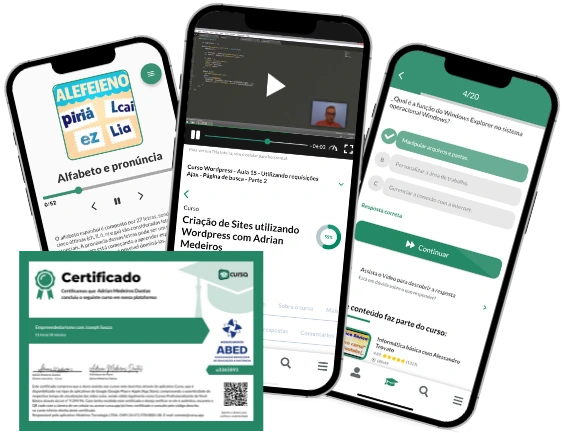
Carry knowledge in your pocket.
Download the Cursa app.
There are hundreds of free courses available, with a free certificate of completion that is saved in your mobile image gallery.
Download the app to access the Course Completion Certificate for Free.


+ 10 million
students

Free and Valid
Certificate

60 thousand free
exercises

4.8/5 rating in
app stores

Free courses in
video and ebooks