
A free ebook that teaches absolute beginners how to ask philosophical questions, evaluate arguments, and reason about values, knowledge, and meaning.
Free ebook content
-

Philosophy for Absolute Beginners: What Philosophical Thinking Is
+ Exercise: Which option best illustrates the core philosophical move of turning an everyday complaint into a philosophical question?
-
Philosophy for Absolute Beginners: Turning Confusion into Clear Questions
+ Exercise: When a discussion gets stuck because a question is vague, which approach best turns it into a precise, examinable philosophical question?
-
Philosophy for Absolute Beginners: Defining Terms and Building Useful Concepts
+ Exercise: In a debate where people keep using the word “fair” but never reach agreement, which approach best helps the group make progress by turning the concept into something they can apply consistently?
-
Philosophy for Absolute Beginners: Spotting Hidden Assumptions
+ Exercise: When you test a hidden assumption by imagining it is false, what are you mainly checking?


-
Philosophy for Absolute Beginners: Building Arguments That Actually Support a Conclusion
+ Exercise: Which statement best describes what makes a set of sentences an argument rather than an explanation or a mere opinion?
-
Philosophy for Absolute Beginners: Evaluating Arguments Without Needing Advanced Logic
+ Exercise: When evaluating an argument, what is the best way to avoid mixing up disagreements about facts with disagreements about reasoning?
-
Philosophy for Absolute Beginners: Finding Fallacies and Weak Moves in Everyday Talk
+ Exercise: A manager says: “Either we approve this plan as-is today, or we do nothing and fall behind.” Which response best repairs the reasoning using the method in the lesson?
-
Philosophy for Absolute Beginners: Objections, Counterexamples, and Stronger Revisions
+ Exercise: A counterexample shows that a universal claim like “All lying is wrong” cannot be true as stated. According to the response menu, what is the best first revision to try?
-
Philosophy for Absolute Beginners: Thought Experiments and Testing Intuitions Carefully
+ Exercise: Why is it important to change only one feature at a time when creating variations of a thought experiment?
-
Philosophy for Absolute Beginners: Reasoning About Values, Fairness, and Responsibility
+ Exercise: When facing a moral decision, what is the main benefit of first separating values, rules, and outcomes before choosing an action?
-
Philosophy for Absolute Beginners: Knowledge, Belief, and Good Reasons to Trust a Claim
+ Exercise: When deciding whether to act on a claim, which approach best matches the idea that confidence should scale with what’s at stake?
-
Philosophy for Absolute Beginners: Meaning, Purpose, and Making Sense of Your Choices
+ Exercise: When using the VTS worksheet to make a decision, what is the main role of “standards”?
About the free ebook
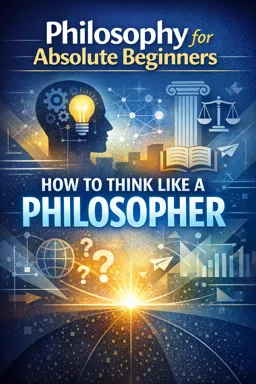
Philosophy for Absolute Beginners: How to Think Like a Philosopher
This free ebook introduces philosophy as a practical way of examining ideas, asking better questions, and making reasons visible. It is designed for readers who want to move beyond quick opinions without needing prior knowledge of famous philosophers or formal logic.
Learn to question with clarity
Philosophical thinking begins when a confusing issue becomes a question that can be explored. You will practice defining important terms, separating claims from assumptions, and noticing when people use the same word in different ways.
Build and test better arguments
Good reasoning is more than having a strong opinion. This ebook shows how premises support conclusions, how to assess whether that support is convincing, and how to recognize common fallacies in everyday conversations, media, and debates.
- Turn vague problems into focused philosophical questions.
- Identify hidden assumptions behind a claim.
- Use objections and counterexamples to improve an idea.
- Test intuitions with carefully designed thought experiments.
Apply philosophy to real choices
Explore how reasoning can illuminate questions about fairness, responsibility, knowledge, belief, meaning, and purpose. Rather than supplying one correct worldview, the ebook helps you develop habits for considering alternatives and explaining why you hold a view.
A useful foundation for school and everyday life
By the end, you will have a repeatable approach: clarify the question, define the terms, identify assumptions, examine reasons, consider objections, and revise your conclusion when the evidence calls for it. Philosophy becomes less about memorizing answers and more about thinking carefully.
How can I identify hidden assumptions in an argument?
Ask what must be true for the conclusion to follow and whether that unstated idea is justified.
What is the difference between an objection and a counterexample?
An objection challenges an argument, while a counterexample shows that a broad claim fails in a specific case.
How do thought experiments help with philosophical questions?
They isolate key features of an issue so you can test intuitions and examine the reasons behind them.
This ebook includes:

12 content chapters

Digital certificate of course completion (Free)

Exercises to train your knowledge

100% free, from content to certificate
Ready to get started?

 recommended
In the app you will also find...

Over 5,000 free courses
Programming, English, Digital Marketing and much more! Learn whatever you want, for free.

Study plan with AI
Our app's Artificial Intelligence can create a study schedule for the course you choose.

From zero to professional success
Improve your resume with our free Certificate and then use our Artificial Intelligence to find your dream job.
You can also use the QR Code or the links below.