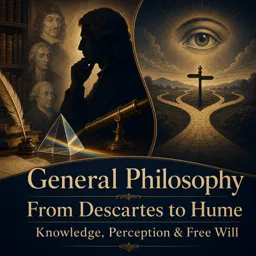
Free online course General Philosophy: From Descartes to Hume, Knowledge, Perception and Free Will
Duration of the online course: 6 hours and 53 minutes
New
Sharpen your critical thinking in this free philosophy course: knowledge, perception and free will from Descartes to Hume, with exercises and a certificate.
In this free course, learn about
How early modern texts frame key epistemology and metaphysics problems
Shift from Aristotelian teleology to Galilean/mechanistic scientific explanation
Mechanism, inertia, corpuscularianism, and Newtonian instrumentalism
Hobbesian compatibilism: free will as acting from desires despite determinism
Locke on primary/secondary qualities and secondary qualities as mind-dependent powers
Berkeley/idealism, occasionalism, and critiques of abstraction and resemblance
Hume on causation, necessity, and the skeptical problem of induction
Limits of a priori reason illustrated by modern physics (e.g., two-slit experiment)
External-world skepticism: problem of the criterion, Cartesian Circle, Moorean replies
Cartesian dualism and modern responses incl. property dualism (Mary knowledge argument)
Theory of knowledge: propositional knowledge, JTB analysis, and Gettier problems
Externalism and ethics of belief: how perceptual knowledge can resist skeptical scenarios
Free will debate: incompatibilism vs compatibilism; Humean moral responsibility
Personal identity: Locke’s memory view, transitivity fixes, and split-brain implications
About the free online course
Build a clear, confident foundation in philosophy by following the debates that shaped how we think about knowledge, reality, and human freedom. This free online course uses the early modern period as a practical starting point because it is where classic questions become especially vivid: How can we know anything about the world? What, exactly, do we perceive? Are mind and body different kinds of things? And if nature is governed by laws, what room is left for choice and moral responsibility?
You will move through the scientific and intellectual shift from Aristotelian explanation to the mechanistic outlook associated with figures such as Galileo and Descartes, then see how later philosophers respond, refine, or resist that picture. Along the way, the course connects big metaphysical claims to everyday assumptions: what it means to say an object causes an effect, why secondary qualities like color feel so immediate, and why sceptical challenges are harder to dismiss than they first appear.
The learning experience is designed to strengthen reasoning, not just memorization. Each section invites you to test your understanding with targeted questions that mirror the style of philosophical argument: spotting hidden assumptions, distinguishing what follows logically from what merely feels intuitive, and evaluating whether a proposed solution really addresses the original problem. This approach makes classic texts and positions accessible even if you have never studied philosophy before.
As you progress, you will see how questions about induction, the external world, and perception lead naturally into contemporary discussions, including thought experiments in the philosophy of mind and modern responses to dualism. You will also examine competing accounts of free will, determinism, and responsibility in a way that clarifies what is at stake in terms of agency, blame, and praise, rather than treating the debate as abstract wordplay.
Finally, the course ties these themes to the puzzle of personal identity: what it takes to remain the same person over time, how memory might ground that continuity, and why edge cases force us to be precise about what we mean by same. By the end, you will have a coherent map of the major moves from Descartes through Hume and a set of analytical tools you can apply far beyond philosophy class, from reading and writing to science, law, and everyday decision-making.
Course content
Video class: 1.1 An Introduction to General Philosophy05m
Exercise: Why does the course use early modern (17th–18th century) texts to introduce most topics in epistemology and metaphysics?
Video class: 1.2 The Birth of Modern Philosophy15m
Exercise: What is the ancient sceptical “problem of the criterion” meant to show?
Video class: 1.3 From Aristotle to Galileo18m
Exercise: What key shift in scientific explanation is highlighted when moving from Aristotelian science to Galileo’s approach?
Video class: 1.4 The Birth of the Early Modern Period: From Galileo to Descartes10m
Exercise: In the mechanistic picture discussed, why does a moving object (like a sledge) continue in a straight line at constant speed unless something changes it?
Video class: 2.1 Recap of General Philosophy Lecture 105m
Exercise: What key change in explanation did 17th-century mechanism introduce compared with Aristotelian physics?
Video class: 2.2 Introduction to Thomas Hobbes11m
Exercise: How does Hobbes argue that free will can exist even if universal determinism is true?
Video class: 2.3 Robert Boyle's Corpuscularian Theory06m
Exercise: What key feature did Boyle’s corpuscular theory add that differs from Descartes’ view of matter as extension?
Video class: 2.4 Isaac Newton and Instrumentalism07m
Exercise: What stance is described when a scientist treats a theory mainly as a tool for predicting observations, without committing to what really causes the phenomena?
Video class: 2.5 Introduction to John Locke12m
Exercise: According to Locke, what is the correct way to understand secondary qualities (like color) in bodies?
Video class: 2.6 George Berkeley and Idealism09m
Exercise: In occasionalism, why can’t the motion of one billiard ball be the real cause of the motion of another?
Video class: 3.1 Introduction to David Hume19m
Exercise: What is Hume’s key skeptical point about induction (inferring from past to future)?
Video class: 3.2 David Hume: Concluding Remarks10m
Exercise: What does the two-slit experiment illustrate about the limits of knowing the world “by pure reason”?
Video class: 3.3 The Problem of Induction23m
Exercise: In Hume’s discussion of induction, why can’t the principle that the future will resemble the past be justified by demonstrative (logical) reasoning?
Video class: 4.1 Scepticism of the External World08m
Exercise: What is the Cartesian Circle problem in the attempt to answer skepticism about the external world?
Video class: 4.2 Possible Answers to Scepticism of the External World09m
Exercise: In the debate about skepticism and the external world, what is the key strategy suggested by the here is one hand, here is another style response?
Video class: 4.3 Introduction to Cartesian Dualism22m
Exercise: In Cartesian dualism, what makes the mind and body distinct according to the view described?
Video class: 4.4 Modern Responses to Dualism10m
Exercise: What is the main point of the knowledge argument (Mary and color) in support of property dualism?
Video class: 5.1 Introduction to Knowledge10m
Exercise: In discussing knowledge, which type is the primary focus when philosophers talk about knowledge that P?
Video class: 5.2 The Traditional Analysis of Knowledge16m
Video class: 5.3 Gettier and Other Complications14m
Exercise: What do Gettier-style cases primarily show about the traditional “justified true belief” (JTB) analysis of knowledge?
Video class: 5.4 Scepticism, Externalism and the Ethics of Belief12m
Exercise: Which claim best captures the externalist idea of how ordinary perceptual knowledge is possible despite skeptical scenarios?
Video class: 6.1 Introduction to Primary and Secondary Qualities14m
Exercise: In Locke’s primary/secondary quality distinction, what is a secondary quality (e.g., yellowness) in an object?
Video class: 6.2 Problems with Resemblance10m
Exercise: What marks the primary/secondary quality distinction in the view discussed?
Video class: 6.3 Abstraction and Idealism10m
Exercise: Why do Berkeley and Hume reject the doctrine of abstraction in arguing about primary qualities?
Video class: 6.4 Making Sense of Perception16m
Exercise: According to the argument presented, why doesn’t simply insisting that we perceive objects directly (rather than ideas or sense-data) solve the skeptic’s worry about the external world?
Video class: 7.1 Free Will, Determinism and Choice18m
Exercise: In the free will debate, which position claims that free will (required for moral responsibility) is incompatible with determinism, and therefore determinism must be false if we have free will?
Video class: 7.2 Different Concepts of Freedom14m
Exercise: According to the compatibilist “contrastive argument,” what is freedom primarily contrasted with?
Video class: 7.3 Hume on Liberty and Necessity10m
Exercise: According to Hume, what is the basis of our idea of necessity/causation, and how does this support determinism about human action?
Video class: 7.4 Making Sense of Free Will and Moral Responsibility09m
Exercise: Why does a Humean sentimentalist view of morality suggest that determinism need not undermine moral responsibility?
Video class: 8.1 Introduction to Personal Identity08m
Exercise: In discussions of personal identity, what is the recommended way to avoid ambiguity when using the word same?
Video class: 8.2 John Locke on Personal Identity15m
Exercise: According to Locke, what most fundamentally constitutes personal identity over time?
Video class: 8.3 Problems for Locke's View of Personal Identity09m
Exercise: How does the “ancestral” (iterated) memory relation address the objection that memory-based personal identity violates the transitivity of identity?
Video class: 8.4 Persons, Humans and Brains11m
Exercise: In split-brain transplant scenarios where each half is placed in a different body, what view is suggested as a plausible response to the problem of personal identity?
This free course includes:
6 hours and 53 minutes of online video course
Digital certificate of course completion (Free)
Exercises to train your knowledge
100% free, from content to certificate
What is Hume's problem of induction?
Hume argues that past regularities cannot logically prove that the future will resemble the past, so inductive predictions rest on habit rather than rational demonstration.
How do Descartes and Locke differ on knowledge and perception?
Descartes emphasizes reason and innate ideas, while Locke argues that the mind begins largely as a blank slate and gains ideas through experience.
What does compatibilism say about free will and determinism?
Compatibilism holds that a person can act freely when they act from their own desires and choices, even if those desires have deterministic causes.
Ready to get started?Download the app and get started today.