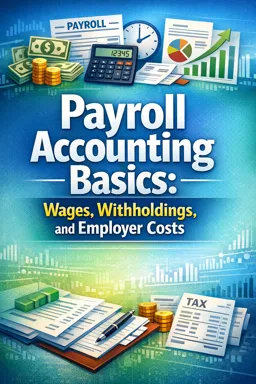


Free ebook on payroll accounting basics: calculate gross and net pay, record withholdings, employer costs, liabilities, and journal entries.
Free ebook content
-

Payroll Accounting Basics: How Wages Flow from Time Worked to Paycheck
+ Exercise: In payroll accounting, how are employee withholdings and deductions typically treated when they are taken out of gross pay?
-
Gross Pay: Wages, Salaries, Overtime, and Pretax Earnings in Payroll Accounting
+ Exercise: A salaried employee is paid biweekly and receives an approved commission and a travel reimbursement with receipts in the same pay period. Which amount should be counted as gross pay for the period?
-
Net Pay: Employee Withholdings and Deductions That Reduce the Paycheck
+ Exercise: Why are employee paycheck reductions such as income tax withholding, employee social insurance, and withheld premiums typically recorded as payroll liabilities rather than employer expenses?
-
Employer Payroll Taxes and Benefits: Employer Costs Beyond Gross Pay
+ Exercise: An employee has gross pay of $1,000 for a pay period. The employer incurs employer social insurance tax of 6.20%, unemployment tax of 0.60%, workers’ compensation of 1.20%, and an employer-paid health insurance premium of $150. What is the total employer payroll cost for the period?


-
Payroll Journal Entries: Recording Wages, Withholdings, and Liabilities
+ Exercise: When payroll is processed at period-end but employees are paid a few days later, which account is credited for the net pay at the time of processing?
-
Timing Differences: Accrued Wages, Pay Dates, and Remittance Schedules
+ Exercise: When a company remits payroll taxes and benefits after payroll has been recorded, what is the main accounting effect on the ledger at the remittance date?
-
Payroll and the Financial Statements: Income Statement, Balance Sheet, and Cash Flow Effects
+ Exercise: Under the indirect method, what is the cash flow effect of an increase in payroll-related liabilities (such as wages payable, withholdings payable, and payroll taxes payable) during the period?
-
Payroll Controls and Common Errors: Preventing Misstatements and Cash Surprises
+ Exercise: Employee health insurance deductions were accidentally posted to Payroll Taxes Payable. Which accounts are most likely misstated and should be investigated first?
-
Putting It Together: A Complete Gross-to-Net Payroll Case with Journal Entries and Statement Impact
+ Exercise: In a payroll where employees earn wages by March 31 but are paid on April 5, which statement best describes what happens in March versus April under accrual accounting?
About the free ebook
Payroll Accounting Basics: Wages, Withholdings, and Employer Costs
This free ebook explains how payroll transactions move from employee time worked to the paycheck, accounting records, tax payments, and financial statements. It provides a practical foundation for understanding the amounts a business owes employees, taxing authorities, and benefit providers.
Understand gross pay, net pay, and payroll cost
Learn how wages and salaries are calculated, including overtime and pretax earnings. The ebook distinguishes gross pay, the employee's total earnings before deductions, from net pay, the amount paid to the employee after withholdings and deductions.
It also clarifies why an employer's payroll expense is often greater than gross wages. Employer-paid payroll taxes and benefits create additional costs that must be measured, recorded, and paid on schedule.
Record payroll accurately
Payroll accounting requires more than issuing paychecks. Businesses must recognize wage expense, employee withholdings, employer tax expense, and payroll-related liabilities. This ebook shows how journal entries keep these amounts separate until they are remitted or paid.
- Identify wage expense and employer payroll costs.
- Track taxes and deductions withheld from employee pay.
- Recognize liabilities owed to employees, agencies, and benefit plans.
- Account for accrued wages and payment timing differences.
Connect payroll to financial reporting
See how payroll affects the income statement, balance sheet, and cash flow statement. A complete gross-to-net case helps connect payroll calculations with journal entries and the resulting financial statement impact.
Build stronger payroll controls
The ebook highlights common payroll errors, such as misstated hours, incorrect deductions, missed accruals, and insufficient cash planning. It introduces control practices that support accurate records, timely remittances, and more reliable financial reporting.
What is the difference between gross pay and net pay in payroll accounting?
Gross pay is earnings before deductions; net pay is the amount left after employee taxes and other withholdings.
How are employee withholdings recorded in a payroll journal entry?
They are credited to payroll liability accounts because the business owes those amounts to agencies or providers.
Why are employer payroll taxes recorded separately from wages?
They are an additional employer expense beyond employee gross pay and create separate liabilities.
This ebook includes:

9 content chapters

Digital certificate of course completion (Free)

Exercises to train your knowledge

100% free, from content to certificate
Ready to get started?

 recommended
In the app you will also find...

Over 5,000 free courses
Programming, English, Digital Marketing and much more! Learn whatever you want, for free.

Study plan with AI
Our app's Artificial Intelligence can create a study schedule for the course you choose.

From zero to professional success
Improve your resume with our free Certificate and then use our Artificial Intelligence to find your dream job.
You can also use the QR Code or the links below.