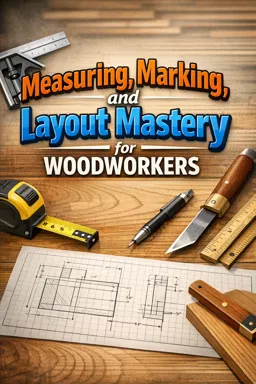

Free ebook on woodworking measuring, marking, layout tools, reference faces, tolerances, joinery, and error prevention.
Free ebook content
-

Measuring and Layout Mindset for Accurate Woodworking
+ Exercise: Why does a precision-first workflow treat measuring, marking, and cutting as separate phases?
-
Tape Measures vs. Rules: Choosing the Right Measuring Tool
+ Exercise: A tape measure’s end hook feels loose and you want more repeatable outside measurements. What technique best reduces error from hook play?
-
Squares for Layout Mastery: Speed Square, Try Square, Combination, and Engineer’s Square
+ Exercise: When using a square to mark a 90° line, which practice most directly improves accuracy before you commit to a cut?
-
Marking Tools That Improve Accuracy: Pencil, Marking Knife, and Scribing Techniques
+ Exercise: When converting a pencil layout line into a final knife line for accuracy, which approach best prevents shifting the true boundary?
-
Gauges and Parallel Layout: Marking Gauge, Cutting Gauge, and Mortise Gauge
+ Exercise: When laying out a mortise and its matching tenon using a mortise gauge, what practice best ensures the tenon cheeks match the mortise width without re-measuring?


-
Story Sticks and Direct Transfer Layout for Repeatable Parts
+ Exercise: What is the main advantage of using a story stick to lay out multiple identical parts?
-
Referencing from a Single Face and Edge: The Foundation of Consistent Joinery
+ Exercise: Why should you take all joinery layout measurements from the same reference face and reference edge on mating parts?
-
Tolerances in Woodworking: Fit, Function, and Realistic Precision
+ Exercise: When cutting a dado intended to fit “3/4 in plywood,” what approach best matches a function-driven tolerance strategy?
-
Planning Cuts to Reduce Cumulative Error: From Rough Breakdown to Final Fit
+ Exercise: Which cut-planning approach best reduces cumulative (stack-up) error when making multiple identical parts for an assembly?
-
Common Layout Mistakes and How to Catch Them Before Cutting
+ Exercise: During a pre-cut inspection, you notice a single cut line with no X/shading and you were planning to split the line with the blade. What is the best corrective action?
-
Layout for Joinery and Hardware: Holes, Dadoes, Mortises, and Hinges
+ Exercise: When laying out a row of holes (such as shelf pins or hardware screws), what approach best prevents spacing drift and keeps the pattern consistent?
About the free ebook
Measuring, Marking, and Layout Mastery for Woodworkers
Accurate woodworking starts long before the saw touches the board. This free ebook develops the practical measuring, marking, and layout habits that help woodworkers produce dependable parts, clean joinery, and hardware that fits correctly.
Build accuracy into every step
Learn how to select and use tape measures, rules, and essential squares for reliable layout. The ebook explains how pencils, marking knives, scribes, and gauges create lines that are easy to see, cut to, and repeat across multiple workpieces.
Use a consistent reference system
Strong results depend on referencing measurements from a single face and edge. You will explore direct-transfer methods, story sticks, parallel layout tools, and practical approaches for reducing variation when making repeated parts.
Plan for realistic precision
Wood moves, tools have limits, and not every dimension needs the same tolerance. Discover how to plan cuts from rough breakdown through final fitting, account for fit and function, and prevent cumulative errors from affecting an entire project.
Lay out joinery and hardware with confidence
Apply clear layout methods to mortises, dadoes, holes, hinges, and other common woodworking details. The ebook also highlights common layout mistakes and simple checks that can catch problems before cutting begins.
What you will strengthen
- Measuring tool selection and dependable reading habits
- Square, gauge, knife, and scribe techniques
- Repeatable layout for matching components
- Reference-face systems for consistent joinery
- Error prevention and final-fit planning
Precision is not only about measuring closely. It is about establishing references, choosing the right marking method, and verifying the work at the right moments.
What is the difference between a marking gauge and a cutting gauge?
A marking gauge uses a pin to score parallel lines, while a cutting gauge uses a knife cutter for cleaner cross-grain lines.
Why should woodworkers reference from one face and one edge?
Using the same reference face and edge prevents small thickness or width variations from misaligning joinery.
How can a story stick reduce woodworking layout errors?
A story stick transfers dimensions directly to repeated parts, avoiding repeated tape-measure readings and cumulative error.
This ebook includes:

11 content chapters

Digital certificate of course completion (Free)

Exercises to train your knowledge

100% free, from content to certificate
Ready to get started?

 recommended
In the app you will also find...

Over 5,000 free courses
Programming, English, Digital Marketing and much more! Learn whatever you want, for free.

Study plan with AI
Our app's Artificial Intelligence can create a study schedule for the course you choose.

From zero to professional success
Improve your resume with our free Certificate and then use our Artificial Intelligence to find your dream job.
You can also use the QR Code or the links below.