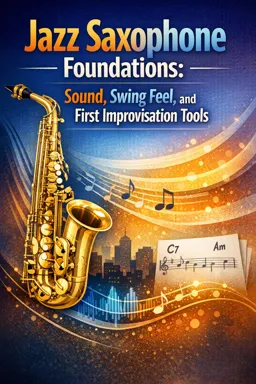

Free ebook for jazz saxophone players covering warm tone, swing feel, lead-sheet reading, blues language, and first improvisation tools.
Free ebook content
-

Jazz Saxophone Setup for a Warm, Centered Sound
+ Exercise: While practicing a long-tone swell (crescendo then decrescendo), what adjustment best helps keep the tone warm and centered as you get louder?
-
Breath Support and Resonance for Jazz Saxophone Tone Control
+ Exercise: When a saxophonist’s pitch tends to sag at the end of long tones, which adjustment best addresses the cause described?
-
Swing Feel on Saxophone: Straight Eighths, Swung Eighths, and Time Placement
+ Exercise: When practicing swing eighth notes with a metronome clicking on 2 and 4, which approach best supports an authentic swing feel without rushing or dragging?
-
Jazz Articulation Basics: Tonguing, Accents, and Note Length
+ Exercise: When you want to accent a note in a jazz line without making the attack harsh, what approach best matches the recommended technique?


-
Reading a Jazz Lead Sheet: Melody, Chord Symbols, and Form
+ Exercise: When reading a jazz lead sheet, what is the best interpretation of chord symbols in relation to the written melody?
-
First Improvisation Note Sets: Major Scale Fragments and Pentatonics
+ Exercise: When practicing an 8-bar two-chord groove (e.g., Dm7 to G7), which approach best helps you connect the chord change without losing your swing feel?
-
Blues Scale Essentials: Expressive Tools for Early Jazz Improvisation
+ Exercise: When practicing the transfer of a blues-scale finger pattern to a nearby key, what approach best builds a fast connection between your ear and hands?
-
Chord-Symbol Navigation for Beginners: Strong Notes Without Heavy Theory
+ Exercise: When improvising over a chord symbol, which approach best follows the “strong notes” method for sounding inside the harmony?
-
Creating Musical Phrases: Motifs, Space, and Simple Development
+ Exercise: When developing a short improvisation motif, what approach best helps the phrase sound intentional and musical?
-
Putting It Together: First Complete Improvisations on a Simple Lead Sheet
+ Exercise: During a beginner “complete improvisation,” what should you prioritize if things start to fall apart?
About the free ebook
Jazz Saxophone Foundations: Sound, Swing Feel, and First Improvisation Tools
Build a confident starting point for playing jazz saxophone with practical guidance on tone, rhythm, articulation, lead sheets, and early improvisation. This free ebook helps you connect fundamental technique with the expressive language of jazz.
Develop a warm, flexible jazz sound
Learn how saxophone setup, breath support, and resonance work together to create a warm, centered tone. Clear playing habits help you control dynamics, sustain notes, and shape a sound that remains stable across the instrument.
Feel swing and articulate with purpose
Jazz is not only about the notes you play, but also how you place and shape them. Explore straight and swung eighth notes, time placement, tonguing, accents, and note length. These tools help written melodies sound more natural, rhythmic, and stylistically aware.
Read lead sheets with confidence
Understand the essential information on a jazz lead sheet: melody, chord symbols, and form. Instead of treating a chart as a dense page of theory, you will learn to recognize the landmarks that keep you oriented while playing a tune.
Take your first steps into improvisation
Use major-scale fragments, pentatonic materials, and the blues scale to create simple melodic ideas. The ebook introduces practical ways to choose strong notes over chord symbols without relying on heavy theory.
Create solos that sound musical
Improvisation becomes clearer when you work with short motifs, intentional space, and repetition with variation. Learn to make phrases that breathe, answer one another, and follow the form of a simple lead sheet.
A practical foundation for jazz expression
- Strengthen tone control through setup and air support.
- Internalize swing feel and basic jazz articulation.
- Navigate melodies, chord symbols, and song form.
- Build complete beginner improvisations from simple note choices.
Use these concepts in focused practice sessions and begin turning scales, rhythms, and familiar melodic ideas into expressive jazz saxophone playing.
How can I make my saxophone tone sound warmer for jazz?
Use steady breath support, an efficient setup, relaxed embouchure control, and sustained-tone practice to develop resonance.
What is the difference between straight and swung eighth notes on saxophone?
Straight eighths divide the beat evenly; swung eighths use a long-short pulse that creates a jazz groove.
Which notes can I use for a first jazz saxophone improvisation?
Start with major-scale fragments, pentatonic notes, and blues-scale notes, then target notes that match each chord symbol.
This ebook includes:

10 content chapters

Digital certificate of course completion (Free)

Exercises to train your knowledge

100% free, from content to certificate
Ready to get started?

 recommended
In the app you will also find...

Over 5,000 free courses
Programming, English, Digital Marketing and much more! Learn whatever you want, for free.

Study plan with AI
Our app's Artificial Intelligence can create a study schedule for the course you choose.

From zero to professional success
Improve your resume with our free Certificate and then use our Artificial Intelligence to find your dream job.
You can also use the QR Code or the links below.