Attach the mouthpiece to the neck, slide the ligature on, moisten the reed, align its tip with the mouthpiece tip, and tighten the ligature gently.

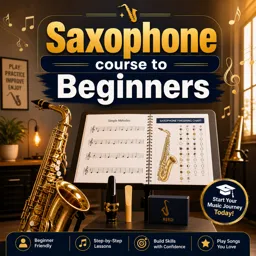
Duration of the online course: 47 minutes
New
Play sax with confidence: free beginner course on setup, embouchure, fingering and tonguing, plus quick quizzes to lock in skills fast.
Learning saxophone as a complete beginner can feel overwhelming: the mouthpiece, the reed, the first sound, and the feeling that your fingers never land where they should. This free online course is designed to remove that friction and help you build a solid foundation from day one, with clear guidance and practical exercises that focus on what makes the biggest difference early on.
You will start by understanding how to set up the mouthpiece and reed correctly, so your instrument responds easily and you avoid the most common beginner mistakes. From there, you will work on embouchure, the essential way your mouth and facial muscles shape the sound. Developing a comfortable, consistent embouchure is one of the fastest routes to better tone and control, and it will make everything else easier as you continue practicing.
Next, you will refine your overall setup and hand position, learning how to hold and align the instrument so you can play more comfortably and accurately. Good habits here reduce tension, improve technique, and help your fingers move efficiently. Once your setup feels natural, you will move into fingering and your first notes, building coordination step by step so the instrument starts to feel familiar rather than intimidating.
To bring your sound to life, you will also practice tonguing, an essential skill for clean starts, articulation, and rhythmic clarity. Along the way, short knowledge checks reinforce key ideas, helping you remember why each detail matters and how it affects your tone, response, and progress. By the end, you will have a practical routine and the core skills needed to keep improving with confidence.

47 minutes of online video course

Digital certificate of course completion (Free)

Exercises to train your knowledge

100% free, from content to certificate
How do I set up a saxophone mouthpiece and reed correctly?
Attach the mouthpiece to the neck, slide the ligature on, moisten the reed, align its tip with the mouthpiece tip, and tighten the ligature gently.
What does the octave key do on a saxophone?
The octave key helps raise notes into a higher register by opening an octave vent and changing the instrument's pitch.
How should I use my tongue to start saxophone notes?
Lightly touch the reed with the tip of your tongue, then release it while blowing steady air to produce a clean attack.
Ready to get started?Download the app and get started today.
Install the app now
to access the course
Over 5,000 free courses
Programming, English, Digital Marketing and much more! Learn whatever you want, for free.

Study plan with AI
Our app's Artificial Intelligence can create a study schedule for the course you choose.

From zero to professional success
Improve your resume with our free Certificate and then use our Artificial Intelligence to find your dream job.
You can also use the QR Code or the links below.



Free CourseSaxophone to beginners - stage 1 -
4.9

(7)

1h27m

14 exercises
Free CourseSaxophone to beginners - stage 2 -
4.2
(6)
1h14m
10 exercises

Free CourseBeginner Saxophone quickstart
4
(1)
1h07m
7 exercises

Free CourseJazz Saxophone for Beginners
New
57m
10 exercises

Free CourseClarinet for beginners
New
2h45m
17 exercises

Free CourseSaxophone for beginners
New
1h32m
23 exercises
Free CourseBeginner Clarinet Lessons: Assembly, Embouchure, Fingerings and First Notes
New
55m
8 exercises
Carry knowledge in your pocket.
Download the Cursa app.
There are hundreds of free courses available, with a free certificate of completion that is saved in your mobile image gallery.
Download the app to access the Course Completion Certificate for Free.


+ 10 million
students

Free and Valid
Certificate

60 thousand free
exercises

4.8/5 rating in
app stores

Free courses in
video and ebooks