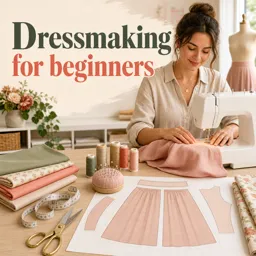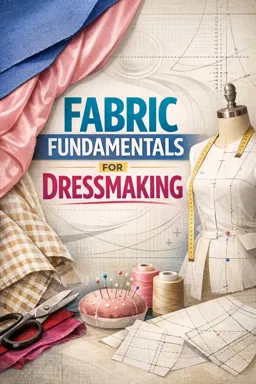

Free ebook on dressmaking fabrics: understand fibers, woven and knit behavior, drape, stretch, preparation, pressing, and stabilization.
Free ebook content
-

Fabric Fundamentals for Dressmaking: How Fabrics Behave in Garments
+ Exercise: A fabric forms narrow, cascading folds in a hang test and tends to follow body contours. Which drape description best matches this behavior?
-
Woven Fabrics for Dressmaking: Grain, Structure, and Stability
+ Exercise: When working with true bias-cut pieces in woven fabric, what practice best helps prevent an uneven, wavy hem?
-
Knit Fabrics for Dressmaking: Stretch, Recovery, and Fit
+ Exercise: A knit pattern requires 4-way stretch, but you substitute a 2-way stretch knit. What fit problem is most likely?
-
Fiber Types in Dressmaking: Comfort, Care, and Performance
+ Exercise: When planning how to wash and press a fabric blend, what is the best guiding rule for predicting the required care?


-
Fabric Weight, Drape, and Opacity: Matching Fabric to Silhouette
+ Exercise: A fabric is semi-sheer: it mostly covers skin, but seam allowances show as shadows on the right side. What is the best next step?
-
Stretch, Ease, and Pattern Compatibility in Dressmaking
+ Exercise: When substituting a fabric for a knit pattern drafted with negative or low ease, what is the most likely result if your chosen fabric has LESS stretch than the pattern expects?
-
Practical Fabric Selection for Common Garment Types
+ Exercise: A drapey knit T-shirt neckline is waving and gaping after sewing. Which action best addresses the likely cause?
-
Pre-Washing, Shrinkage Testing, and Fabric Preparation for Dressmaking
+ Exercise: Which approach best reduces the risk of a garment changing size after its first cleaning?
-
Pressing and Heat Management for Dressmaking Fabrics
+ Exercise: When pressing a seam for best shape retention, what approach helps prevent stretching and distortion?
-
Stabilizing Fabrics: Interfacing, Underlining, and Seam Support
+ Exercise: A knit top’s shoulder seams keep “growing” and drooping with wear. Which stabilization method best addresses this problem while keeping stretch comfort?
-
Avoiding Common Fabric-Related Mistakes in Dressmaking
+ Exercise: For a semi-fitted shirt pattern with a collar and button band that needs crisp edges but still some drape, which fabric choice best matches the required fabric behavior?
About the free ebook
Fabric Fundamentals for Dressmaking
Learn how fabric choices shape the fit, comfort, finish, and durability of handmade clothing. This free ebook gives dressmakers a practical framework for understanding how textiles behave before they are cut and sewn.
Choose fabric with confidence
Explore the difference between woven and knit fabrics, including grain, stretch, recovery, stability, and ease. Understand how fiber content affects breathability, care requirements, warmth, strength, and garment performance.
Fabric weight, drape, opacity, and texture all influence the final silhouette. The ebook explains how to assess these properties and match a fabric to dresses, skirts, trousers, shirts, fitted garments, and flowing designs.
Prepare and handle fabrics professionally
Good dressmaking starts before sewing. Learn practical methods for pre-washing, checking shrinkage, managing heat while pressing, and preventing damage to delicate or synthetic fabrics.
Build stable, polished garments
- Select fabrics that work with a pattern’s intended ease and stretch.
- Use interfacing, underlining, and seam support where structure is needed.
- Identify common fabric-related problems before they affect the finished garment.
- Make more informed purchasing decisions for everyday dressmaking projects.
Fabric Fundamentals for Dressmaking is designed for makers who want clearer fabric knowledge and more reliable sewing results.
How do I know whether a fabric matches a sewing pattern?
Compare the pattern’s recommended fabric type, stretch needs, weight, drape, and required ease with the fabric you plan to use.
Why should dressmaking fabric be pre-washed before cutting?
Pre-washing helps reveal shrinkage, color bleeding, and changes in texture before the garment is sewn.
What is the difference between interfacing and underlining?
Interfacing reinforces selected areas, while underlining is a full layer attached to garment pieces for added body, support, or opacity.
This ebook includes:

11 content chapters

Digital certificate of course completion (Free)

Exercises to train your knowledge

100% free, from content to certificate
Ready to get started?

 recommended
In the app you will also find...

Over 5,000 free courses
Programming, English, Digital Marketing and much more! Learn whatever you want, for free.

Study plan with AI
Our app's Artificial Intelligence can create a study schedule for the course you choose.

From zero to professional success
Improve your resume with our free Certificate and then use our Artificial Intelligence to find your dream job.
You can also use the QR Code or the links below.