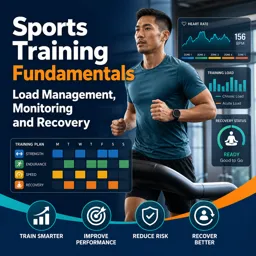
Free online course Sports Training Fundamentals: Load Management, Monitoring and Recovery
Duration of the online course: 10 hours and 13 minutes
New
Train smarter and recover faster with this free online course on load management and monitoring, featuring practical tools and a certificate-ready learning path.
In this free course, learn about
Core sports training concepts: load, recovery, adaptation, and how they interact
Fitness vocabulary and distinctions: physical activity vs exercise; types of fitness
Health-related fitness components and acute training variables (FITTVP) in practice
Exercise prescription: ordering FITTVP elements to build a weekly training plan
Training principles and GAS; understanding supercompensation and adaptation phases
Getting fitter is not just about working harder; it is about applying the right dose of training at the right time, then allowing recovery to convert effort into performance. This free online course in Health and Physical Exercise and Healthy Living focuses on the fundamentals that help you improve results while reducing unnecessary fatigue and injury risk. You will learn to think like a coach: choosing training variables intentionally, understanding how the body adapts, and recognizing when load is building resilience versus when it is quietly pushing you toward breakdown.
Through a clear progression from foundational terminology to practical decision-making, the course connects training theory with real-world monitoring. You will explore how acute variables shape each session, how principles such as overload and adaptation guide long-term planning, and why periodization is more than a calendar of workouts. Instead of guessing, you will develop a structured way to balance stimulation and recovery, supported by frameworks used in athletic development and health-focused training alike.
A major emphasis is load management and monitoring: what load actually means, how to quantify it across different activities, and how internal signals (such as perceived exertion and physiological responses) relate to external work. You will also learn where popular methods can mislead, how to interpret threshold-based concepts, and how combining tools can create a clearer picture than relying on a single metric. This makes the course valuable whether you are training for sport, improving general fitness, or supporting others with program design.
Recovery is treated as a performance skill, not an afterthought. You will examine fatigue, the difference between productive overreaching and harmful overtraining, and how recovery strategies should be prioritized so training adaptations are protected. The course also introduces the role of technology in modern training, from wearables and monitoring systems to performance analysis and innovation, helping you understand what data can and cannot tell you.
By the end, you should feel more confident building sensible training plans, adjusting load based on feedback, and communicating training decisions with clearer rationale. If you are looking for a practical foundation that bridges exercise science and everyday training choices, this course offers an accessible path to smarter training and more consistent progress.
Course content
Video class: Introduction - Fundamentals of Sports Training, Load Management and recovery01m
Exercise: Who is this course on Sports Training Fundamentals: Load Management, Monitoring and Recovery intended for?
Video class: Introduction to Fitness Vocabulary17m
Exercise: Which statement best describes when a physical activity becomes an exercise?
Video class: Types of FItness14m
Exercise: Which set correctly lists the components of health-specific fitness?
Video class: Health Specific Fitness Acute Training varibales Part - 0125m
Exercise: Which set of components correctly represents the acute training variables acronym FITTVP?
Video class: Health Specific Fitness Acute Training varibales Part - 0218m
Exercise: For power (explosive strength) development, how is training intensity primarily expressed?
Video class: Application of Acute Training variables10m
Exercise: In the exercise prescription format using acute training variables, what is the correct order of elements for a weekly plan?
Video class: Principle of Training 107m
Exercise: In the General Adaptation Syndrome (GAS), what is the phase called when fitness rises above the previous baseline to create a new baseline?
Video class: Principle of Training 210m
Exercise: Which loading theory is characterized by progressive overload with an interspersed deload phase to allow sufficient recovery?
Video class: Principle of Training 307m
Exercise: In the stimulation–recovery–adaptation theory, what is the relationship between training stimulation and recovery needs?
Video class: Periodization in sports 109m
Exercise: Which statement best describes sequential (block) periodized planning?
Video class: Periodization in sports 210m
Exercise: In the transition phase of annual periodization, what is the typical recommendation for reducing training load compared to the competition phase?
Video class: Concept of Load Training 113m
Exercise: Why is the term density preferred over frequency when describing an athlete’s training load?
Video class: Concept of Load Training 216m
Exercise: Which statement best describes a key limitation of using %1RM (person-based training) to set muscular strength intensity?
Video class: Concept of Load Training 320m
Exercise: What is the correct description of blood lactate threshold (BLT) in training load monitoring for athletes?
Video class: Load monitoring in Sports 120m
Exercise: Which monitoring method is specifically used to calculate session load using the formula duration × session RPE?
Video class: Load monitoring in Sports 209m
Exercise: What is the main purpose of integrating different load monitoring technologies into one athlete monitoring system?
Video class: Acute Training Methods 116m
Exercise: Which condition best distinguishes aerobic training from simply doing an aerobic activity?
Video class: Acute Training Methods 218m
Video class: Aerobic Methods 316m
Exercise: Which statement best describes tempo (threshold) training as an aerobic training method?
Video class: Anerobic Tranining Method 113m
Exercise: In velocity-based training (VBT), what is primarily used to prescribe and adjust training intensity?
Video class: Anerobic Tranining Method 208m
Exercise: What best describes post-activation potentiation (PAP) as an anaerobic training method?
Video class: Load Monitoring Methods in HSF 105m
Exercise: Which method uses the Karvonen formula to set a target heart rate range for cardio training intensity?
Video class: Load Monitoring Methods in HSF 208m
Exercise: In velocity-based monitoring for improving maximal strength, what movement velocity is recommended to guide load selection?
Video class: Load Monitoring Methods in SSF 107m
Exercise: Which combination of monitoring tools is recommended for sports-specific fitness conditioning load monitoring, especially for threshold-based training?
Video class: Load Monitoring Methods in SSF 207m
Exercise: In velocity-based training for power development, which velocity range represents the explosive strength variation called strength-speed?
Video class: Load Monitoring Methods in SSF 307m
Exercise: Why are timing gate systems considered more efficient than a simple stopwatch for monitoring speed and agility training load?
Video class: Fatigue in Sports Training20m
Exercise: Which statement best describes fatigue in sports training?
Video class: Overtraining21m
Exercise: Which statement best distinguishes overreaching from overtraining?
Video class: Diagnosis and management of OTS20m
Exercise: Which approach best describes how overtraining syndrome (OTS) is diagnosed?
Video class: Recovery in sports13m
Exercise: Which of the following is identified as the best marker of recovery?
Video class: Recovery Technique24m
Exercise: According to the recovery pyramid, which strategy forms the foundation and should be prioritized the most?
Video class: Training Program Design 110m
Exercise: Which statement best describes the General Adaptation Syndrome (GAS) concept applied in training program design?
Video class: Training Program Design 231m
Exercise: When using greater external load as the main stimulation to improve muscular strength, what is the recommended intensity range?
Video class: Training Program Design 324m
Exercise: According to the general guideline mentioned, what weekly training volume is recommended to improve cardio fitness?
Video class: Training Program Design 409m
Exercise: Which loading and velocity range best describes a "speed strength" stimulation for improving muscular power?
Video class: Training Program Design 512m
Exercise: Which training stimulations are recommended to improve Conditioning 5 (anaerobic system + neuromuscular system only)?
Video class: Technoloy in Performance Analysis20m
Exercise: Which statement best describes performance analysis in sport?
Video class: Technoloy in Performance Enchanmnet21m
Exercise: Which approach best maintains fairness when performance-enhancing technology is used in sport?
Video class: Waerables in Sports19m
Exercise: In wearable technology, what is the correct flow of how performance data becomes insights for the user?
Video class: Future of technology in sports18m
Exercise: Which future technology is described as enabling players to replicate game-like situations, accelerate learning, and reduce physical demands to help limit injury risk?
Video class: Sports Training Technology and innovation20m
Exercise: Which technology category refers to devices and procedures used to treat injuries or reduce the debilitating effects of training so athletes can continue to train and compete?
This free course includes:
10 hours and 13 minutes of online video course
Digital certificate of course completion (Free)
Exercises to train your knowledge
100% free, from content to certificate
What is the FITTVP principle in exercise prescription?
FITTVP stands for Frequency, Intensity, Time, Type, Volume and Progression. It helps structure and adjust a safe, goal-focused training plan.
How is training load monitored using session RPE?
Session load is calculated by multiplying workout duration by the athlete’s session rating of perceived exertion (RPE).
What is the difference between overreaching and overtraining syndrome?
Overreaching is a short-term performance decline that improves with recovery; overtraining syndrome is a prolonged decline requiring extended recovery and careful assessment.
Ready to get started?Download the app and get started today.