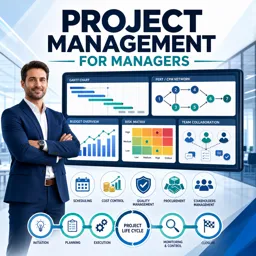
Free Course Image Project Management for managers

Free online course Project Management for managers

Duration of the online course: 31 hours and 38 minutes

4.9

StarStarStarStarStar

(7)

Lead projects with confidence: learn practical project management for managers with a free online course, real tools for selection, finance, risks and delivery.

In this free course, learn about

  • Core concepts and importance of project management in modern, fast-paced environments
  • Project success criteria: Iron Triangle plus stakeholder/customer value and benefits realization
  • Organizational structures (functional, matrix, projectized) and their impact on project success
  • PMO purpose and functions vs project manager responsibilities
  • Stakeholder identification, analysis, engagement planning, and communication management
  • Types of projects (e.g., greenfield) and full project life cycle phases
  • Project selection considerations and limits of portfolio tools like the BCG Matrix
  • Project selection methods: scoring models, space diagrams, and MCDM approaches
  • Goal programming focus (meeting multiple goals) and AHP pairwise comparisons/priority setting
  • Market & demand analysis and forecasting methods incl. exponential smoothing and alpha
  • Financial analysis: payback period comparison and interpreting results for decisions
  • Capital budgeting: NPV, IRR, and techniques that do/don’t use time value of money
  • Project financing basics: equity vs debt, and implications for ownership and repayment
  • Risk management: PESTLE analysis and the four-stage risk management process

About the free online course

Managing projects is no longer a specialist task reserved for a separate team. In a fast-paced business environment, managers are expected to turn ideas into measurable results, coordinate cross-functional stakeholders, and make confident decisions under constraints of time, budget, and shifting priorities. This free online course is designed to help you build a clear, manager-friendly project management foundation that you can apply immediately in day-to-day work.

You will strengthen the way you define success beyond simple deadlines and costs by understanding how value, quality, expectations, and business outcomes shape whether a project is truly successful. You will also learn how organizational structures influence authority, collaboration, and communication, so you can choose the right approach to manage people and resources effectively. The course clarifies how project managers and a Project Management Office operate, what each is responsible for, and how governance can support delivery without slowing momentum.

A key focus is making better decisions before work begins. You will gain a practical understanding of project types and life cycles, and how selection methods help organizations invest in the right initiatives. You will explore decision frameworks used in real business settings, including multi-criteria approaches, and learn how market and demand thinking supports smarter prioritization. By connecting these decisions to financial reasoning, you will be able to interpret concepts such as payback and capital budgeting perspectives, giving you a stronger voice in leadership discussions.

Finally, you will improve how you anticipate uncertainty. You will develop a risk-aware mindset, learn how to scan external forces that affect delivery, and understand the stages of risk management so you can move from reactive firefighting to structured control. Throughout the course, short checks for understanding help reinforce the concepts and prepare you to apply them in meetings, planning sessions, and stakeholder conversations. Whether you want to improve performance in your current role or add a recognized skill set for career growth, you will leave with a practical, business-oriented view of project management.

Course content

  • Video class: Introduction of Project Management 31m
  • Exercise: What is the primary reason for the significance of project management in today's fast-paced world?
  • Video class: Project Success 41m
  • Exercise: What is a key additional criterion for project success beyond the Iron Triangle?
  • Video class: Types of Structure Organizations 31m
  • Exercise: What are the three main factors on which the success of a project depends?
  • Video class: Project Management Office 31m
  • Exercise: What is the primary function of a Project Management Office (PMO)?
  • Video class: Stakeholders Management 32m
  • Exercise: What are the primary responsibilities of a Project Manager versus a PMO?
  • Video class: Types of Projects and Project Life Cycle 32m
  • Exercise: What is a key characteristic of a Green Field Project?
  • Video class: Project Life Cycle Phases 31m
  • Exercise: What is an important consideration that needs to be evaluated during the project selection phase in project management?
  • Video class: Methods of Project Selection- I 33m
  • Exercise: What is a key limitation of the BCG Matrix?
  • Video class: Methods of Project Selection- II 32m
  • Exercise: What is the primary purpose of a space diagram in project selection?
  • Video class: Methods of Project Selection (MCDM -I) 32m
  • Exercise: What is the primary focus of goal programming as an extension of linear programming?
  • Video class: Methods of Project Selection (MCDM-II) 30m
  • Exercise: What is the most important criterion while selecting a project in AHP?
  • Video class: Methods of Project Selection (MCDM-III) 30m
  • Exercise: Which criterion was assigned the highest importance in the AHP method example?
  • Video class: Market and Demand Analysis - I 30m
  • Exercise: Which of the following is NOT a method of demand forecasting mentioned in the session?
  • Video class: Market and Demand Analysis - II 30m
  • Exercise: What is the smoothing constant alpha used for in exponentially smoothing method?
  • Video class: Financial Analysis 31m
  • Exercise: Which Project Has a Better Payback Period?
  • Video class: Capital Budgeting Techniques - I 30m
  • Exercise: Which of the following capital budgeting techniques does not take into account the time value of money?
  • Video class: Capital Budgeting Techniques - II 29m
  • Exercise: What is the primary advantage of the NPV method over the IRR method in capital budgeting?
  • Video class: Financing of Projects 31m
  • Exercise: What is the main difference between equity funds and debt funds in financing projects?
  • Video class: Risk Management - I 30m
  • Exercise: In the context of risk management in project management, what does PESTLE analysis stand for?
  • Video class: Risk Management - II 30m
  • Exercise: What are the four stages of risk management?
  • Video class: Risk Management (Control 28m
  • Video class: Stand Alone Risk Analysis- I 30m
  • Exercise: What does a sensitivity analysis in project risk management involve?
  • Video class: Stand Alone Risk Analysis- II 28m
  • Video class: Hillier Model 34m
  • Video class: Simulation Analysis 30m
  • Exercise: In project management, which method is described as appropriate for situations where future predictions are highly uncertain and even mathematical modeling is challenging?
  • Video class: Decision Tree Analysis- I 25m
  • Video class: Decision Tree Analysis- II 29m
  • Video class: Abandonment Analysis 31m
  • Exercise: What is Abandonment Analysis in project management?
  • Video class: Technical Analysis 31m
  • Video class: Product Mix and Plant Capacity Analysis 35m
  • Video class: Project Team Building, Conflict and Negotiation 34m
  • Exercise: Which of the following is a crucial characteristic that a project team should have according to the 'Project Management for managers by IIT Roorkee' session?
  • Video class: HRM Issues and time Management 25m
  • Video class: Project Time Management- Introduction 35m
  • Video class: Project Time Management (Project Scheduling) 36m
  • Exercise: In project time management, what are the two types of network techniques mentioned?
  • Video class: Project time Management- Numbering of Nodes 31m
  • Video class: Project Time Management- PERT Networks 29m
  • Video class: Project Time Management- CPM 35m
  • Exercise: Which type of lag relationship in project management indicates that a successor activity's finish is dependent on the predecessor activity's start?
  • Video class: Project Time Management- Laddering in PERT/CPM 35m
  • Video class: Probability Models in Networks- I 28m
  • Video class: Probability Model in Networks- II 28m
  • Exercise: What is the variance of activity T 4 5 in a project network?
  • Video class: Probability Model in Networks- III 35m
  • Video class: Probability Model in Networks- IV 47m
  • Video class: Simulation of Networks- I 32m
  • Video class: Simulation of Networks- II 31m
  • Video class: Slacks 34m
  • Video class: Slacks 28m
  • Exercise: Which concept demonstrates that the safety float values are generally equal to or greater than the independent float values for project activities?
  • Video class: Time and Cost Relationship 31m
  • Video class: Crashing of Networks- I 31m
  • Video class: Crashing of Networks II 29m
  • Exercise: Which of the following statements is true regarding project crashing?
  • Video class: Crashing of networks- III (Free Float Method) 29m
  • Video class: Crashing of Networks- IV 24m
  • Video class: Introduction to Project Cost Management 30m
  • Exercise: What term refers to a time-phased budget that is used as a basis against which to measure, monitor, and control overall cost performance on the project?
  • Video class: Cost Control (Tools and Techniques) 30m
  • Video class: Cost Estimation 32m
  • Video class: Introduction to Quality Management 30m
  • Exercise: What is the oldest definition of quality mentioned by a quality expert?
  • Video class: Cost of Quality 32m
  • Video class: Quality Management (Source of variability and Six Sigma ) 28m
  • Video class: Quality Management (Six Sigma Tools) 29m
  • Exercise: What is the primary purpose of using a checksheet in process quality management?
  • Video class: Procurement Management- I 34m
  • Video class: Procurement Management- II and Project Termination 31m

This free course includes:

Icon for learning via the audio course

31 hours and 38 minutes of online video course

Icon for the digital course completion certificate

Digital certificate of course completion (Free)

Icon for exercises to practice what you've learned

Exercises to train your knowledge

Icon for courses that are 100% free from start to finish

100% free, from content to certificate

What does a Project Management Office (PMO) do in an organization?

A PMO establishes project standards, provides governance and reporting, supports project managers, and helps align projects with business strategy.

How do managers select projects using NPV, AHP, and demand analysis?

Managers compare financial value using NPV, weigh decision criteria through AHP, and assess expected market demand before prioritizing investments.

What are the four stages of project risk management?

The core stages are risk identification, risk assessment, risk response planning, and ongoing risk monitoring and control.

Ready to get started?Download the app and get started today.

Install the app now

to access the course
Icon representing technology and business courses

Over 5,000 free courses

Programming, English, Digital Marketing and much more! Learn whatever you want, for free.

Calendar icon with target representing study planning

Study plan with AI

Our app's Artificial Intelligence can create a study schedule for the course you choose.

Professional icon representing career and business

From zero to professional success

Improve your resume with our free Certificate and then use our Artificial Intelligence to find your dream job.

You can also use the QR Code or the links below.

QR Code - Download Cursa - Online Courses

Course comments: Project Management for managers

FJ

Fahadi Juma Likwena

StarStarStarStarStar

Very useful course for the managers

LS

Lokude Sebit Logwee Raphael

StarStarStarStarStar

Thanks goes to the cursa team for making this course available online.

More free courses at Project Management

Free Ebook + Audiobooks! Learn by listening or reading!