The course covers Java compilation, primitive types, variables and scope, pseudocode, loops, strings, arrays, sorting, inheritance, abstract classes, exceptions, storage, and Swing layouts.

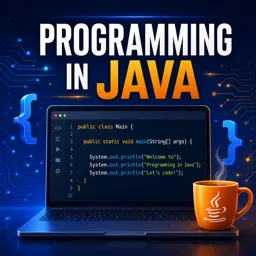
Duration of the online course: 9 hours and 57 minutes
New
Build real Java skills for work: learn OOP, arrays, loops and debugging in a free online course with exercises and optional certificate.
Java remains one of the most in-demand programming languages for building reliable software, from backend services to desktop applications. This free online course helps you move from curiosity to confident coding by guiding you through the core ideas that power everyday Java development. You will learn how Java code is compiled and executed, how to think like a programmer, and how to turn problem statements into working solutions.
Along the way, you will strengthen foundational skills that employers and technical interviews expect: working with primitive types, variables, and scope; writing clear conditional logic; and designing repeatable processes with loops while avoiding common pitfalls such as infinite loops. You will also practice reading and writing methods, using pseudocode to plan solutions before implementation, and building the habit of checking assumptions early so you can debug faster.
As you progress, the course focuses on practical data handling and classic problem-solving patterns. You will work with strings correctly, understand array indexing and traversal, and explore essential algorithms such as bubble sort to connect code with performance and clarity. These concepts translate directly into real tasks like processing user input, organizing data, and writing code that is easier to test and maintain.
A major turning point is learning object-oriented programming the Java way. You will understand why abstraction matters, how inheritance supports code reuse and cleaner design, and when to use abstract classes to define reusable blueprints. You will also build resilience in your programs through exception handling, a key skill for writing software that behaves predictably when something goes wrong.
To round out your perspective, the course introduces important computing concepts such as memory and volatile storage, plus an applied look at user interface structure with Swing and layout management. With videos and targeted exercises throughout, you will keep practicing until the fundamentals feel natural, leaving you prepared to continue into projects, advanced topics, or entry-level roles that require Java proficiency.

Explore the best free online JavaScript courses with certificates and build in-demand web development skills at your own pace. Learn JavaScript fundamentals, DOM manipulation, ES6, APIs, frameworks, and more through beginner-friendly and advanced classes. Enroll today, earn a certificate, and strengthen your resume for developer career opportunities.

Explore free online Programming Basics courses designed for beginners ready to learn coding. Build essential skills in programming concepts, logic, algorithms, variables, and problem-solving through flexible, self-paced lessons. Enroll at no cost, practice with beginner-friendly content, and earn a certificate to showcase your new programming skills.

9 hours and 57 minutes of online video course

Digital certificate of course completion (Free)

Exercises to train your knowledge

100% free, from content to certificate
What Java programming concepts are covered in the CSCI 111 course?
The course covers Java compilation, primitive types, variables and scope, pseudocode, loops, strings, arrays, sorting, inheritance, abstract classes, exceptions, storage, and Swing layouts.
How do you compare two strings correctly in Java?
Use the equals() method to compare string contents, such as str1.equals(str2), rather than using ==.
What is the purpose of a layout manager in Java Swing?
A layout manager automatically controls the size and position of components within a Swing container.
Ready to get started?Download the app and get started today.
Install the app now
to access the course
Over 5,000 free courses
Programming, English, Digital Marketing and much more! Learn whatever you want, for free.

Study plan with AI
Our app's Artificial Intelligence can create a study schedule for the course you choose.

From zero to professional success
Improve your resume with our free Certificate and then use our Artificial Intelligence to find your dream job.
You can also use the QR Code or the links below.



Free CourseLearn Python
5

(3)

13h00m

17 exercises
Free CourseCreate Desktop App
5
(4)
5h33m
30 exercises
Free CourseRuby on Rails
5
(7)
9h39m
34 exercises
Free CourseJava Programming
5
(4)
9h15m
48 exercises
Free CoursePython Ultimate Course: Learn Python from Scratch
5
(1)
12h31m
42 exercises
Free CourseJava
4.8
(56)
22h17m
28 exercises
Free CourseC# Sharp for beginner
4.8
(37)
3h55m
15 exercises
Free CourseC++ as your first Programming Language
4.8
(108)
5h12m
23 exercises
Free CourseJava for beginners
4.8
(183)
26h50m
49 exercises
Free CourseComputer science and Java
4.8
(65)
9h15m
31 exercises
Carry knowledge in your pocket.
Download the Cursa app.
There are hundreds of free courses available, with a free certificate of completion that is saved in your mobile image gallery.
Download the app to access the Course Completion Certificate for Free.


+ 10 million
students

Free and Valid
Certificate

60 thousand free
exercises

4.8/5 rating in
app stores

Free courses in
video and ebooks