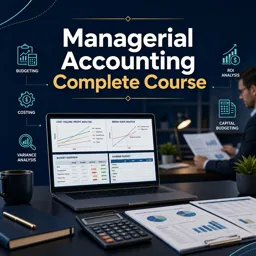
Free Course Image Managerial Accounting Complete Course

Free online course Managerial Accounting Complete Course

Duration of the online course: 31 hours and 51 minutes

4.3

StarStarStarStar

(4)

Make smarter business decisions with managerial accounting skills in this free online course—master costs, budgets, CVP and pricing with practical exercises.

In this free course, learn about

  • Introduction and Managerial Accounting Foundations
  • Cost Classification and Cost Flows
  • Cost Behavior and Contribution Income Statements
  • Cost-Volume-Profit Analysis
  • Job-Order Costing
  • Process Costing
  • Activity-Based Costing
  • Variable and Absorption Costing
  • Budgeting and Performance Reporting
  • Standard Costing and Variance Analysis
  • Segment Reporting and Decentralization
  • Relevant Costs and Decision Making
  • Capital Budgeting

About the free online course

Build the managerial accounting skills that turn financial data into clear decisions. This free online course helps you move beyond basic reporting and learn how managers actually use accounting information to plan, control operations, and improve performance. Whether you are aiming for a role in accounting, finance, operations, or entrepreneurship, you will gain a practical way to think about costs, profitability, and resource allocation in real business settings.

You will learn to distinguish financial versus managerial perspectives and connect accounting work to the everyday responsibilities of managers. As you progress, you will develop confidence with cost concepts that drive pricing and profit, including product versus period costs, cost of goods manufactured, and the behavior of fixed, variable, and mixed costs. The course emphasizes problem-solving through applied practice, helping you interpret results instead of simply memorizing formulas.

The learning experience is built around decision tools used across industries: contribution format income statements, cost-volume-profit relationships, break-even and target profit analysis, operating leverage, and sales mix thinking for multi-product environments. You will also explore how costs are assigned in different settings through job-order and process costing, including equivalent units, reconciliation, and FIFO methods—skills that matter for both manufacturing and many service processes.

To support modern analysis, you will work with activity-based costing and understand how overhead is traced through activities to cost objects, enabling better customer and product profitability insights. Later sections connect planning and control through budgeting, flexible budgets, and performance reporting, then expand into standard costing and variance analysis so you can investigate what is changing and why. The course closes with manager-focused topics such as segment reporting, transfer pricing, balanced scorecard thinking, relevant cost analysis, constrained resource decisions, cost-plus and target costing, and capital budgeting methods including NPV and IRR—giving you a rounded toolkit for evaluating alternatives and communicating decisions with evidence.

By the end, you will be able to explain cost behavior, build stronger profitability analysis, and approach managerial accounting questions with structure and confidence. If you want a career-ready foundation in accounting within business and marketing, this course provides a comprehensive, practice-oriented path from core concepts to advanced decision-making.

Course content

  • Video class: Managerial Accounting Introduction - Start Here 05m
  • Exercise: What study approach is emphasized as most effective for mastering managerial accounting?
  • Video class: Financial Versus Managerial Accounting 05m
  • Video class: Functions of Managers - Role of Management Accountants 09m
  • Video class: Corporate Governance and Corporate Social Responsibility 12m
  • Exercise: In continuous improvement, what is the main emphasis of lean production (Just-in-Time) systems?
  • Video class: Product Versus Period Costs 10m
  • Video class: Cost of Goods Manufactured 14m
  • Video class: Variable versus Fixed, Direct versus Indirect 13m
  • Exercise: Which statement best describes a variable cost?
  • Video class: Manufacturing Costs, Product Costs, Period Costs 18m
  • Video class: Cost of Goods Manufactured 09m
  • Video class: Fixed and Variable Costs 12m
  • Video class: Cost of Goods Manufactured 19m
  • Video class: Product Costs versus Period Costs 17m
  • Video class: Cost Behaviour 12m
  • Exercise: Which equation best represents a mixed (semi-variable) cost, where total cost includes both a fixed and a variable component?
  • Video class: Mixed Costs 11m
  • Video class: Contribution Format Income Statement 03m
  • Video class: Mixed Cost Using Least Squares 09m
  • Exercise: In least squares regression for cost estimation (y = a + bX), what makes the best-fit line?
  • Video class: Cost Behaviour using a Scattergram 11m
  • Video class: Mixed Cost - High-Low Method 13m
  • Video class: Contribution Format Income Statement 12m
  • Exercise: In the high-low method, what is the estimated variable shipping cost per unit (B) when the highest activity is 8 units with $3,600 cost and the lowest is 2 units with $1,500 cost?
  • Video class: High-Low Method and Mixed Costs 07m
  • Video class: High-Low Method, Scattergram 10m
  • Video class: Contribution Format Income Statement 15m
  • Exercise: Why can showing fixed costs on a per-unit basis be misleading in a contribution format income statement?
  • Video class: Cost-Volume-Profit Graph 13m
  • Video class: Contribution Margin Analysis 07m
  • Video class: Break-Even and Target Profit Analysis 12m
  • Exercise: Using the formula method, what is the break-even point in units if fixed costs are $35,000, selling price is $250, and variable cost per unit is $150?
  • Video class: Margin of Safety - Degree of Operating Leverage 08m
  • Video class: Cost Structure - Degree of Operating Leverage 10m
  • Video class: Sales Mix and Contribution Margin 11m
  • Exercise: In a multi-product firm, what key factor makes the break-even point change compared with a single-product firm?
  • Video class: Contribution Format Income Statement 10m
  • Video class: Contribution Margin Ratio 10m
  • Video class: Break-Even Point - Target Profit 10m
  • Exercise: A product sells for $8 with variable cost $6 per unit and fixed costs of $5,500 per month. What is the break-even point in unit sales?
  • Video class: Margin of Safety - Degree of Operating Leverage 09m
  • Video class: Multi-Service Company Break-Even 12m
  • Video class: Break-Even and Target Profit 14m
  • Exercise: If fixed expenses are $360,000, selling price is $60, and the contribution margin ratio is 40%, what is the break-even point in units?
  • Video class: Cost-Volume-Profit 18m
  • Video class: CVP Analysis 15m
  • Video class: Operating Leverage 17m
  • Exercise: Operating leverage: If sales volume increases by 25% and the degree of operating leverage is 6, what is the expected percentage increase in operating income?
  • Video class: Target Profit Analysis 09m
  • Video class: Break-Even Analysis 13m
  • Video class: Job-Order Costing 11m
  • Exercise: In job order costing, why is manufacturing overhead harder to assign than direct materials and direct labor?
  • Video class: Predetermined Overhead Rates 10m
  • Video class: Job-Order Costing 10m
  • Video class: Under/Over-Applied Manufacturing Overhead 13m
  • Video class: Job-Order Costing 09m
  • Video class: Predetermined Overhead Rate 12m
  • Video class: Applying Overhead Costs 11m
  • Exercise: How is manufacturing overhead applied when a predetermined overhead rate is used?
  • Video class: Applying Overhead 16m
  • Video class: Applying Overhead 18m
  • Video class: Applying Overhead 15m
  • Exercise: In a service company using job order costing, how is overhead applied to a job when the predetermined overhead rate is $45 per designer hour?
  • Video class: Under/Over-Applied Overhead 19m
  • Video class: Applying Overhead Costs 26m
  • Video class: Process Costing 10m
  • Video class: Equivalent Units of Production 11m
  • Video class: Cost Reconciliation 19m
  • Video class: Production Report - Complete 08m
  • Exercise: In a process costing production report, which section is used to compute equivalent units?
  • Video class: Computation of Equivalent Units 14m
  • Video class: Cost per Equivalent Unit 16m
  • Video class: Cost Per Equivalent Unit 16m
  • Exercise: How is the cost per equivalent unit for materials calculated in the production report?
  • Video class: Equivalent Units and $/Unit 19m
  • Video class: FIFO Process Costing 15m
  • Video class: FIFO Process Costing 09m
  • Exercise: Under FIFO process costing, which costs are used to compute the cost per equivalent unit?
  • Video class: FIFO Process Costing 17m
  • Video class: FIFO Process Costing 12m
  • Video class: Activity Based Costing 11m
  • Exercise: Which statement best describes activity-based costing (ABC) compared with traditional costing?
  • Video class: Activity Based Costing 15m
  • Video class: First-Stage Allocation 13m
  • Video class: Second-Stage Allocation 19m
  • Exercise: In second-stage allocation under activity-based costing (ABC), how are overhead costs assigned to a specific cost object?
  • Video class: ABC Management Reports 10m
  • Video class: First-Stage Allocation 12m
  • Video class: First-Stage Allocation 08m
  • Exercise: In an ABC system with two-stage allocation, how is the activity rate for an overhead cost pool computed?
  • Video class: Second-Stage Allocation 08m
  • Video class: Customer and Product Margins 14m
  • Video class: Variable Costing 13m
  • Video class: Variable Costing vs Absorption Costing 16m
  • Video class: Variable vs Absorption Costing 06m
  • Video class: Variable and Absorption Costing 08m
  • Exercise: Which cost is included in absorption costing unit product cost but excluded from variable costing unit product cost?
  • Video class: Absorption vs Variable Costing 17m
  • Video class: Absorption vs Variable Costing 14m
  • Video class: Budgeting 10m
  • Exercise: Which statement best describes zero-based budgeting?
  • Video class: Master Budget 10m
  • Video class: Production Budget 18m
  • Video class: Cash Budget 15m
  • Exercise: Why is the ending finished goods inventory budget typically prepared after the direct materials, direct labor, and manufacturing overhead budgets?
  • Video class: Flexible Budgets 14m
  • Video class: Budgeting 18m
  • Video class: Direct Materials and Direct Labour Budgets 12m
  • Exercise: In a direct materials purchases budget, how is the desired ending inventory typically determined in this scenario?
  • Video class: Manufacturing Overhead Budget 17m
  • Video class: Cash Budget and Flexible Budget 15m
  • Video class: Flexible Budget Performance Report 17m
  • Exercise: In a comprehensive performance report, how is the static budget variance (sales volume variance) calculated?
  • Video class: Standard Costing 15m
  • Video class: Standard Costing 12m
  • Video class: Standard Costing Variance Interpretation 16m
  • Exercise: Which scenario best explains how a favorable materials price variance can still lead to unfavorable results elsewhere?
  • Video class: Fixed Overhead under Standard Costing 16m
  • Video class: Fixed Overhead under Standard Costing 11m
  • Video class: Variance Investigations and Capacity Analysis 15m
  • Exercise: In an overhead performance report, how is the variable overhead efficiency variance computed?
  • Video class: Material Variances 13m
  • Video class: Labour and Overhead Variances 14m
  • Video class: Fixed Overhead Variances 10m
  • Exercise: How is the fixed portion of the predetermined overhead rate (POHR) computed in a standard costing system that applies overhead using standard direct labor-hours?
  • Video class: Material and Labour Variances 16m
  • Video class: Material and Labour Variances 10m
  • Video class: Labour and Variable Manufacturing Overhead Variances 19m
  • Exercise: Which set of variances correctly reconciles the $1,300 total direct labor variance for July?
  • Video class: Standard Costing Journal Entries 15m
  • Video class: Standard Costing Journal Entries 10m
  • Video class: Segment Reporting 09m
  • Exercise: In a segmented contribution format income statement, what happens after subtracting traceable fixed costs from the contribution margin?
  • Video class: Segment Reporting and Responsibility Centers 10m
  • Video class: Return on Investment 16m
  • Video class: Residual Income 12m
  • Video class: Segmented Income Statement 15m
  • Video class: Segmented Income Statement 15m
  • Video class: ROI vs Residual Income 11m
  • Video class: ROI and Residual Income 13m
  • Video class: Transfer Pricing Part 1 11m
  • Video class: Transfer Pricing Part 2 12m
  • Exercise: When the selling division has idle capacity (no outside sales are displaced), what transfer-price range allows a mutually beneficial internal transfer in this example?
  • Video class: Transfer Pricing 16m
  • Video class: Balanced Scorecard 17m
  • Video class: Relevant Costs 11m
  • Exercise: Which cost is considered relevant for decision-making between alternatives?
  • Video class: Relevant Cost Analysis 15m
  • Video class: Relevant Cost Analysis 17m
  • Video class: Utilization of a Constrained Resource 06m
  • Exercise: When a resource is constrained (a bottleneck), which metric best guides product mix decisions to maximize profit?
  • Video class: Cost Plus Pricing 14m
  • Video class: Cost Plus Pricing and Target Costing 14m
  • Video class: Relevant Costs and Dropping a Segment 16m
  • Exercise: In a replacement decision where production and sales will not change, which item is a sunk cost and therefore not relevant?
  • Video class: Relevant Cost Scenarios 14m
  • Video class: Utilization of a Constrained Resource 10m
  • Video class: Target Pricing 12m
  • Exercise: Under absorption costing cost-plus pricing, what mark-up percentage is needed to achieve an 8% ROI given 10,000 units, $16 unit product cost, $40,000 annual SG&A, and $400,000 investment?
  • Video class: Capital Budgeting Introduction 09m
  • Video class: Present Value A 18m
  • Video class: Present Value B 21m
  • Exercise: Which statement best describes why the present value of an annuity due is greater than the present value of an ordinary annuity (all else equal)?
  • Video class: Net Present Value A 12m
  • Video class: Net Present Value B 13m
  • Video class: Net Present Value C 07m
  • Exercise: When computing the NPV in Excel for this 5-year project, what net cash flow should be entered for the end of Year 4?
  • Video class: Net Present Value D 17m
  • Video class: Net Present Value E 13m
  • Video class: Internal Rate of Return 12m
  • Exercise: What does the internal rate of return (IRR) of a project represent?
  • Video class: Preference Payback and Simple Rate of Return 18m
  • Video class: NPV and IRR 10m
  • Video class: NPV and IRR 07m
  • Exercise: What annual dollar amount of intangible benefits is required to make the automated equipment investment acceptable (NPV = 0) given the shortfall at 15% over 10 years?
  • Video class: Payback and Simple Rate of Return and NPV 06m
  • Video class: NPV and IRR 10m
  • Video class: Net Present Value with Taxes A 19m
  • Exercise: Why is depreciation (CCA) handled separately when calculating after-tax NPV?
  • Video class: Net Present Value with Taxes B 11m
  • Video class: Net Present Value and Taxes 21m
  • Video class: Net Present Value and Taxes 28m
  • Exercise: When selling old equipment that is fully depreciated for $22,500, how should the cash inflow be treated for NPV purposes when the tax rate is 30%?

This free course includes:

Icon for learning via the audio course

31 hours and 51 minutes of online video course

Icon for the digital course completion certificate

Digital certificate of course completion (Free)

Icon for exercises to practice what you've learned

Exercises to train your knowledge

Icon for courses that are 100% free from start to finish

100% free, from content to certificate

What is the difference between financial accounting and managerial accounting?

Financial accounting produces standardized reports for external users, while managerial accounting provides internal information for planning, control, and decision-making.

How do you calculate cost of goods manufactured?

Add direct materials used, direct labor, and manufacturing overhead, then adjust for the change in work-in-process inventory.

How is variable cost per unit calculated using the high-low method?

Subtract the low total cost from the high total cost and divide by the difference in activity levels. For $3,600 at 8 units and $1,500 at 2 units, the variable cost is $350 per unit.

Ready to get started?Download the app and get started today.

Install the app now

to access the course
Icon representing technology and business courses

Over 5,000 free courses

Programming, English, Digital Marketing and much more! Learn whatever you want, for free.

Calendar icon with target representing study planning

Study plan with AI

Our app's Artificial Intelligence can create a study schedule for the course you choose.

Professional icon representing career and business

From zero to professional success

Improve your resume with our free Certificate and then use our Artificial Intelligence to find your dream job.

You can also use the QR Code or the links below.

QR Code - Download Cursa - Online Courses

Course comments: Managerial Accounting Complete Course

IA

ijaz ahmed

StarStarStarStarStar

Best content

More free courses at Accounting

Free Ebook + Audiobooks! Learn by listening or reading!