Platform threads map to operating-system threads, while virtual threads are lightweight JVM-managed threads designed to support large numbers of blocking tasks.

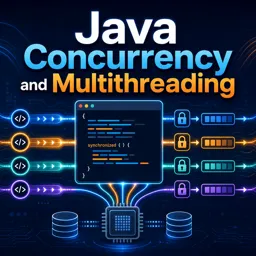
Duration of the online course: 8 hours and 38 minutes
New
Build fast, reliable Java apps with a free concurrency course—master threads, virtual threads, locks, and ExecutorService with hands-on practice.
Modern Java applications rarely run in a quiet, single-threaded world. Web backends handle thousands of requests, data pipelines process streams continuously, and desktop or mobile apps must stay responsive while work happens in the background. This free online course helps you become confident with Java concurrency and multithreading so you can write software that is faster, safer, and easier to scale.
You will learn how threads actually behave in the JVM, how to create and manage them correctly, and when a different approach is a better fit. You will explore virtual threads and what they change for high-throughput, I/O-heavy services, then connect those ideas to the fundamentals that never go away: the Java Memory Model, visibility, ordering, and the happens-before guarantee. With that foundation, concepts like volatile, synchronized blocks, and CPU cache coherence stop feeling like magic and start becoming practical tools you can apply with intention.
As you move forward, the course strengthens your ability to design predictable multithreaded code. You will recognize and prevent race conditions, understand the difference between concurrency and parallelism, and choose strategies that match the problem instead of adding complexity. You will get comfortable with core building blocks used in real systems such as thread pools, locks like ReentrantLock, ThreadLocal, and higher-level execution patterns with ExecutorService, including methods that control how tasks are scheduled and results are retrieved.
You will also learn to spot classic failure modes early. Deadlocks, congestion, and false sharing can quietly destroy performance or reliability; here you will see why they happen and how to avoid them through disciplined structure and simple prevention techniques. The course connects these ideas to scalable coordination patterns like producer-consumer with BlockingQueue, signaling between threads, and efficient parallel execution using ForkJoinPool. By the end, you will be better prepared to reason about concurrency tradeoffs and build Java applications that remain correct under load.

Explore free online Multithreading courses designed to help you master concurrent programming, thread management, synchronization, locks, race conditions, deadlocks, and performance optimization. Learn practical skills for Java, Python, C++, and more at your own pace, then earn a certificate to showcase your multithreading expertise.

Explore the best free online JavaScript courses with certificates and build in-demand web development skills at your own pace. Learn JavaScript fundamentals, DOM manipulation, ES6, APIs, frameworks, and more through beginner-friendly and advanced classes. Enroll today, earn a certificate, and strengthen your resume for developer career opportunities.

8 hours and 38 minutes of online video course

Digital certificate of course completion (Free)

Exercises to train your knowledge

100% free, from content to certificate
What is the difference between Java platform threads and virtual threads?
Platform threads map to operating-system threads, while virtual threads are lightweight JVM-managed threads designed to support large numbers of blocking tasks.
How do volatile and synchronized differ in Java concurrency?
volatile guarantees visibility of variable updates between threads, while synchronized provides both visibility and mutual exclusion for protected code.
How can Java deadlocks be prevented when using multiple locks?
Use a consistent lock acquisition order, keep lock scope short, and consider timed lock attempts with ReentrantLock.
Ready to get started?Download the app and get started today.
Install the app now
to access the course
Over 5,000 free courses
Programming, English, Digital Marketing and much more! Learn whatever you want, for free.

Study plan with AI
Our app's Artificial Intelligence can create a study schedule for the course you choose.

From zero to professional success
Improve your resume with our free Certificate and then use our Artificial Intelligence to find your dream job.
You can also use the QR Code or the links below.



Free CourseLearn Python
5

(3)

13h00m

17 exercises
Free CourseCreate Desktop App
5
(4)
5h33m
30 exercises
Free CourseRuby on Rails
5
(7)
9h39m
34 exercises
Free CourseJava Programming
5
(4)
9h15m
48 exercises
Free CoursePython Ultimate Course: Learn Python from Scratch
5
(1)
12h31m
42 exercises
Free CourseJava
4.8
(56)
22h17m
28 exercises
Free CourseC# Sharp for beginner
4.8
(37)
3h55m
15 exercises
Free CourseC++ as your first Programming Language
4.8
(108)
5h12m
23 exercises
Free CourseJava for beginners
4.8
(183)
26h50m
49 exercises
Free CourseComputer science and Java
4.8
(65)
9h15m
31 exercises
Carry knowledge in your pocket.
Download the Cursa app.
There are hundreds of free courses available, with a free certificate of completion that is saved in your mobile image gallery.
Download the app to access the Course Completion Certificate for Free.


+ 10 million
students

Free and Valid
Certificate

60 thousand free
exercises

4.8/5 rating in
app stores

Free courses in
video and ebooks