The RL time constant is represented by τ (tau) and is calculated as τ = L/R seconds, where L is inductance in henries and R is resistance in ohms.

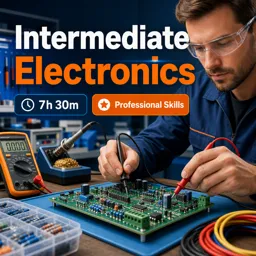
Duration of the online course: 7 hours and 30 minutes
New
Build job-ready electronics skills in this free online course—master AC/DC basics, inductors, oscilloscopes and digital logic, plus a certificate option.
Step beyond the basics and start thinking like a technician. This intermediate electronics course is designed for learners in professional trades—especially electricians—who want a clearer, more confident grasp of how real-world circuits behave. Instead of stopping at simple rules, you will learn to interpret what is happening inside a circuit, predict outcomes, and connect theory to practical troubleshooting decisions you make on the job.
You will strengthen your foundation in essential electronic principles and then build into the logic that powers modern control systems. By understanding why digital circuits were developed and how numbering systems such as binary, BCD, and larger bit-based systems represent information, you gain the mindset needed to read specifications, follow signals through a system, and avoid common misinterpretations when working around digital equipment.
On the power and reactive components side, you will develop a practical understanding of inductance and how magnetic fields and core materials change what an inductor does in a circuit. You will connect those ideas to Lenz’s law, explore how orientation and construction influence inductance, and understand how RL time constants affect switching, stability, and response time. This helps you make sense of behaviors that otherwise look like noise, lag, or unexplained delays in equipment.
AC concepts are treated as tools you can use, not formulas to memorize. You will focus on effective values you should work with in practice, how phase relationships shift in capacitive circuits, and how frequency changes reactance. These concepts translate directly to safer decisions and more accurate measurements when dealing with alternating current systems and common circuit combinations.
Measurement and signal visibility are central to the course. You will learn what an oscilloscope is for, what the key controls achieve, and how proper display setup improves interpretation of waveforms. You will also see how technicians use analysis techniques and graphs to understand behaviors like feedback response and noise—skills that support better diagnosis rather than guesswork.
By the end, you will be better prepared to work with electronics found in controls, power applications, and audio or filtering circuits, with a stronger ability to communicate clearly about what you observe and what it means. It is a practical step toward more advanced study and more confident field work.

7 hours and 30 minutes of online video course

Digital certificate of course completion (Free)

Exercises to train your knowledge

100% free, from content to certificate
How is the RL circuit time constant calculated?
The RL time constant is represented by τ (tau) and is calculated as τ = L/R seconds, where L is inductance in henries and R is resistance in ohms.
What is the maximum decimal value represented by 16-bit binary?
An unsigned 16-bit binary system represents 65,536 combinations, from 0 to 65,535.
Why is an oscilloscope used in electronics troubleshooting?
An oscilloscope displays voltage signals over time, helping technicians measure waveform shape, amplitude, frequency, timing, and electrical noise.
Ready to get started?Download the app and get started today.
Install the app now
to access the course
Over 5,000 free courses
Programming, English, Digital Marketing and much more! Learn whatever you want, for free.

Study plan with AI
Our app's Artificial Intelligence can create a study schedule for the course you choose.

From zero to professional success
Improve your resume with our free Certificate and then use our Artificial Intelligence to find your dream job.
You can also use the QR Code or the links below.




Free CourseInstall Your Own Solar Power System
5

(2)

59m

6 exercises
Free CourseElectronic Circuits Course
5
(7)
43h25m
49 exercises

Free CourseWind Turbines
5
(4)
3h49m
19 exercises
Free CourseEngineering Circuits Analysis
5
(6)
3h11m
20 exercises
Free CourseElectronics - Nanoelectronics: Devices and Materials
4.8
(44)
40h15m
31 exercises
Free CourseBasic electronics
4.8
(23)
6h04m
30 exercises
Free CourseElectrical engineering
4.8
(27)
11h53m
20 exercises
Free CourseElectrical - Fabrication of Silicon
4.8
(26)
35h10m
28 exercises
Free CourseBeginner Electronics
4.8
(85)
5h27m
24 exercises
Free CourseElectricity course
4.8
(58)
31h41m
6 exercises
Carry knowledge in your pocket.
Download the Cursa app.
There are hundreds of free courses available, with a free certificate of completion that is saved in your mobile image gallery.
Download the app to access the Course Completion Certificate for Free.


+ 10 million
students

Free and Valid
Certificate

60 thousand free
exercises

4.8/5 rating in
app stores

Free courses in
video and ebooks