It covers chords, scales, intervals, rhythm and notation, modes, pentatonic and blues playing, triads, chord voicings, progressions, modulation, and ear training.

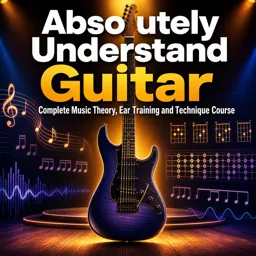
Duration of the online course: 31 hours and 16 minutes
New
Play electric guitar with confidence: a free course to master music theory, ear training and technique, so you can learn faster and improvise better.
If you have ever memorized shapes on the fretboard but still felt unsure about what you are playing, this course is designed to change that. You will connect technique with real understanding, so chords, scales, rhythm and ear training stop feeling like separate topics and start working together every time you pick up the guitar. Instead of relying on guesswork, you will build a clear mental map of music that makes learning songs easier and creating your own ideas feel natural.
Through a practical approach to pitch patterns, you will learn how the musical alphabet repeats, why standard tuning is laid out the way it is, and how to navigate the instrument without getting lost. The lessons focus on turning information into ability: seeing chord shapes as movable systems, understanding why barre chords work, and recognizing how chord names are constructed so you can decode unfamiliar symbols quickly. As your foundation solidifies, you will use a number-based view of harmony to understand what stays consistent across keys, which makes transposing and communicating with other musicians far less intimidating.
Rhythm and notation are treated as useful tools rather than academic hurdles, helping you line up what you hear with what you play. You will train your ear to recognize intervals and the character they add to a melody or chord, then apply that to must-know scales, inversions and position shifts on the neck. From modes and diatonic harmony to pentatonic relationships, minor-key thinking, blues color, chord voicings, progressions, and the basics of modulation, the goal is the same: give you a working understanding you can use immediately in riffs, solos and songwriting.
By the end, you will have a stronger fretboard awareness, faster decision-making when improvising, and a reliable process for identifying and learning any pitch pattern. Whether you are returning to guitar or trying to break through a plateau, you will walk away with skills that make practice more productive and playing more musical.

31 hours and 16 minutes of online video course

Digital certificate of course completion (Free)

Exercises to train your knowledge

100% free, from content to certificate
What music theory topics does the Absolutely Understand Guitar course teach?
It covers chords, scales, intervals, rhythm and notation, modes, pentatonic and blues playing, triads, chord voicings, progressions, modulation, and ear training.
How does the course explain guitar modes over chord progressions?
It teaches matching modes to chord function in diatonic progressions, such as using Ionian over the I chord and Mixolydian over the V chord.
What does “four ways to know” a guitar pitch pattern mean?
It is a framework for learning chords, scales, and intervals through multiple connected perspectives, helping players understand, hear, visualize, and apply patterns on the fretboard.
Ready to get started?Download the app and get started today.
Install the app now
to access the course
Over 5,000 free courses
Programming, English, Digital Marketing and much more! Learn whatever you want, for free.

Study plan with AI
Our app's Artificial Intelligence can create a study schedule for the course you choose.

From zero to professional success
Improve your resume with our free Certificate and then use our Artificial Intelligence to find your dream job.
You can also use the QR Code or the links below.




Free CourseElectric Guitar
5

(1)

25h45m

37 exercises
Free CourseMetal Guitar 101 for Beginners
5
(1)
52m
2 exercises

Free CourseEletric guitar
4.8
(18)
7h37m
36 exercises
Free CourseGuitar basics
4
(1)
1h09m
6 exercises

Free CourseLearn Blues Guitar
New
43m
8 exercises
Free CourseBeginner Eletric Guitar course
New
6h51m
40 exercises
Free CourseBeginner Eletric Guitar
New
3h21m
13 exercises
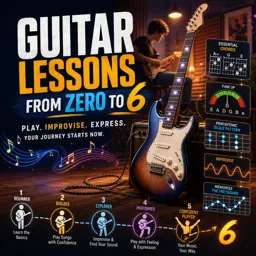
Free CourseGuitar Lessons From Zero To 6
New
3h03m
17 exercises

Free CourseEletric Guitar Beginners Level
New
3h10m
25 exercises
Free CourseSlide Guitar 101 Basics
New
26m
5 exercises
Carry knowledge in your pocket.
Download the Cursa app.
There are hundreds of free courses available, with a free certificate of completion that is saved in your mobile image gallery.
Download the app to access the Course Completion Certificate for Free.


+ 10 million
students

Free and Valid
Certificate

60 thousand free
exercises

4.8/5 rating in
app stores

Free courses in
video and ebooks