
Exercises
Explore how information architecture helps users find, understand, and navigate digital content. This quiz covers taxonomy design, navigation systems, card sorting, tree testing, labeling, sitemaps, breadcrumbs, search data, and IA governance. Questions range from foundational concepts to practical interpretation of navigation structures and research findings.
Answer the questions below and check the explanation for each answer.
0/18 answered
Auto audio on: the next questions will be read aloud when you click Continue.
Information architecture structures, organizes, and labels content so users can locate information and understand where they are within a product.
In closed card sorting, participants sort content into predefined categories. It is useful for evaluating an existing or proposed taxonomy.
Tree testing presents a simplified hierarchy and asks participants where they would look for specific information. This isolates the effectiveness of the structure and labels.
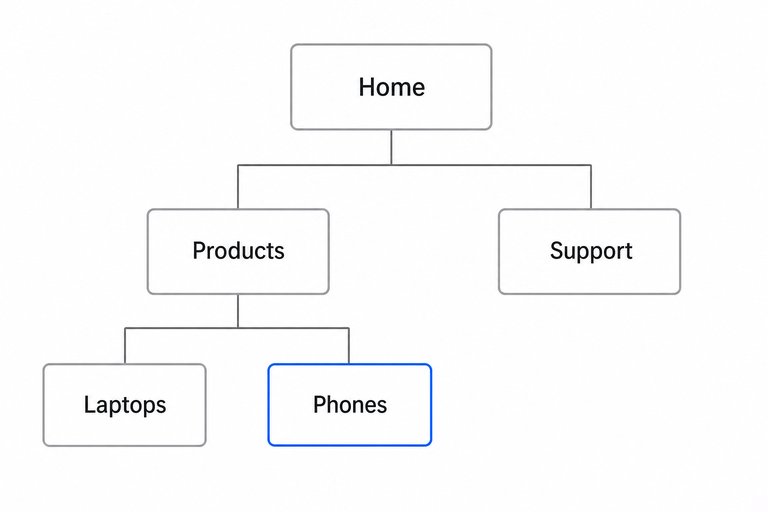
The diagram places Phones directly beneath Products, making Phones a child page and Products its parent.
Mutually exclusive categories have distinct boundaries, reducing uncertainty about where an item belongs. Some systems intentionally allow overlap, but it should be deliberate.
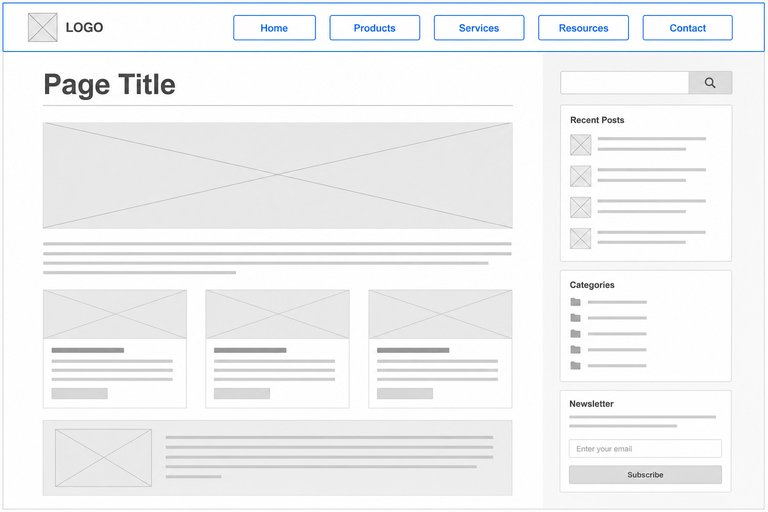
Global navigation provides access to major sections from across the product. It commonly appears persistently in the header.
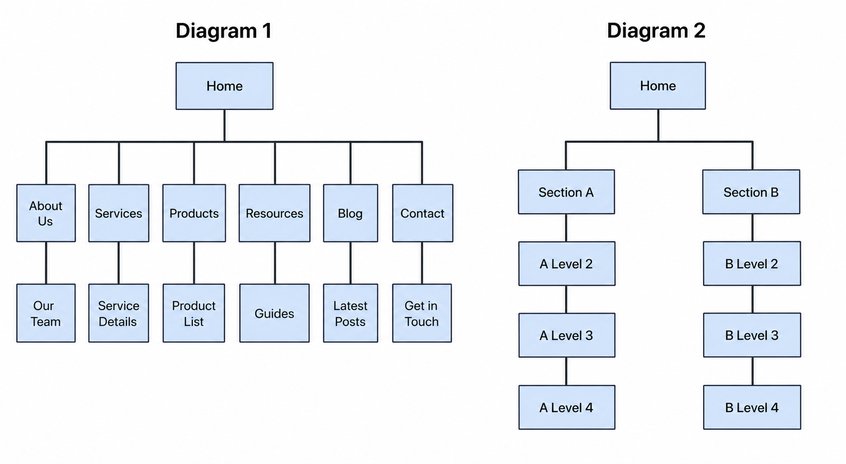
Diagram 1 has many choices near the top and few levels, so it is broad and shallow. Diagram 2 has fewer choices per level but extends more deeply.
A specific, descriptive label closely predicts the destination content. This gives users stronger information scent than vague labels such as More or Useful Information.
Polyhierarchy allows the same item to appear in more than one logical category. This can support different user expectations, though excessive duplication may create management challenges.
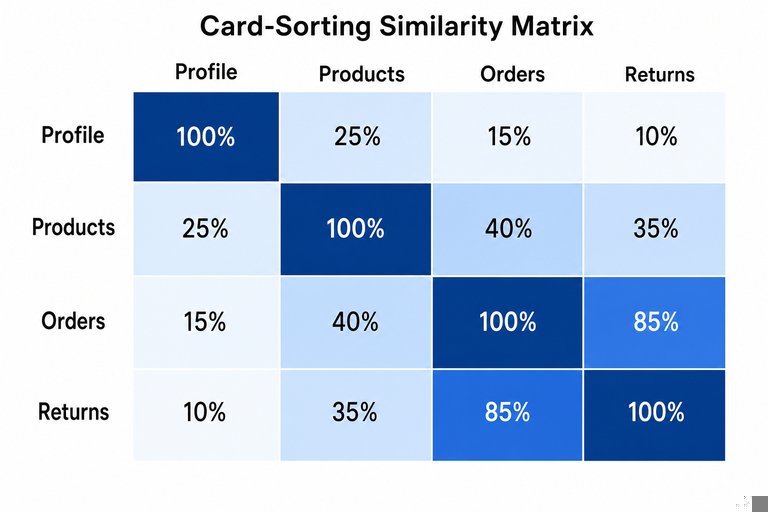
The Orders–Returns cell has the highest similarity value. This indicates that participants grouped those two items together more frequently than the other listed pairs.
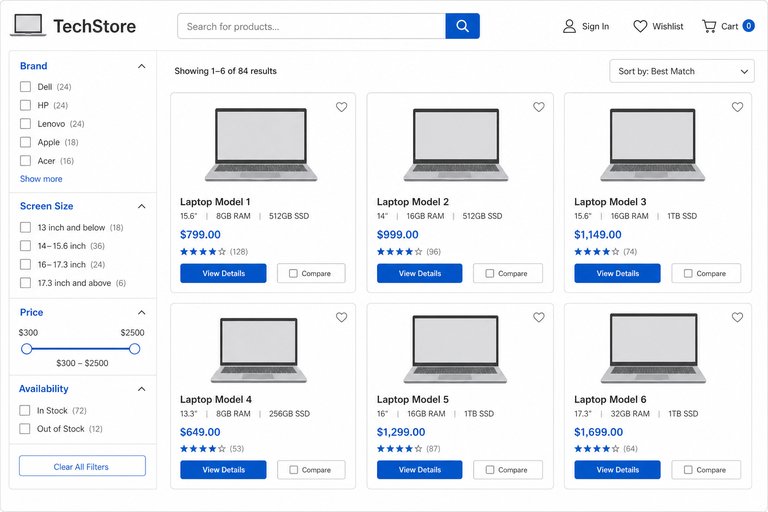
Faceted classification lets users narrow a collection through multiple independent attributes, such as brand, size, price, and availability.
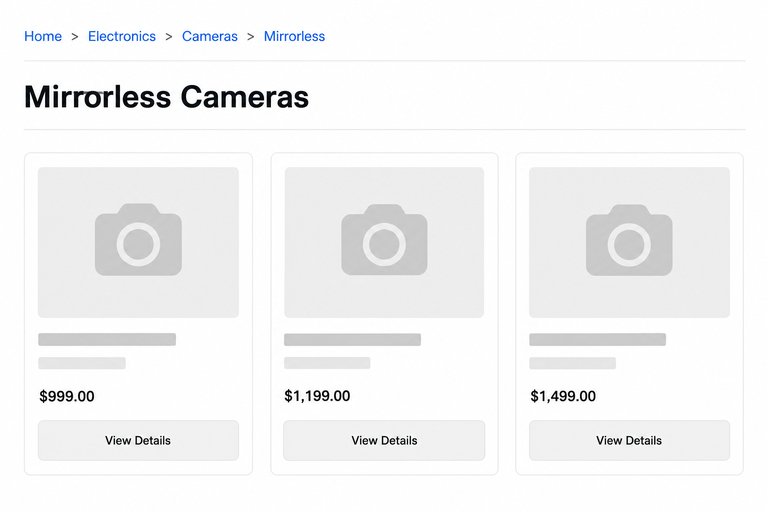
This breadcrumb displays the current page's position within the site's category hierarchy, so it is hierarchy-based rather than based on attributes or browsing history.
First-click testing examines the initial location selected for a task. A correct first choice often predicts successful navigation through the remaining path.
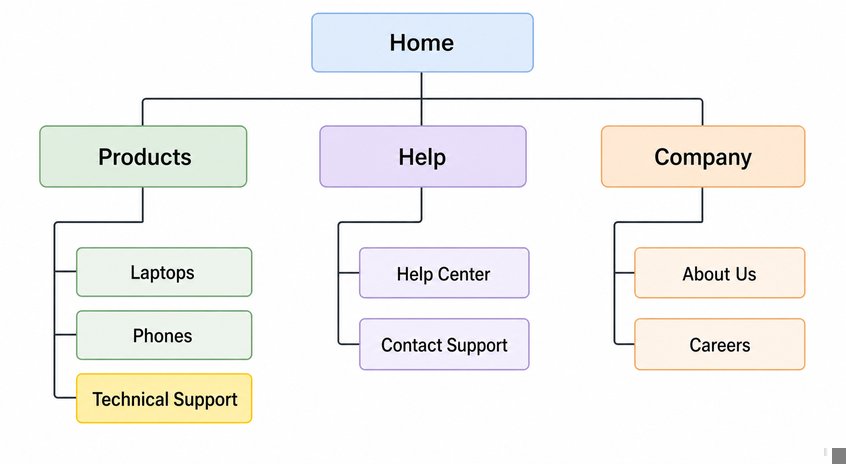
Technical Support is conceptually aligned with Help Center and Contact Support. Placing these items together creates a more coherent support category.
A controlled vocabulary establishes consistent preferred terms and can map synonyms to them. This improves labeling, metadata quality, browsing, and search retrieval.
Search logs reveal the words users employ, the content they seek, and queries that fail. These findings can guide labels, synonyms, categories, and content priorities.
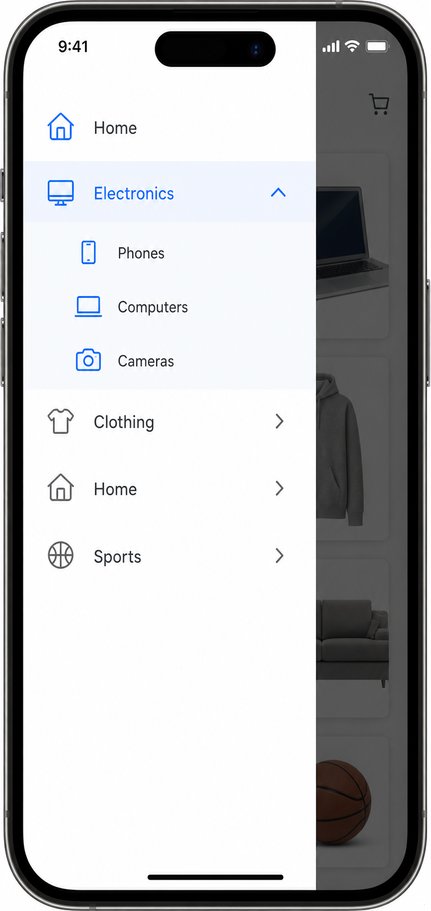
Progressive disclosure initially hides secondary choices and reveals them when relevant. This reduces visible complexity while preserving access to deeper levels.
Governance assigns responsibility and establishes standards for maintaining labels, metadata, categories, and navigation as products and content evolve.
Free CourseUser Interface Design
5

(4)

12h04m

21 exercises

Free CourseUI Design for beginners
5
(1)
1h20m
5 exercises

Free CoursePrinciple UI/UX
4.9
(39)
6h39m
20 exercises

Free CourseWeb and Desktop app UI design in Figma
4.9
(8)
1h16m

Free CourseWeb design
4.9
(7)
4h17m
18 exercises
Free CourseAdobe XD Tutorials
4.8
(23)
7h23m
16 exercises

Free CourseUX design for mobile
4.8
(94)
1h37m
24 exercises

Free CourseUX/UI design course
4.7

(31)
2h34m
20 exercises
Thousands of online courses in video, ebooks and audiobooks.
To test your knowledge during online courses
Generated directly from your cell phone's photo gallery and sent to your email

Download our app via QR Code or the links below:.


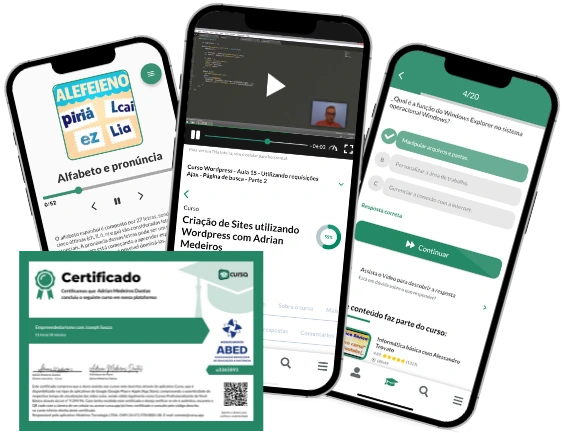
Carry knowledge in your pocket.
Download the Cursa app.
There are hundreds of free courses available, with a free certificate of completion that is saved in your mobile image gallery.
Download the app to access the Course Completion Certificate for Free.


+ 10 million
students

Free and Valid
Certificate

60 thousand free
exercises

4.8/5 rating in
app stores

Free courses in
video and ebooks