
Exercises
Put your piano skills to the test with this Intermediate Piano Knowledge Assessment. Explore essential concepts that help developing pianists play with greater confidence, accuracy, and musical expression. Questions cover the differences between grand and upright pianos, scale fingering, legato touch, octaves and semitones, metronome practice, thumb technique, arpeggios, strategies for difficult passages, forte dynamics, and sustain pedal use. Whether you are preparing for lessons, reviewing music theory, or strengthening your practice habits, this quiz is a useful way to assess your understanding of core intermediate piano techniques and terminology.
Answer the questions below and check the explanation for each answer.
0/10 answered
Auto audio on: the next questions will be read aloud when you click Continue.
The strings of a grand piano run horizontally, allowing for longer strings and a larger soundboard, which typically produce a richer sound compared to the vertical string arrangement in upright pianos.
When practicing scales, a common fingering for both hands is 1-2-3-1 for the right hand ascending or left hand descending, helping in smooth transitions across octaves.
'Legato' means to play notes smoothly and connected, ensuring no breaks between the transitions, which contrasts with the detached articulation of staccato playing.
An octave on the piano encompasses 12 semitones, covering all the keys from one pitch to its next occurrence of the same pitch in the music scale.
A metronome provides a steady beat, aiding pianists in maintaining a consistent tempo, which is crucial for developing rhythmic precision and discipline in practice.
The thumb, due to its adaptive angle and strength, often acts as a pivot in scale transitions, enabling smooth passages and reducing hand movement or strain.
An arpeggio involves playing the notes of a chord in sequence, rather than simultaneously, creating a flowing, melodic pattern distinct from block chord formations.
Practicing difficult passages separately with each hand before playing them together allows a focus on each hand's role, aiding memory, coordination, and making the combined effort more manageable.
'Forte' is a dynamic marking indicating that a passage should be played loudly, contrasting with 'piano,' which signifies a soft dynamic.
The sustain pedal, when depressed, lifts the dampers off the strings, allowing notes to sound longer and resonate, thus enriching the sound and enhancing legato playing.

Free CoursePiano theory course
5

(4)

2h58m

29 exercises

Free CourseHow to play Piano for beginners
5
(1)
7h13m
27 exercises

Free CoursePiano Level 1
5
(1)
11h24m
31 exercises

Free CourseBeginner Piano Lessons
5
(1)
2h38m
20 exercises

Free CourseIntermediate Piano
5
(1)
2h15m
6 exercises

Free CourseLearn Piano for Beginners to Advanced
5
(1)
15h43m
37 exercises

Free CoursePiano
4.9
(73)
10h44m
51 exercises

Free CourseLearn Chords
4.5

(37)
45m
12 exercises
Thousands of online courses in video, ebooks and audiobooks.
To test your knowledge during online courses
Generated directly from your cell phone's photo gallery and sent to your email

Download our app via QR Code or the links below:.


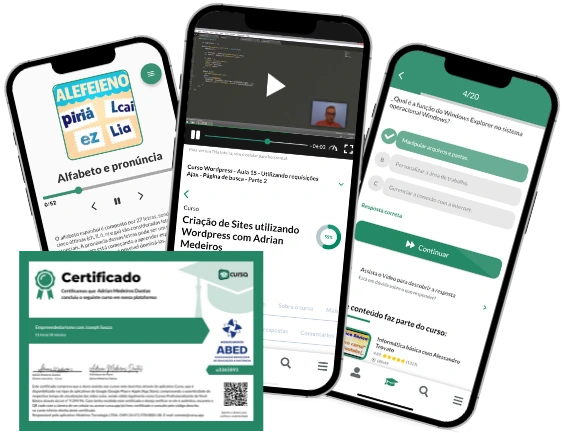
Carry knowledge in your pocket.
Download the Cursa app.
There are hundreds of free courses available, with a free certificate of completion that is saved in your mobile image gallery.
Download the app to access the Course Completion Certificate for Free.


+ 10 million
students

Free and Valid
Certificate

60 thousand free
exercises

4.8/5 rating in
app stores

Free courses in
video and ebooks