
Exercises
Explore the ideas that reshaped Europe in this Renaissance Philosophy Knowledge Simulation. Test your understanding of leading thinkers, including Erasmus, Machiavelli, Thomas More, Francis Bacon, René Descartes, Michel de Montaigne, Giovanni Pico della Mirandola, Giordano Bruno, and Petrus Ramus. Questions examine humanism, political realism, ideal societies, scientific inquiry, methodological doubt, the dignity of humankind, cosmology, and challenges to Aristotelian tradition. See how well you know the philosophers and movements that helped bridge the medieval and modern worlds.
Answer the questions below and check the explanation for each answer.
0/10 answered
Auto audio on: the next questions will be read aloud when you click Continue.
Erasmus of Rotterdam was known as the Prince of Humanists for his influential works advocating Christian humanism. His Erasmusian perspective significantly shaped the intellectual landscape of the Renaissance period.
Niccolò Machiavelli, in his work The Prince, is often associated with the idea that the end justifies the means, emphasizing pragmatic approaches over moral ones in political leadership.
Thomas More's Utopia describes an ideal society on an imaginary island, exploring themes like political structures, social norms, and justice, presenting a contrast to European society of his time.
Francis Bacon is credited with developing the scientific method, emphasizing empirical evidence and systematic experimentation as the basis for scientific discovery.
René Descartes pioneered the concept of doubt as a method in philosophy, famously stating, I think, therefore I am, which laid the groundwork for modern rationalism.
Michel de Montaigne is known for his essays, where he explores the concept of silent language as the eloquence of absence, with a deep self-reflective approach.
Giovanni Pico della Mirandola emphasized human dignity and potential in his works, especially in Oration on the Dignity of Man, which celebrates human ability and aspiration.
Giordano Bruno advocated the concept of an infinite universe with countless worlds, which was controversial and led to his persecution by opposing religious views of the cosmos.
Renaissance humanism was primarily based on a revival of classical antiquity, focusing on Greco-Roman texts and values celebrating secularism, individualism, and empirical evidence.
Galileo Galilei is known for challenging Aristotle's traditional physics and astronomy, using observation and experimentation, which laid the foundation for modern science distinguishing from Aristotelian perspectives.
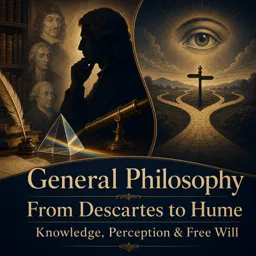
Free CourseGeneral Philosophy: From Descartes to Hume, Knowledge, Perception and Free Will
5

(1)

6h53m

32 exercises
Free CoursePhilosophy of Justice
4.9
(14)
11h01m
12 exercises
Free CoursePhilosophy and the Science of Human Nature
4.9
(82)
19h40m
22 exercises
Free CoursePhilosophy of Death
4.5

(2)
20h45m
25 exercises
Thousands of online courses in video, ebooks and audiobooks.
To test your knowledge during online courses
Generated directly from your cell phone's photo gallery and sent to your email

Download our app via QR Code or the links below:.



Carry knowledge in your pocket.
Download the Cursa app.
There are hundreds of free courses available, with a free certificate of completion that is saved in your mobile image gallery.
Download the app to access the Course Completion Certificate for Free.


+ 10 million
students

Free and Valid
Certificate

60 thousand free
exercises

4.8/5 rating in
app stores

Free courses in
video and ebooks