
Exercises
This quiz explores how managers make sound choices when outcomes are uncertain. It covers programmed and nonprogrammed decisions, expected monetary value, decision trees, payoff matrices, minimax regret, Bayesian reasoning, sensitivity analysis, the value of perfect information, sunk costs, cognitive bias, and groupthink prevention. Questions combine conceptual knowledge with practical calculations and visual interpretation.
Answer the questions below and check the explanation for each answer.
0/11 answered
Auto audio on: the next questions will be read aloud when you click Continue.
A nonprogrammed decision addresses a novel, complex, or unstructured problem for which no established procedure provides a complete answer.
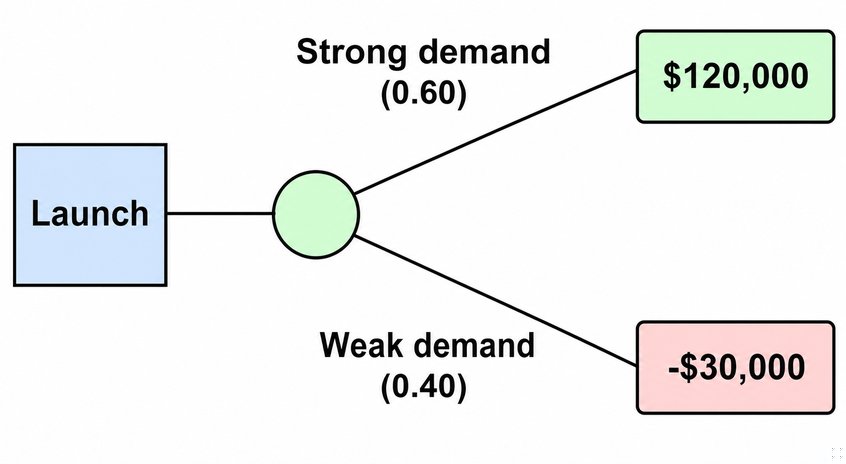
The expected monetary value is (0.60 × $120,000) + (0.40 × −$30,000) = $72,000 − $12,000 = $60,000.
Maximin identifies each alternative's minimum payoff and then selects the alternative with the highest of those minimum payoffs. It is a conservative criterion.
The research expenditure is already incurred and cannot be recovered. Rational analysis should compare only the future costs and benefits of continuing or stopping.
Confirmation bias is the tendency to favor information that supports an existing belief while discounting evidence that challenges it.

In standard decision trees, a circle represents a chance node, where uncertain outcomes branch according to their probabilities. A square represents a decision node.
Sensitivity analysis varies important inputs, such as probabilities, costs, or demand estimates, to determine whether the preferred choice remains robust.
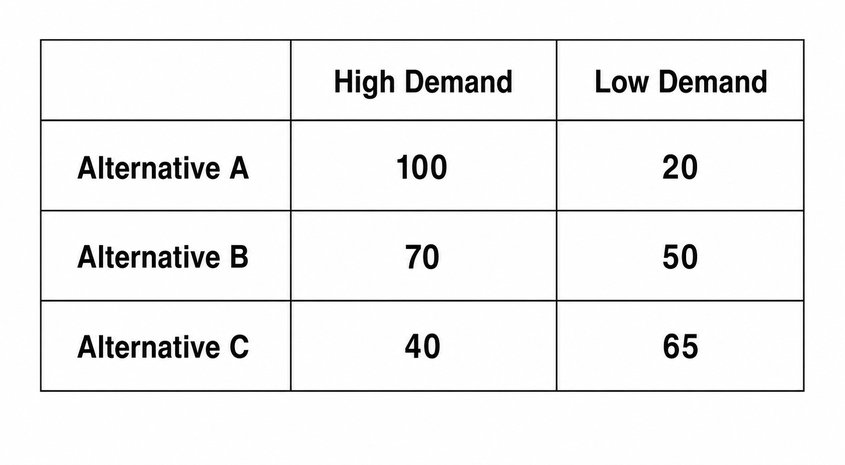
The maximum regrets are 45 for A, 30 for B, and 60 for C. Minimax regret selects B because its largest possible regret is the smallest.
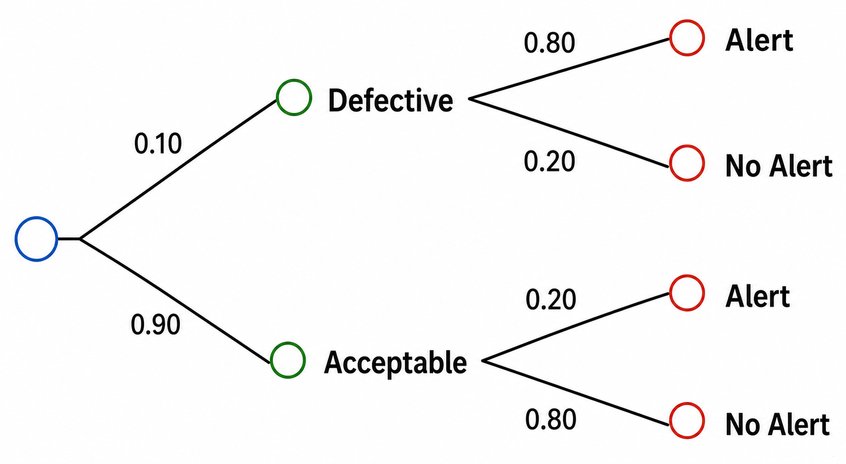
Bayes' rule gives (0.10 × 0.80) ÷ [(0.10 × 0.80) + (0.90 × 0.20)] = 0.08 ÷ 0.26, or approximately 31%.
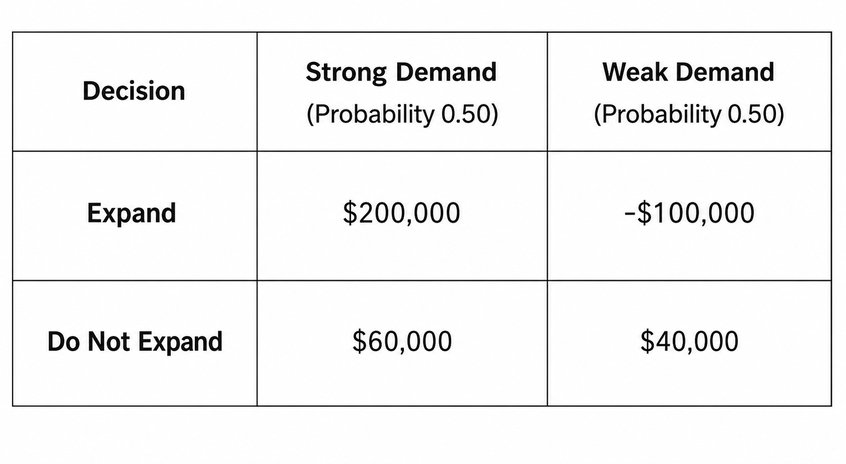
Without perfect information, the best expected payoff is $50,000. With perfect information, it is 0.5($200,000) + 0.5($40,000) = $120,000. EVPI is therefore $70,000.
A devil's advocate challenges assumptions and makes disagreement legitimate. Inviting contrary evidence helps the team evaluate alternatives rather than conform prematurely.

Free CoursePrinciples of Management
4.9

(22)

33h58m

33 exercises

Free CourseManagement - Managerial Accounting
4.6

(206)
34h20m
21 exercises

Free CourseBusiness Analyst
4.5
(12)
1h19m

Free CourseIntroduction to Management
4.4
(5)
4h32m
27 exercises

Free CourseManagement - Strategic Marketing
4.3
(184)
31h40m
21 exercises
Thousands of online courses in video, ebooks and audiobooks.
To test your knowledge during online courses
Generated directly from your cell phone's photo gallery and sent to your email

Download our app via QR Code or the links below:.



Carry knowledge in your pocket.
Download the Cursa app.
There are hundreds of free courses available, with a free certificate of completion that is saved in your mobile image gallery.
Download the app to access the Course Completion Certificate for Free.


+ 10 million
students

Free and Valid
Certificate

60 thousand free
exercises

4.8/5 rating in
app stores

Free courses in
video and ebooks