
Exercises
How well do you understand Korean speech levels and honorific language? This quiz tests key forms used to show politeness and respect in everyday Korean communication. Practice choosing appropriate honorific suffixes for older people and those in higher positions, conjugating verbs such as 먹다 and 가다 in polite formal speech, and using endings like -(으)세요. You will also review respectful ways to ask a teacher about dinner, describe another person’s actions, request that someone sit down or give you something, ask for a favor politely, and refer to someone else’s home with the correct honorific term. Use this quiz to strengthen your understanding of Korean etiquette, formal expressions, and respectful conversation.
Answer the questions below and check the explanation for each answer.
0/11 answered
Auto audio on: the next questions will be read aloud when you click Continue.
The honorific suffix -시 is used in Korean to show respect and is often added to verbs when addressing someone older or in a higher social position. It indicates a higher level of politeness and acknowledgement of social status.
The correct option is 2 because in polite formal speech level in Korean, verbs typically end with the suffix -습니다 or -ㅂ니다. For the verb ‘to eat’ (먹다), it becomes 먹습니다.
The verb ending -(으)세요 is commonly used in Korean to make suggestions or give polite commands. It is often attached to verbs to gently suggest an action to be taken by the listener or to request someone to do something. Therefore, the correct choice is Option 1) Making suggestions.
The correct answer is 3. In Korean, to ask a teacher if they had dinner in an honorific manner, you use the verb 드시다 instead of 먹다 for 'to eat' to show respect. So, the sentence 선생님, 저녁을 드셨어요? correctly translates to 'Teacher, did you eat dinner?' in a polite and respectful form.
The verb ending -(으)시 is used in Korean to show respect when talking about someone else's actions. It's an honorific form that indicates respect towards the subject of the sentence. This is frequently used when the subject is someone whom you need to respect, such as elders or superiors.
The polite formal form of the verb 'to go' (가다) is 갑니다. This is used in formal settings to show respect and politeness when stating a fact or information.
The phrase 앉으세요 is the correct choice for politely and formally saying 'please sit down' in Korean. This phrase uses the honorific verb ending -세요, which is appropriate for formal and respectful requests.
The phrase Have you been well? is the correct interpretation of the question What does it mean? in this context, as it is asking about someone's state of being over a period of time up to now.
The correct expression to politely request 'please give me' in Korean is 주세요. This is a common honorific form used to make polite requests.
The form -아/어 주세요 is used for making polite requests or asking someone to do a favor in Korean. It adds politeness to the verb stem, making it appropriate in formal or polite situations. Option 2 -아/어 줘 is more informal, and Option 3 -아/어 주겠어 is not typically used for polite requests.
In Korean, an honorific term is used when referring to or discussing someone else's belongings or attributes to show respect. The standard word for 'house' is 집, but the honorific form is 댁. Therefore, the correct choice is Option 2.

Free CourseKorean Vocabulary
5

(2)

13h13m

19 exercises

Free CourseKorean for Beginners
4.9
(29)
21h54m
16 exercises

Free CourseKorean Full course
4.7

(28)
4h21m
6 exercises

Free CourseBeginner korean course
4.6
(142)
6h01m
23 exercises
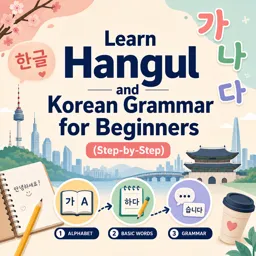
Free CourseLearn Hangul and Korean Grammar for Beginners (Step-by-Step)
4.6
(5)
6h44m
50 exercises

Free CourseKorean MasterClass
4.5
(2)
11h27m
9 exercises

Free CourseKorean basic vocabulary
4.3
(3)
150h55m
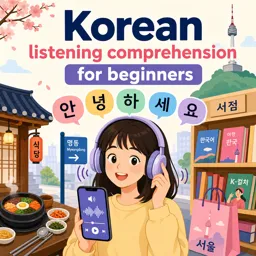
Free CourseKorean listening comprehension for beginners
4
(1)
1h15m
3 exercises
Thousands of online courses in video, ebooks and audiobooks.
To test your knowledge during online courses
Generated directly from your cell phone's photo gallery and sent to your email

Download our app via QR Code or the links below:.


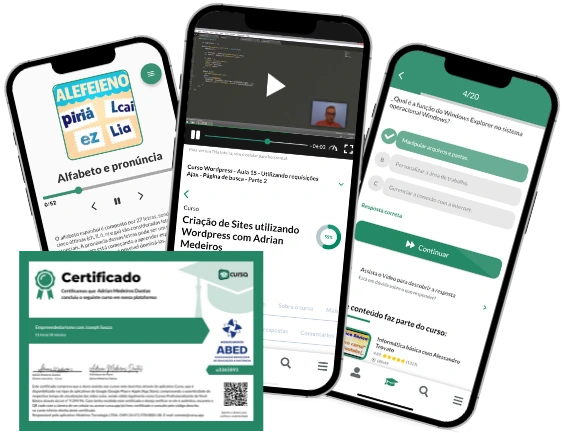
Carry knowledge in your pocket.
Download the Cursa app.
There are hundreds of free courses available, with a free certificate of completion that is saved in your mobile image gallery.
Download the app to access the Course Completion Certificate for Free.


+ 10 million
students

Free and Valid
Certificate

60 thousand free
exercises

4.8/5 rating in
app stores

Free courses in
video and ebooks