Duration of the online course: 6 hours and 1 minutes
4.6
(141)
Learn to read Hangul and speak basic Korean fast with a free online course. Practice pronunciation, essential phrases, and core grammar—study anytime.
In this free course, learn about
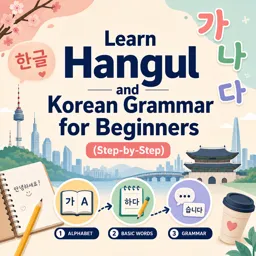
Course goals: core beginner skills in reading, pronunciation, and basic conversation
What Hangul is and how Korean letters form syllable blocks
Basic consonants/vowels, including ㄹ sound and new syllable types
Double/strong consonants and how their pronunciation differs from regular consonants
Korean diphthongs (combined vowel sounds) and how to read them
Key sound change rules and why they make Korean pronunciation smoother
Korean sentence order basics (SOV) for simple statements like 'I eat pizza'
Polite greetings and farewells in Korean
Polite self-introductions for first meetings
Polite thanks and apologies/attention-getting (e.g., to bus driver, waiter)
Intro to verbs and expressing wants with the '-고 싶다' form
Object marker usage (을/를) and what it does in a sentence
Topic marker usage (은/는) and how it frames a conversation topic
This/that, simple adjectives (e.g., 'tall'), likes/loves, and basic adverbs
About the free online course
Start learning Korean from the ground up with a beginner-friendly online course designed to take you from curious to confident in everyday situations. You will build a practical foundation that helps you recognize the writing system, pronounce sounds more clearly, and form simple sentences you can actually use when greeting someone, introducing yourself, or expressing basic needs.
A major focus is Hangul, the Korean alphabet. Instead of memorizing random symbols, you will understand how letters combine into syllable blocks and how different consonants and vowels change the way words sound. You will also train your ear and mouth with pronunciation points that often confuse new learners, such as strong and double consonants and common diphthongs. With guided explanations, you will begin to read Korean more comfortably and approach new words without guessing.
As you progress, you will connect sound and writing to real communication. The course helps you move from single words to natural sentence patterns, so you can say hello and goodbye appropriately, show thanks in polite contexts, and get someone’s attention in places like cafés or restaurants. You will also learn how Korean sentences are typically ordered and how small markers attached to nouns shape meaning in conversation, making your speech clearer and more accurate.
To keep learning active, the course includes short checks and exercises that reinforce each idea right after you learn it. This structure supports steady progress, whether you are studying for travel, personal interest, or a first step toward using Korean for school, work, or understanding media. Because it is free and online, you can learn at your own pace and return to key lessons whenever you need a refresher.
Course content
Video class: Billy Go’s Beginner Korean Course | #1: Course Introduction04m
Exercise: What language skills will you learn in this Korean course?
Video class: Billy Go’s Beginner Korean Course | #2: Intro to Korean09m
Exercise: What is Hangul?
Video class: Billy Go’s Beginner Korean Course | #3: Learning Part 1 The First Letters07m
Exercise: Which sound is formed with the tongue in a D position but does not sound like D, L, or R in Hangul?
Video class: Billy Go’s Beginner Korean Course | #4: Learning New Kinds of Syllables Part 207m
Exercise: What is a characteristic of the new consonant described in the lesson?
Video class: Billy Go’s Beginner Korean Course | #7: Learning Part 5 Double and Strong Consonants16m
Exercise: What distinguishes double consonants from regular consonants in Korean pronunciation?
Video class: Billy Go's Beginner Korean Course | #8: Learning Part 6 Diphthongs07m
Exercise: What is a diphthong in the context of Korean language learning?
Video class: Billy Go's Beginner Korean Course | #9: Sound Change Rules for ? and ?23m
Exercise: What is the main purpose of sound change rules in Korean?
Video class: Billy Go’s Beginner Korean Course | #10: Hello and Goodbye06m
Exercise: What is the correct sentence structure in Korean?
Video class: Billy Go’s Beginner Korean Course | #11: Introducing Yourself07m
Exercise: What is the polite way to introduce yourself in Korean when meeting someone for the first time?
Video class: Billy Go’s Beginner Korean Course | #12: Saying Thanks04m
Exercise: In Korean, how do you say 'thank you' politely to a bus driver?
Video class: Billy Go’s Beginner Korean Course | #13: Excuse Me03m
Exercise: How do you address a waiter in a Korean restaurant to say 'excuse me'?
Video class: Billy Go’s Beginner Korean Course | #14: Intro to Verbs06m
Exercise: What is the standard Korean sentence structure for "I eat pizza"?
Video class: Billy Go’s Beginner Korean Course | #15: I Want07m
Exercise: What is the correct way to express "want to go" using the grammar form discussed?
Video class: Billy Go’s Beginner Korean Course | #16: The Object Marker03m
Exercise: What is the function of the object marker in a sentence?
Video class: Billy Go’s Beginner Korean Course | #17: The Topic Marker05m
Exercise: What is the role of a topic marker in a conversation?
Video class: Billy Go’s Beginner Korean Course | #18: This and That08m
Exercise: What does 'Tall' indicate in Korean adjectives?
Video class: Billy Go’s Beginner Korean Course | #19: The Particle ?03m
Exercise: What is a particle?
Video class: Billy Go’s Beginner Korean Course | #21: Likes and Dislikes05m
Exercise: Which verb in Korean means 'to love'?
Video class: Billy Go’s Beginner Korean Course | #23: The Verb ??04m
Exercise: What is the meaning of 'Khumbu Hada' in Korean?
Video class: Billy Go’s Beginner Korean Course | #24: Intro to Adverbs05m
Exercise: In Korean, what is the correct adverb to use before 'komma' to express 'I eat really quickly'?
Video class: Billy Go’s Beginner Korean Course | #25: Descriptive Verbs07m
Video class: Billy Go’s Beginner Korean Course | #26: The Subject Marker06m
Video class: Billy Go’s Beginner Korean Course | #28: The Particle ?04m
Video class: Billy Go’s Beginner Korean Course | #29: Can and Can’t05m
Video class: Billy Go’s Beginner Korean Course | #30: Saying Sorry04m
Exercise: How do you spell “sorry” in Korean?
Video class: Billy Go’s Beginner Korean Course | #31: Saying Please04m
Video class: Billy Go’s Beginner Korean Course | #32: Asking Favors Part 104m
Video class: Billy Go’s Beginner Korean Course | #33: Asking Favors Part 207m
Video class: Billy Go’s Beginner Korean Course | #34: The Particle ?04m
Video class: Billy Go’s Beginner Korean Course | #35: Family Tree05m
Video class: Billy Go’s Beginner Korean Course | #36: Here and There04m
Video class: Billy Go’s Beginner Korean Course | #37: And05m
Video class: Billy Go’s Beginner Korean Course | #38: But04m
Video class: Billy Go’s Beginner Korean Course | #39: Asking Questions08m
Video class: Billy Go’s Beginner Korean Course | #40: How to Say ‘You’06m
Video class: Billy Go’s Beginner Korean Course | #41: Intro to Politeness Levels07m
Video class: Billy Go’s Beginner Korean Course | #43: The Future Tense06m
Video class: Billy Go’s Beginner Korean Course | #45: The Particle ?/?07m
Video class: Billy Go’s Beginner Korean Course | #46: Making Negative Sentences13m
Video class: Billy Go’s Beginner Korean Course | #48: To and From10m
Video class: Billy Go’s Beginner Korean Course | #49: Humble Speech11m
Video class: Billy Go’s Beginner Korean Course | #51: Making Suggestion05m
Video class: Billy Go’s Beginner Korean Course | #53: I Have04m
Exercise: Choose the correct writing for “I have a hat in my house”:
Video class: Billy Go’s Beginner Korean Course | #54: How Are You?04m
Video class: Billy Go’s Beginner Korean Course | #55: Comparisons08m
Video class: Billy Go’s Beginner Korean Course | #56: Asking for Clarification04m
Video class: Billy Go’s Beginner Korean Course | #57: Describing Everything05m
Video class: Billy Go’s Beginner Korean Course | #58: Asking Permission07m
Video class: Billy Go’s Beginner Korean Course | #59: Colors11m
Video class: Billy Go’s Beginner Korean Course | #60: Location Words06m
Video class: Billy Go’s Beginner Korean Course | #62: Counting Part 209m
Exercise: Choose the correct calculation using native Korean numbers:
Does this beginner Korean course teach Hangul from the first letters to diphthongs and double consonants?
Yes. It introduces Hangul, syllable formation, consonants, double consonants, strong sounds, and diphthongs.

Which everyday Korean expressions are taught in the course?
The lessons cover greetings, goodbyes, self-introductions, polite thanks, and ways to say “excuse me” in common situations.
What Korean grammar topics are included after learning the alphabet?
The course teaches Korean sentence order, verbs, wanting to do something, object and topic markers, demonstratives, adjectives, particles, and adverbs.
Ready to get started?Download the app and get started today.
Programming, English, Digital Marketing and much more! Learn whatever you want, for free.
Study plan with AI
Our app's Artificial Intelligence can create a study schedule for the course you choose.
From zero to professional success
Improve your resume with our free Certificate and then use our Artificial Intelligence to find your dream job.
You can also use the QR Code or the links below.

Course comments: Beginner korean course
Students found the free course excellent, understandable, and suitable for beginners. They praised the professor’s teaching style and said it helps improve spoken skills through practice, with some viewing it as useful for learning and earning money.
T
Timma
i really like the way you teach its understandable
SK
Sumit Kumar
This course great for begginer Learn and practice more and more
BH
Bellal Hossain
wow what a learning platform
KT
Khasan Tokhirov
best
MS
MOHD Sufyan khan
Good course for all over student to improve your spoken knowledge to learn and earn money
Course comments: Beginner korean course
Students found the free course excellent, understandable, and suitable for beginners. They praised the professor’s teaching style and said it helps improve spoken skills through practice, with some viewing it as useful for learning and earning money.
Timma
i really like the way you teach its understandable
Sumit Kumar
This course great for begginer Learn and practice more and more
Bellal Hossain
wow what a learning platform
Khasan Tokhirov
best
MOHD Sufyan khan
Good course for all over student to improve your spoken knowledge to learn and earn money
Sumit Sarkar
It is very good
Avishek Barnwal
Its a great course altogether